
Goblin sharks are seen alive for the first time in their natural habitat and expand the species’ range

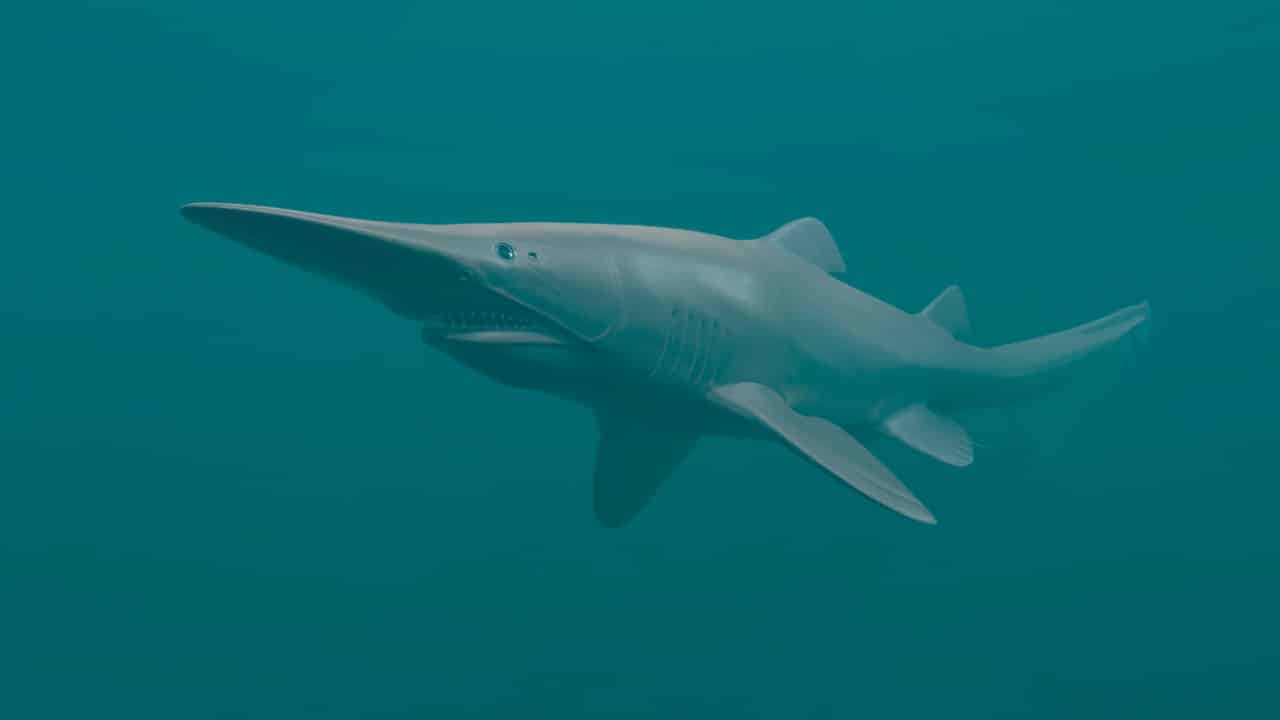
In an unprecedented event for science, a remote-controlled vehicle spotted an extremely rare goblin shark (Mitsukurina owstoni) in the depths of the Pacific Ocean. The creature, which seems to have come out of science fiction narratives, was found more than a thousand meters below the surface, revealing unprecedented details.
The specimen measured approximately three meters in length and had pink skin with shades of gray. Remarkable was its elongated and pointed snout, as well as a jaw adapted for jumping quickly and capturing prey.
The first record occurred in July 2019, near Jarvis Island. However, only after years of analysis did scientists identify the images as the first observation of a live goblin shark in its natural environment.
The discovery, which includes this video and a second recording made in 2024 near the Tonga Trench, was detailed in the scientific journal *Journal of Fish Biology*. These snapshots offer crucial information about one of the most enigmatic sharks on the planet.
The ancient lineage and peculiar hunting apparatus of the goblin shark
The formal description of the goblin shark dates back to 1898, after a specimen was found in deep waters off Japan.
The species is often referred to as a “living fossil”, as it is the only survivor of an ancient lineage of sharks that emerged about 125 million years ago. Their ancestors coexisted with the dinosaurs that inhabited the Earth.
Its unique appearance also contributed to its notoriety among creatures of the deep. The popular name “goblin shark” refers to beings from Japanese folklore, known for their prominent noses and reddish faces.
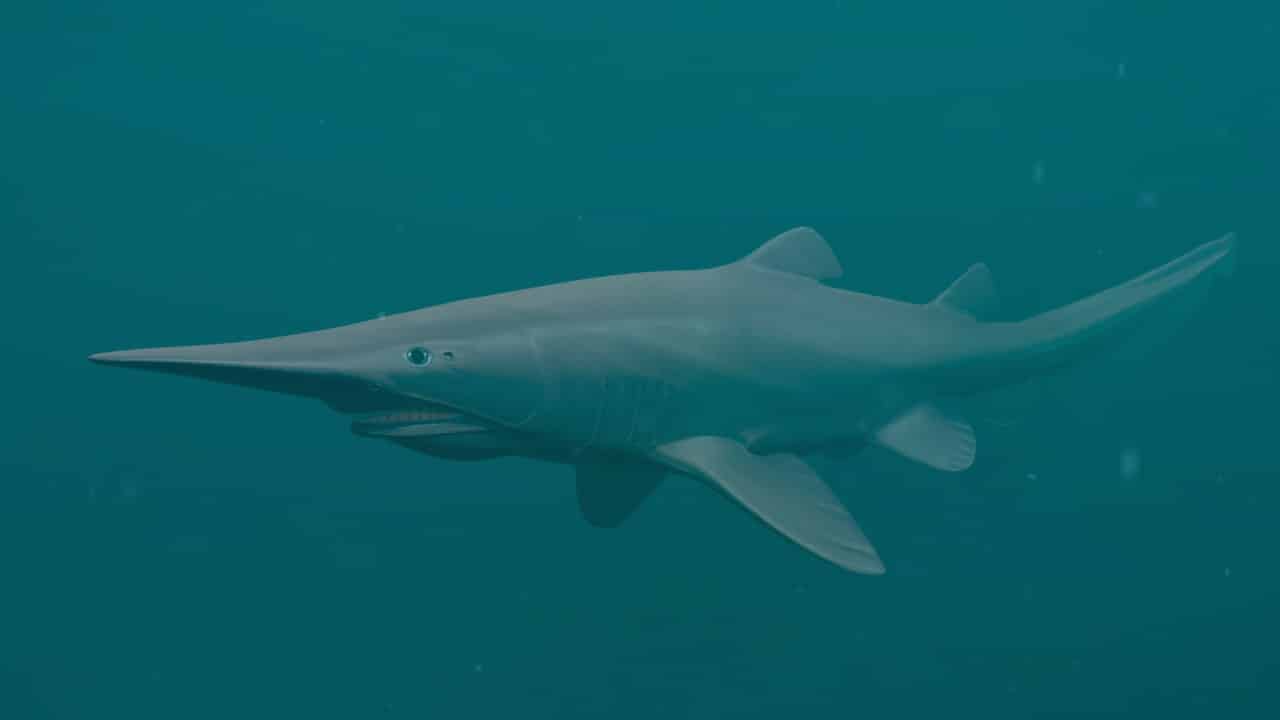
The goblin shark’s disproportionate snout serves a vital function. In the depths of the ocean, where light is scarce, finding food is a huge challenge. Many animals have developed specific adaptations to thrive in this environment. For the goblin shark, the main adaptation lies in its mouth.
When swimming normally, its jaw remains retracted, giving the animal an elongated head silhouette. However, when detecting prey, it is capable of projecting its jaw forward in a movement similar to a slingshot, launching its teeth outward.
This movement is considered the fastest ever recorded among sharks, with the jaw advancing at a speed of more than three meters per second. Such agility allows the goblin shark to capture fish and other creatures, even though it is a relatively slow swimmer.
Pioneering records that expand knowledge of the species
The first video investigated by the researchers was captured in 2019, during an expedition on the Ocean Exploration Trust ship E/V Nautilus.
The team used the Hercules, a remotely operated underwater vehicle equipped with cameras, to explore deep-sea ecosystems near Jarvis Island. It was during a dive on a seamount that the equipment located the goblin shark.
The images remained archived for years before they attracted the attention of scientists. In 2025, Aaron Judah, a doctoral candidate at the University of Hawai’i at Mānoa and lead author of the study, was informed by colleagues about the possible existence of a record of the species in material from the expedition.
Judah expressed surprise upon learning of the discovery, as the presence of the species in the Central Pacific was, until then, unknown.
When analyzing the files, he confirmed the sighting of a male goblin shark, measuring approximately 3.4 meters, swimming at a depth of 1,237 meters. The researcher described it as a unique honor to see the most iconic deep-sea shark alive and well in its natural environment.
The second record occurred in 2024, during an expedition to the Tonga Trench, one of the deepest areas on the planet. This time, researchers aboard the R/V Dagon used a baited camera attached to underwater equipment to document local wildlife, finding another goblin shark.
These images indicate that the second individual was almost 2,000 meters deep, expanding the previously known depth limit for the species by approximately 700 meters.
The new record not only expanded the goblin shark’s range, but also set a new depth record for the entire lamniform group, an order of sharks that includes the great white shark and the mako shark.
Scientists believe that the animal filmed in Tonga was a female, due to the absence of male reproductive structures. Jamieson commented that he never expected to see a live goblin shark, describing the sight as incredible and the confirmation of another sighting in Hawaii as unbelievable.
In addition to revealing never-before-seen images of such a rare animal, the videos help scientists better understand the distribution and habitat of goblin sharks.
Previously, the species was predominantly known from some regions near Japan, Australia, the west coast of the United States, and parts of the Atlantic and Indian Oceans. The new records demonstrate that their presence in the Pacific is much broader than previously assumed.
Jamieson classified the case as a classic example of a deep-sea animal with low abundance but an extremely wide geographic distribution.
This information is vital to species conservation efforts. Records confirm that the goblin shark uses environments such as seamounts and areas close to ocean trenches. Such regions are subject to impacts from human activities, such as deep-sea trawling and seabed mining.
Even though they live in remote and inaccessible places, these animals are susceptible to the consequences of the transformations that occur in the oceans.
Judah concluded that recent discoveries like this highlight the vast potential for exploration in our underwater home. He added that given the recent increase in the goblin shark’s geographic distribution, the species may now be included in regional management and nations’ biodiversity lists, something unthinkable before this new evidence.





