New research challenges Kamoʻoalewa’s lunar origin, suggesting common asteroid; Tianwen-2 probe collects decisive sample
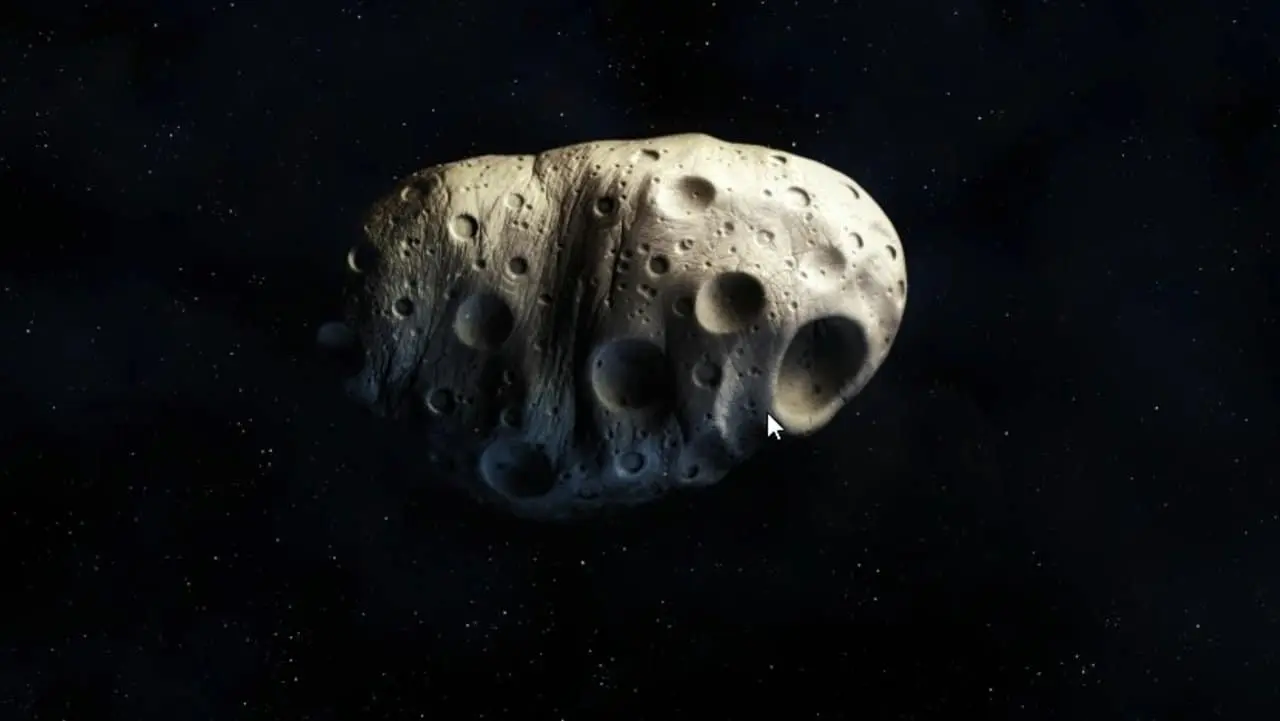
A recent scientific investigation shows that Kamoʻoalewa, an asteroid for years considered a piece of the Moon, may actually be a space rock of a more common composition. This conclusion emerges while the Chinese probe Tianwen-2 is already circling the object to collect material.
For about five years, the main hypothesis about Kamoʻoalewa, a small asteroid that follows Earth’s orbit, indicated that it could be a fragment detached from the lunar surface.
However, new peer-reviewed research argues that the object is most likely a fragment of a more distant asteroid family that has suffered intense surface weathering, making its appearance resemble that of the Moon.
The revelation of this research coincides with a pivotal moment: around June 7, after a 13-month journey, the Chinese Tianwen-2 spacecraft inserted itself into Kamoʻoalewa’s orbit. This important maneuver was monitored by independent radio astronomers, even before it was made official by the Chinese space agency.
The expectation is that sample collection will take place in the coming weeks. This asteroid, which has the potential to resolve an old argument regarding its formation, is currently surrounded by the probe specifically designed to bring a fragment back to our planet.
Understand why the lunar origin hypothesis gained strength in the past
The asteroid Kamoʻoalewa was identified in 2016 by the Pan-STARRS program, operated in Hawaii, and belongs to a rare category of celestial bodies known as quasi-satellites. These are rocks that, although they revolve around the Sun, remain close enough to the Earth to be seen as smaller satellites. Among the members of this group, Kamoʻoalewa is considered the most stable, projected to remain nearby on Earth for hundreds of years.
With modest dimensions, its diameter varies between 40 and 100 meters, and it performs a complete rotation every 28 minutes, characterizing a relatively fast movement.
Quasi-satellites are celestial bodies with low luminosity and, therefore, difficult to observe. This characteristic helps to explain the great interest aroused by Kamoʻoalewa, especially after the emergence of evidence about its composition. Its proximity, the stability of its position for centuries, and its brightness enough to be studied annually with large telescopes make it a unique target for research.
For an object with the potential to store records of the Solar System in its early phases, this combination of attributes is particularly rare and valuable.
In 2021, teams of astronomers reported that the light reflected by Kamoʻoalewa bore a greater resemblance to the silicates found on the Moon than to any other type of known asteroid, displaying an atypical reddish color. This observation served as the basis for formulating the hypothesis that the asteroid was a lunar fragment.
Going further, a study published in 2024 even proposed a specific place of origin: the crater Giordano Bruno, located on the far side of the Moon, where a large impact could have ejected debris into an orbit similar to that of Earth.
The theory outlined a scenario that was both organized and poetically appealing: a remnant of the Moon, revolving around its mother planet, waiting to be recovered.
Uncovering Recent Study Findings
In an article published by Nature Communications, an extensive international group of researchers, under the coordination of the Chinese Academy of Sciences, reviewed the case from three different approaches. First, the team re-examined the asteroid’s spectrum, identifying a crucial absorption feature at a wavelength of 1.001 micrometers. This value, they say, is compatible with LL chondrites, a common type of rocky meteorite, and not with lunar material.
Leia Também

After earthquakes, Venezuela receives more than 1,600 rescuers and faces looting in La Guaira

Messi reaches 19 goals in FIFA World Cups with great free kick for Argentina in clash with Jordan

Cristiano Ronaldo shines beyond the pitch at the 2026 World Cup with business empire and family luxury
In the next step, scientists investigated the possibility of ordinary meteorites being altered to exhibit features similar to those of Kamoʻoalewa. In a laboratory environment, the team subjected samples of LL chondrites to laser pulses, with the aim of replicating space weathering – a gradual process of darkening and reddening caused by the solar wind and smaller impacts that affect surfaces without an atmosphere over millions of years. They found that the chondrite powder, when subjected to significant weathering, replicated the asteroid’s spectrum, unlike the solid fragments of the same meteorite.
Finally, the researchers tracked down a possible origin for an object with these characteristics. The modeling used indicated the ν6 secular resonance, a gravitational escape route located in the inner asteroid belt, focusing on the Flora family, a cluster of asteroids formed from an ancient collision. Kamoʻoalewa’s composition, according to the authors, resembles that of the widely studied asteroid Itokawa and seven other members of the Flora family, but with a more pronounced level of wear.
The mentioned resonance is relevant because it offers a viable displacement path. Rocks that enter this resonance can have their orbits stretched, causing them to cross Earth’s orbit. This is one of the mechanisms by which a fragment of the inner belt could become a quasi-satellite rather than a lunar satellite. In short, the argument is that it is not necessary to turn to the Moon to explain the existence of Kamoʻoalewa. A common asteroid, detached from the Flora family and aged by solar radiation, can justify the same tone, orbit and peculiar relationship with Earth.
Understanding the Crucial Role of Dust, Not Massive Rock
The conclusion of the comparison between dust and chips is the central point of the study. A newly formed asteroid surface and a deeply eroded one may have the same rocky composition but reflect light in different ways; particle size is as important as chemical composition. The team concluded that Kamoʻoalewa is covered by a thin layer of dust exposed to space for a long period, which would be enough to give a common asteroid a reddish hue that is close to the lunar color.
If this theory is confirmed, the reddish color that initially suggested a lunar connection would not, in fact, be a mark of rock from the Moon. It would be the result of the action of time on a small, slowly rotating asteroid, exposed to the solar wind for eons. The comparison with Itokawa is significant, as the Japanese Hayabusa mission has already collected samples of its grains, confirming it as an ordinary chondrite body. The new study therefore places Kamoʻoalewa in the same group.
What the research establishes and what remains open
This is an alternative explanation, not a final verdict. The authors are cautious in stating that Kamoʻoalewa “probably” came from the Flora family, indicating that uncertainty still plays an important role. Reflectance spectra are notoriously susceptible to variations; Factors such as weathering, grain size, viewing angle, and composition can influence an asteroid’s color in similar directions. This is why two teams of competent researchers can analyze the same faint object and come to divergent conclusions.
The hypothesis of lunar origin has not been completely discarded, and the dynamic argument in favor of a recent lunar ejection still has defenders. It is also important to highlight that the newly published article is an early access version of an already accepted manuscript, released before the final edition, which means that small details may still undergo changes. The study, however, undermines the strongest point of the lunar origin theory – the red spectrum match – by demonstrating that an ordinary meteorite can be altered to present an identical appearance.
In other words, the similarity with the Moon is real. The new study merely argues that it is a coincidence resulting from wear and tear, and not a sign of shared origin.
The definitive sample that promises to end the debate about its origin
What makes this discussion unusual is that it has a deadline to be resolved. Most debates about the origin of an asteroid are usually resolved, at best, through increasingly precise remote measurements. This, in turn, will be resolved by analyzing the rock itself.
The relevance of this issue is not trivial. If the collected grains are lunar, Kamoʻoalewa will become a free sample of the far side of the Moon, delivered to nearby Earth without the need for a manned landing. If they are common chondrites, the asteroid will represent a well-preserved relic of the early Solar System and will serve as a test to assess how much space erosion can disguise a rock of a familiar type. These are two very different scientific results, and the same capsule will determine which one will be obtained.
The Tianwen-2 mission is scheduled to collect material from Kamoʻoalewa in the coming weeks and send a return capsule to Earth in 2027. After this stage, the spacecraft will head towards a comet. A collected sample can be analyzed to determine the isotopes and minerals that differentiate a lunar rock from a chondrite asteroid, a type of test impossible to perform with telescopes at a distance. For the first time, the origin of a space rock will be answered by the rock itself, and that answer is already on the way.