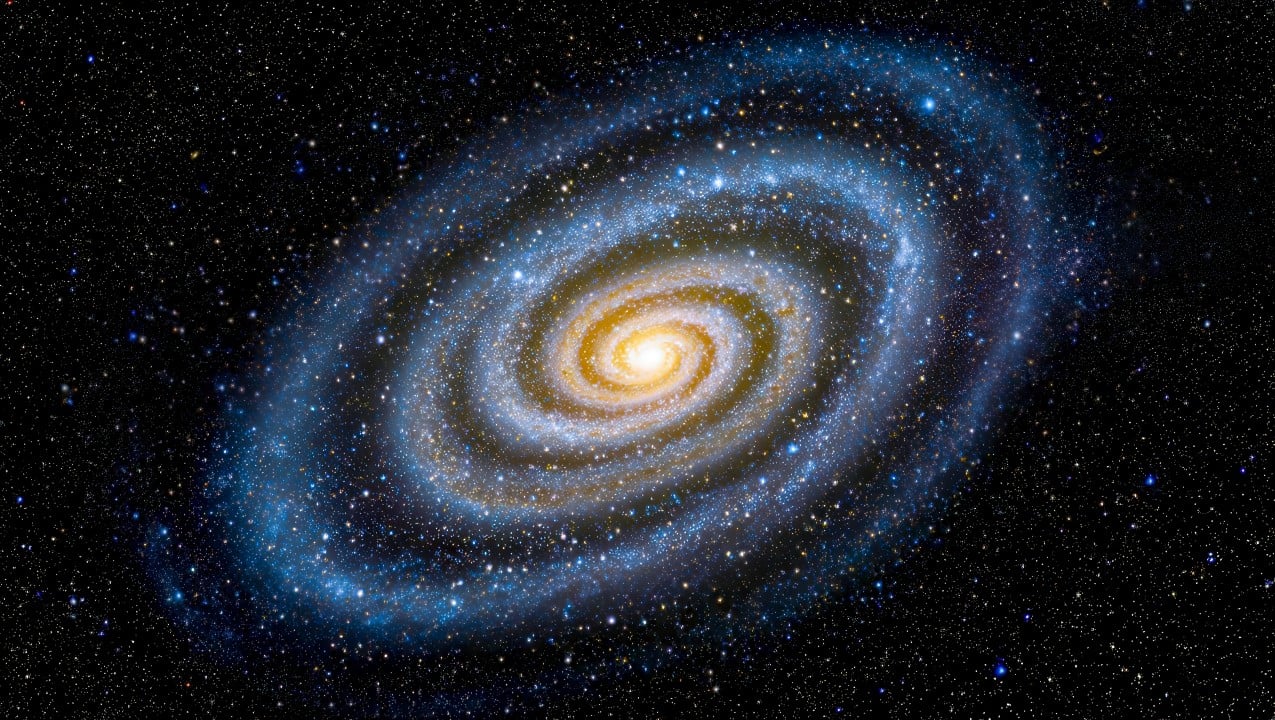
The Milky Way, home to our Solar System, bears the scars of a violent encounter billions of years ago and is destined for a new and spectacular cosmic collision in the remote future. This dynamic reveals that the apparent stability of the night sky hides a history of drastic transformations and monumental galactic events, challenging the perception of permanence that human beings have had since ancient times.
Evidence for a Galactic Encounter in the Distant Past
Scientists point out that the current shape of the Milky Way, with its characteristic spiral arms, is the direct result of an ancient collision with a smaller galaxy. This event, which happened several billion years ago, was responsible for realigning stars, gas and dust, significantly reshaping the structure of our galaxy and irreversibly altering its evolutionary course.
Detailed observations and complex simulations allowed researchers to reconstruct this primordial scenario. The night sky, with its immutable constellations, was believed to represent an unshakable cosmic order. However, modern science reveals that, behind this apparent tranquility, the universe is a stage for vast and violent galactic dances, where mergers and impacts are essential driving forces for the evolution of stellar systems like ours.
The Milky Way’s Heading for a New Cosmic Impact
In addition to its turbulent past, the Milky Way is on a direct collision course with the Andromeda Galaxy, its closest cosmic neighbor. This epic encounter, predicted to occur in about 4.5 billion years, will not result in the destruction of individual stars, but rather a gigantic merger that will create a new, larger elliptical galaxy, affectionately nicknamed “Milkomeda” by astronomers.
This phenomenon, although unimaginably distant in time, represents a natural stage in the life cycle of galaxies. As the two stellar masses approach each other, their mutual gravity will cause distortions and shock waves, triggering intense formation of new stars and completely altering the galactic landscape we know today.
Understanding these events underscores the extraordinarily dynamic nature of the cosmos. Far from being a static space, the universe is constantly transforming, with entire galaxies moving, colliding and merging, continually redefining the structures that inhabit the vastness of space.