
Erling Haaland surprises: five unexpected facts about Norway’s top scorer at the 2026 World Cup


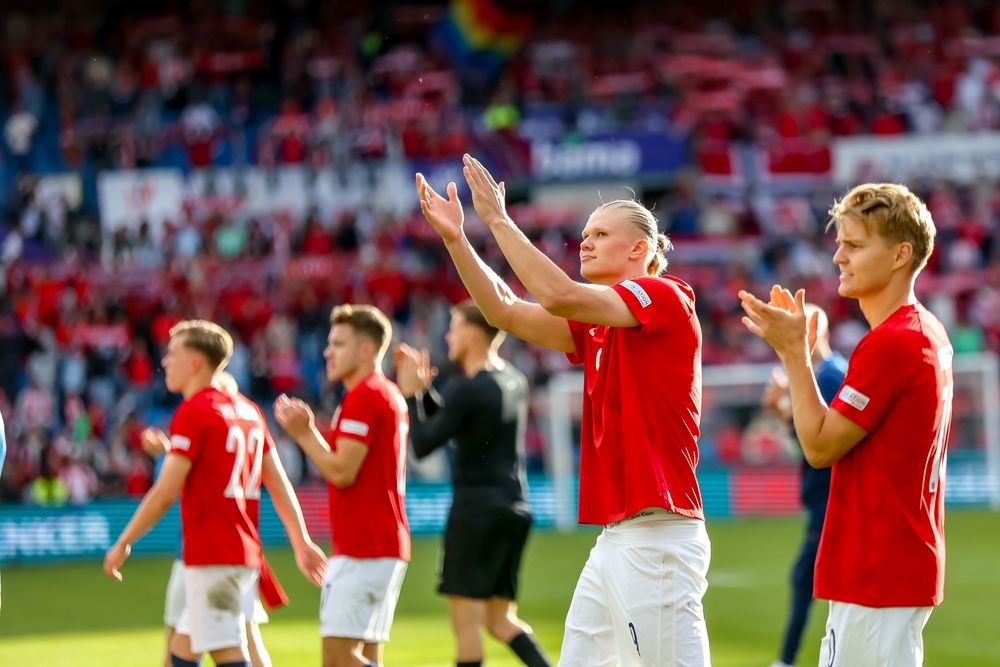
Striker Erling Haaland is already positioned as one of the big names to shine in the 2026 World Cup. The center forward, who plays for Manchester City, was a key player in Norway’s 4-1 victory over Iraq on Tuesday, scoring two goals and revealing unique aspects of his personality.
Among its most notable characteristics, the incessant search for calm, stress management and a strong concentration on the current moment stands out. His goal celebration, adopting a meditative posture after finding the net in the first half of Tuesday’s match, became a clear symbol of his life philosophy.
Family influence and Haaland’s athletic background
The notable striker for the Norwegian national team is heir to a sporting legacy, being the son of Alf-Inge Rasdal Haaland and Gry Marita Braut, both former prominent athletes.
His father, Alf-Inge Haaland, had a notable football career in the 1990s and 2000s, spending more than ten years on English pitches, including a spell at Manchester City. He was part of the Norwegian team that participated in the 1994 World Cup, hosted in the United States and won by the Brazilian team.
On the other hand, Gry Marita Braut, mother of the Norwegian star, achieved the title of national champion in heptathlon. This athletics discipline requires versatility, combining seven distinct events: 100m hurdles, high jump, shot put, 200m run, long jump, javelin throw and 800m run.
Erling Haaland’s atypical birthplace
Her father’s professional trajectory in British territory meant that Haaland came into the world in Leeds, England, and not on Norwegian soil. After Alf-Inge’s retirement from football, the family returned to Norway, where the current European team center forward began his football journey with the Bryne club.
Haaland later left his home country for Austria to join Red Bull Salzburg. From then on, the talented striker’s career rose rapidly, marked by successful spells and great prominence at clubs such as Borussia Dortmund and Manchester City.
Haaland’s musical foray as a teenager
During his teenage years, while playing for the Norwegian under-17 team, Haaland became involved in a musical project. Alongside his friends Erik Tobias Sandberg and Erik Botheim, he recorded a home-produced rap music video, using a residential backyard, a playground and a square as settings.
Available on the internet, the original audiovisual record has already accumulated an impressive 15 million hits on the YouTube platform. Although they did not reach the same level of fame as Haaland, his rap companions pursued professional careers in football, currently playing for the teams Akranes, from Iceland, and Malmo, from Sweden.
The importance of serenity for athlete performance
Even in the face of intense media exposure and growing notoriety, the player shows a preference for a more discreet lifestyle, directing a considerable part of his energy towards self-knowledge and personal concentration. His characteristic celebrations, which have already attracted the attention of the international press since his time at Borussia Dortmund, are a reflection of this stance.
“I enjoy meditating. This practice significantly helps me find inner peace and is very beneficial for me”, said the Norwegian in an interview with TNT in 2020, explaining the origin of his gestures.
The unusual role of “plant father” in Haaland’s daily life
Recently, in 2024, the Netflix platform made available the documentary “Unidos – Manchester City Trichampion”, which explores behind the scenes of the team during the victorious Triple Crown campaign in the 2022/2023 season. In this context, Haaland once again captured attention. His relevance was not only due to the goals he scored or the interaction with his colleagues, but also to the remarkable care he dedicated to a bonsai.
The striker introduced the small tree into the training center’s physiotherapy room, a daily coexistence space for the squad, with the aim of infusing good energy into the team’s environment. This dedication to the plant was so remarkable that it ended up influencing other Manchester City players to adopt similar practices, reinforcing the culture of well-being in high-performance sport.
“We must give it what it needs, nourish it. It demands adequate lighting. We take the energy from the bonsai, we extract this vitality and it is absorbed by our body. I believe it brings us good fortune”, declared the player, expressing his contemplative perspective when talking about the plant.





