
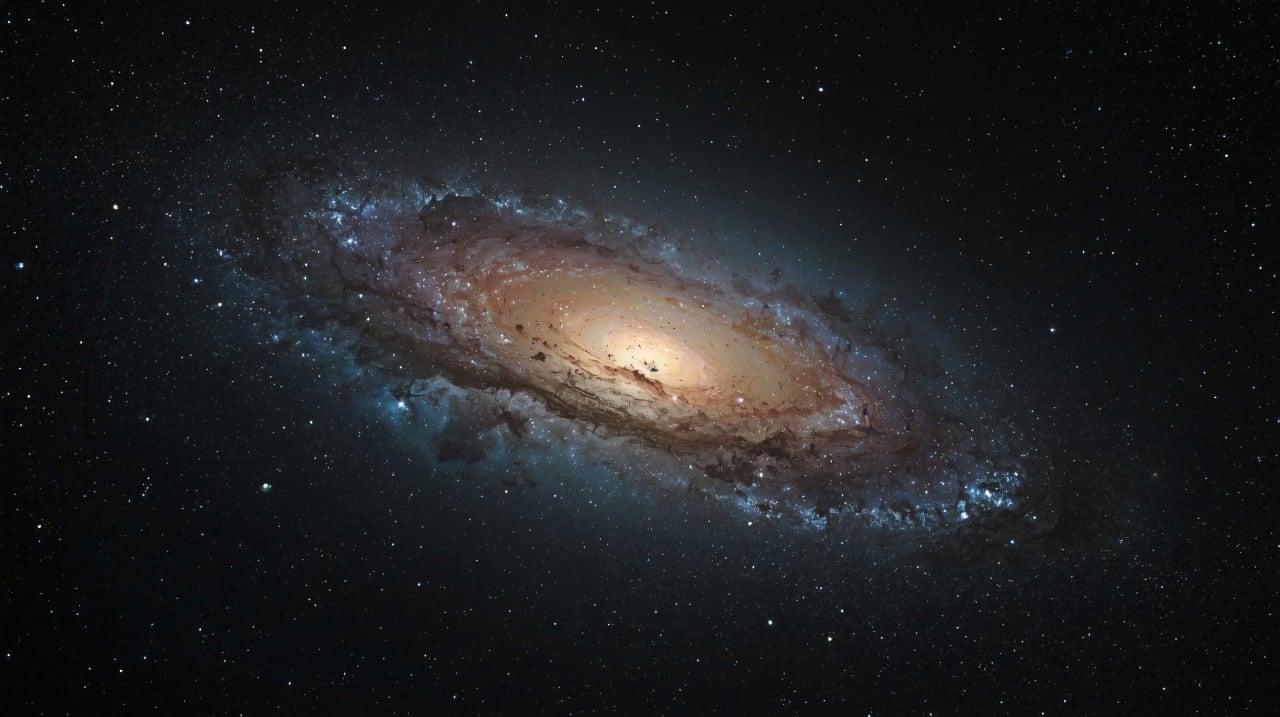
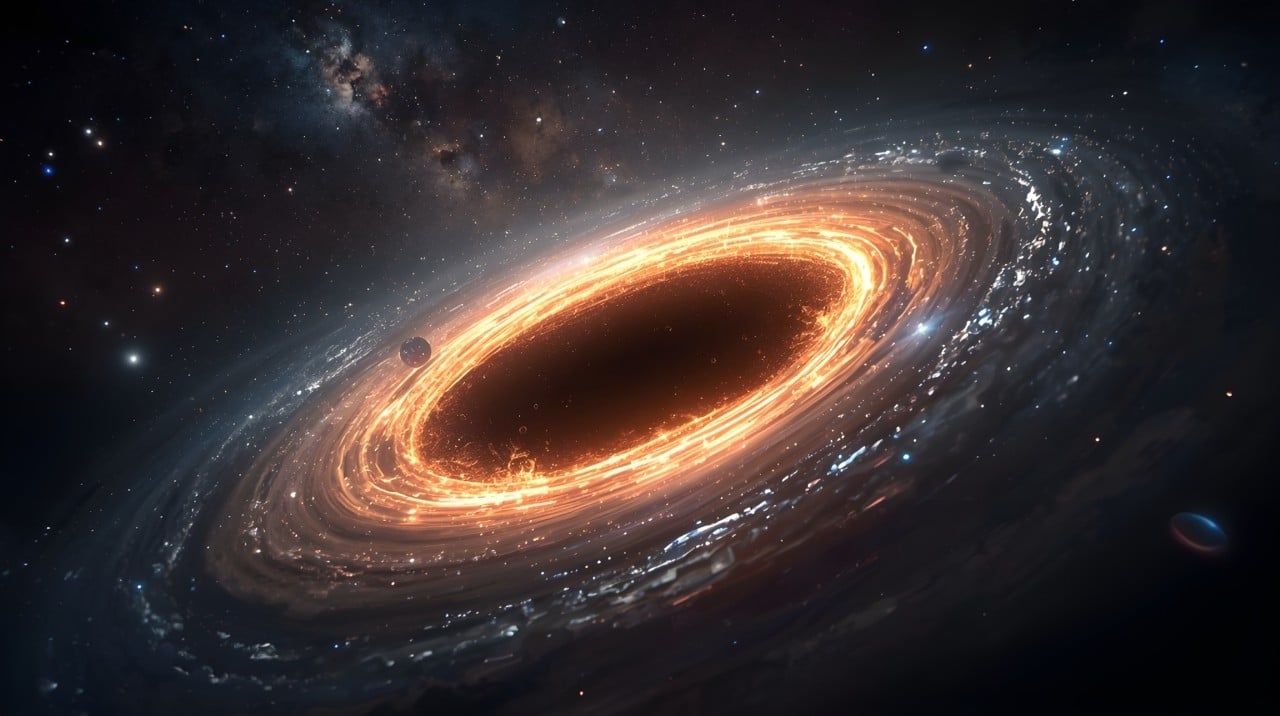
American scientists have made a significant discovery by finding concrete evidence that Sagittarius A*, the imposing supermassive black hole located at the heart of the Milky Way, expels gas in the form of winds. The revelation, based on five years of detailed observations, sheds new light on one of the most enigmatic objects in the universe and redefines our understanding of its dynamics with the galaxy.
Unraveling the mystery of silent Sagittarius A*
For decades, the astronomical community has pored over Sagittarius A*, intrigued by a paradox. Although the laws of physics predict that supermassive black holes, in addition to swallowing matter, should also expel gas in winds or jets, Sagittarius A* remained remarkably inactive. Past observations pointed to an explosive event more than 20,000 years ago, but the cosmic giant’s recent activity was an unsolved mystery, giving it a “silent” character that intrigued researchers. The absence of direct detections of gas flows represented an important gap in the Milky Way’s galactic evolution model.
How the Northwestern team detected the gaseous ejections
The research team, consisting of Mark Gorski and Lena Murchkova from Northwestern University, dedicated five years to collecting and analyzing data. They focused on the area surrounding Sagittarius A*, developing high-resolution images that revealed a cone-shaped cavity surprisingly devoid of cold gas. This structure, which spans approximately 3 light years with a 45-degree opening, has become the key to new understanding.
- ALMA Telescope (Chile):Used to map the distribution of cold gas around Sagittarius A* with unprecedented precision, eliminating electromagnetic interference.
- Chandra X-ray Observatory (NASA):Employed to confirm that cold gas in the region was being displaced by hot plasma (ionized gas) originating from the center of the galaxy.
Although they did not detect wind particles directly, scientists were able to accurately estimate the direction and energy of these flows.
The “hairdryer” mechanism and its role in the Milky Way
To illustrate the phenomenon, Mark Gorski used a simple and effective analogy: “The black hole works like a hair dryer.” He explained that it’s like blowing a strong jet of hot air onto a cold, dense substance, like wet hair. The heated air draws out moisture and moves some of the hair away, but not with enough force to pull it out completely. This flow of energy is fundamental to cosmic dynamics.
Similar gas flows from supermassive black holes are observed at the centers of other galaxies. Professor Christopher Reynolds of the University of Maryland points out that these gas ejections are a vital component in the process by which black holes release energy to their host galaxies and consequently regulate their growth and evolution. The ability to control galaxy growth through the release of energy is a crucial aspect of understanding the formation and development of larger cosmic structures.
Implications of the discovery for galactic evolution
The identification of these winds in Sagittarius A*, even if indirectly, represents a “true achievement”, in Reynolds’ words. Until now, detecting such outflows in the Milky Way’s central black hole has been extremely challenging, and this new research fills a significant gap in astrophysical knowledge. A black hole’s ability to influence the galactic environment through energy flows now has more robust confirmation for our own galaxy.
This discovery not only confirms theoretical models about the behavior of black holes, but also deepens the understanding of how Sagittarius A* interacts with its host galaxy. The light but constant “wind” offers an unprecedented glimpse into how energy is redistributed, affecting star formation and the distribution of gas and dust throughout the Milky Way. The results suggest that the central black hole may not be as “silent” as previously thought, but rather a dynamic agent with an ongoing role in shaping its galactic surroundings.





