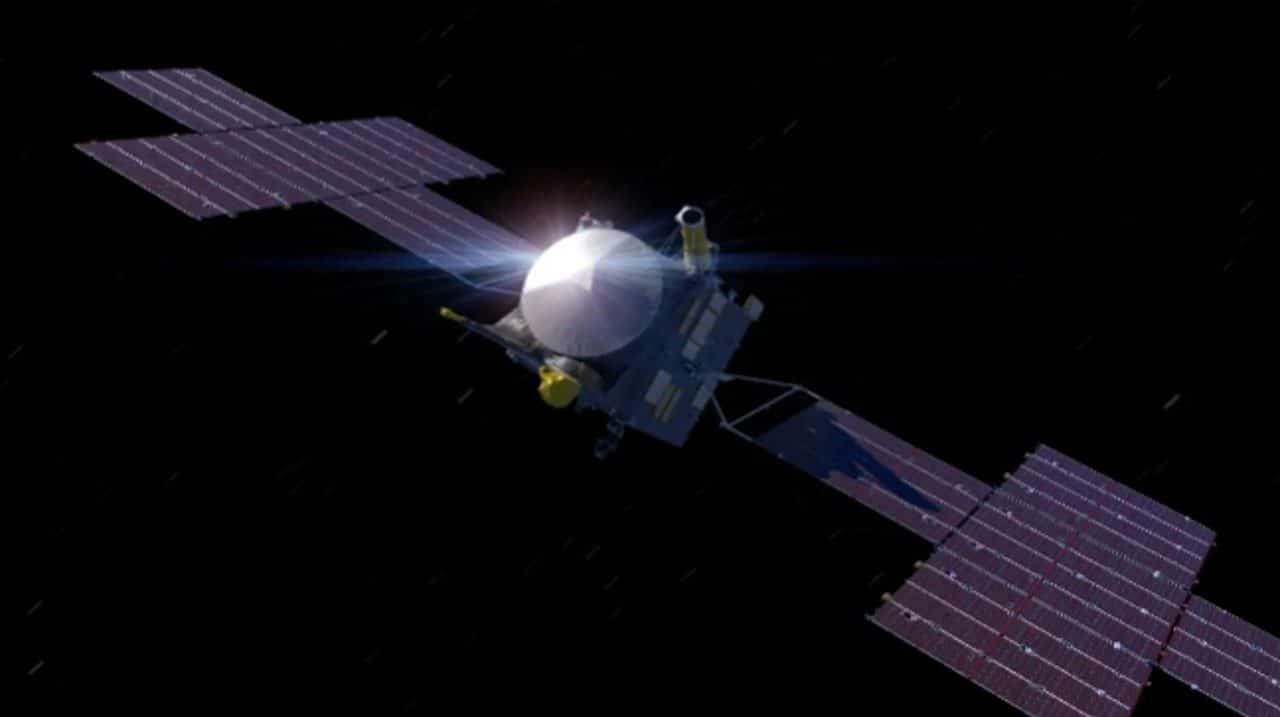
A NASA spacecraft, named Psyche, performed a flyby of Mars to boost its speed, correct its route and collect thousands of new images of the red planet, while continuing its journey towards the asteroid 16 Psyche, a metallic space rock between Mars and Jupiter, whose wealth in iron, nickel and gold associates it with trillion-dollar financial projections.
The Psyche probe passed exactly 4,609 kilometers from the Martian surface, receiving an increase of 1,600 kilometers per hour in its speed and solidifying the path that will take it to the asteroid 16 Psyche, located in the belt between Mars and Jupiter, in August 2029.
Trajectory of the Psyche probe takes advantage of Mars to head to a metal-rich asteroid
Launched in October 2023 from the Kennedy Space Center, in Cape Canaveral, Florida, the mission led by the North American space agency is on its way to one of the most discussed celestial bodies in the Solar System, the asteroid 16 Psyche.
The fascination of the scientific community lies in the probable composition of the space object, which is speculated to be rich in metals such as iron, nickel and gold. Previously released estimates have already calculated the potential value of the asteroid at an impressive US$10,000,000,000,000,000, a value that highlights the immense potential of space resources and could redefine planetary exploration and economy in the future, if the metallic composition is confirmed.
The definitive verification of the asteroid’s composition will only occur with the probe’s arrival in 2029. Until then, the long trip also serves as a crucial opportunity to test the ship’s instruments and improve the procedures of its complex mission.
Thousands of images of Mars were captured during the approach
During its passage by Mars, the Psyche probe traveled at a speed of approximately 84,000 miles per hour. The gravitational assistance maneuver was fundamental, allowing the planet to alter the spacecraft’s trajectory effectively.
Jim Bell, who coordinates the Psyche mission’s imaging instrument at Arizona State University, confirmed the capture of thousands of photographic records during the approach phase, showing details of the Martian surface and atmosphere.
Among the images obtained are the first almost complete view of Mars and the highest resolution record of the planet’s south polar cap, which is rich in water ice and extends for more than 700 kilometers.
Data collection helps prepare for arrival in 2029
In addition to their immediate scientific value, images of Mars contribute to the calibration of cameras and the testing of processing tools that will be used in the exploration of the asteroid Psyche.
Don Han, mission navigation chief at NASA’s Jet Propulsion Laboratory, assured that precise monitoring of the Doppler signal confirmed the complete success of the flyby.
With the gravitational boost provided by Mars and an orbital adjustment of about 1 degree, the spacecraft continues on its way to the scheduled rendezvous in the summer of 2029.