Aptos surfer recounts frightening encounter with great white shark captured in viral drone video
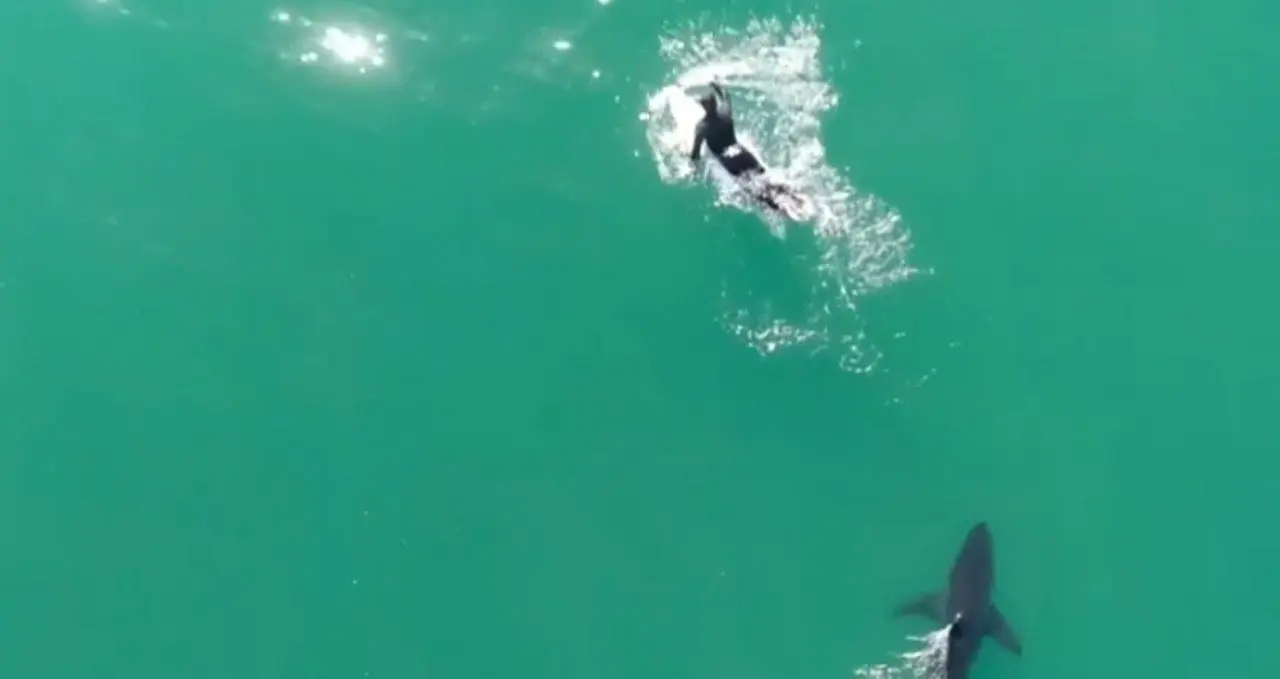
An experienced surfer from Aptos, California, shared his take on a close encounter with a great white shark that was caught on drone video and went viral. The incident gained prominence not only because of the proximity of the animal, but also because of the unexpected role of a drone that alerted the athlete to the imminent danger.
The morning seemed perfect for surfing in Santa Cruz County, with ideal waves and few people in the water. Aptos resident Max Eder had just caught one of his best waves of the day, enjoying the calm of the sea in front of Seascape beach.
The moment of perceiving danger with the drone
While Eder and his friend, Rex Boyes, waited for the next wave, a drone began to fly over the area, catching their attention. The aircraft got closer and closer, and the whir of its propellers grew louder.
Eder remembers that there was no one else on the beach. Boyes, observing the equipment’s behavior, commented that the drone was probably trying to warn them about something. The suspicion made Eder look more closely at the water around him.
Shark population growth in Monterey Bay
Recent research indicates that great white sharks are thriving in Monterey Bay, driven in part by warming waters. This phenomenon contributes to an increase in the frequency of sightings and encounters with animals in the coastal region.
A few moments after the conversation about the drone, a large dark shadow appeared next to Eder’s board. He described the image as a “large, sinister figure” flanking him, confirmed by the presence of a dorsal fin that emerged about 45 to 60 centimeters away. There was no doubt: a great white shark was there.
The impact of images and the real experience
The episode, which took place on June 10 and filmed by drone operator Nick Bertocchini, quickly reached millions of views on social media and television. The images offered a never-before-seen perspective on one of a surfer’s closest documented encounters with a shark in Santa Cruz County.
Despite the grandeur of the video, Eder highlighted that the personal experience was considerably different from what people witnessed online. He declared that the “drone footage was 10 times scarier than the encounter itself.”
The surfer’s reaction to the animal
At 55 years old, Eder, who was born and raised in Aptos, has decades of experience surfing in local spots. Although I had seen sharks from a distance or noticed unusual movements in the water, that day’s sighting was unquestionably the most graphic. “That was the first time I looked at something and knew without a shadow of a doubt that it was a shark,” he said.
Leia Também
Messi reaches 19 goals in FIFA World Cups with great free kick for Argentina in clash with Jordan

Cristiano Ronaldo shines beyond the pitch at the 2026 World Cup with business empire and family luxury

At 41, Cristiano Ronaldo reaffirms his historic legacy and prepares to shine in the 2026 World Cup
Immediately after realizing the danger, Eder found himself in a situation of choice. He considered three possible reactions: panicking, calmly walking away, or holding his position. He opted for the second, seeking calm. “I knew that flailing around wasn’t the right thing to do, so I focused on gently paddling back to shore,” he explained.
As Eder paddled toward the sand, the drone continued to record the shark circling behind him, its dorsal fin breaking the surface. His friend, Rex Boyes, did not hesitate and paddled with unusual speed to the beach, reaching the sand quickly.
Tributes and the context of other incidents on the coast
The local community and surfers from other regions often come together at events that remember victims of shark attacks, like Ben Kelly, reinforcing the importance of awareness and safety in the marine environment. These occasions serve to pay tribute and promote discussions about coexistence with wildlife.
The emotions after the scare and the sight of the ocean
In the sand, the gravity of what had happened began to manifest itself. Eder described the feelings as a mixture of fascination and terror, stating: “We were both shaken. It was fantastically beautiful, but completely terrifying at the same time.”
Even though the waves were still perfect, and the session lasted just over half an hour, the idea of returning to the water was quickly discarded. Eder, jokingly, said that he had already caught his “only good wave” and that it was time to leave.
Seeing the video of the incident in his truck heightened Eder’s perception of danger. “When you’re in the water, you can’t see what’s happening beneath you. The video allows you to see every movement the animal made,” he commented.
He believes the shark’s behavior went beyond mere curiosity. “He was circling and coming from behind,” he noted. However, Eder considers that, if a shark really intended to attack, the victim would probably never see it approach.
The impact of the video and personal reflection
As the video spread across the country, countless messages and comments flooded social media. Friends from as far away as Texas got in touch, and local surfers called to check on Eder’s condition.
While some praised his calmness during the incident, others made jokes. Eder and his wife even read some of these comments in funny voices, but he reflected on the seriousness of the situation: “If someone had to tell my family that I was murdered, they probably wouldn’t find it funny.”
The experience, however, did not change his view of sharks or the ocean. If anything, it only reinforced his perspective on a lifetime spent in Monterey Bay, an ecosystem abundant with marine life, including whales, dolphins, otters, seals and, of course, sharks. For Eder, “it’s their world. We’re just tourists in it.”