1.5 km asteroid will pass close to Earth on Saturday under intense monitoring by NASA
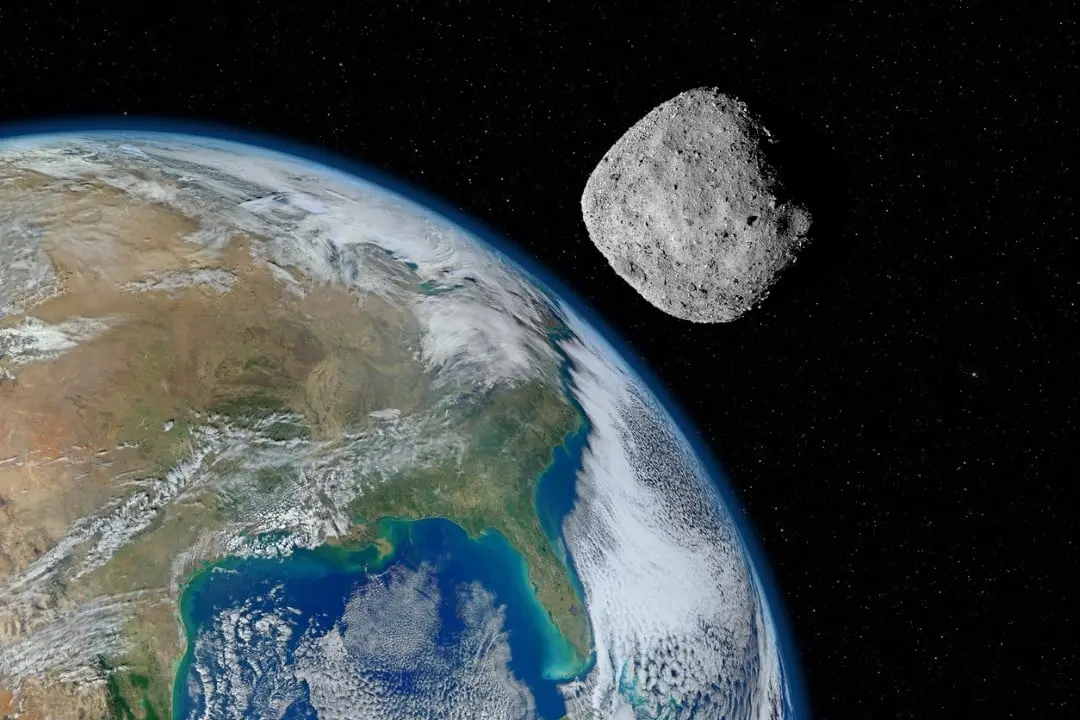
A large asteroid, discovered decades ago, will make its closest approach to planet Earth this Saturday. The object, officially named 152637 (1997 NC1), was first identified in 1997 through the Neat program in Hawaii.
Classified as a large celestial body, the asteroid has an estimated diameter of between 900 meters and 1.5 kilometers. Despite its designation as “potentially dangerous”, there is no threat of collision with Earth, scientists guarantee.
The closest pass will occur at a distance of approximately 0.017 astronomical units, which is equivalent to about 6.8 times the distance between the Earth and the Moon, or approximately 2.5 million kilometers. During the point of maximum approach, the asteroid can be observed with the aid of small telescopes, although the brightness of the Moon may interfere with visibility.
Leia Também

Messi reaches 19 goals in FIFA World Cups with great free kick for Argentina in clash with Jordan

Cristiano Ronaldo shines beyond the pitch at the 2026 World Cup with business empire and family luxury

At 41, Cristiano Ronaldo reaffirms his historic legacy and prepares to shine in the 2026 World Cup
The event will be carefully monitored by several international observation networks. The North American space agency, NASA, will take the opportunity to improve measurements of the asteroid’s size, composition and orbital behavior, as current data is still considered inconsistent.
Furthermore, this passage in 2026 will be used for detailed radar observations. Transmission will be carried out by the DSS-26 antenna of the deep space network, with reception by DSS-13. The expectation is to capture signals robust enough to generate partial reconstructions of its shape and rotation.
Astronomers emphasize the rarity of encounters like this, with asteroids of similar scale approaching Earth on average once every ten years. This will be the object’s closest pass since at least the 1600s, and a similar approach is only predicted for 2133.
Even with the confirmed safety of the current approach, NASA maintains a rigorous program of continuous monitoring of objects close to Earth’s orbit. The agency reiterates that, to date, no known asteroid poses a risk of impacting Earth in the next 100 years.