Strongest new gravitational waves ever recorded offer unprecedented insight into black hole event horizons
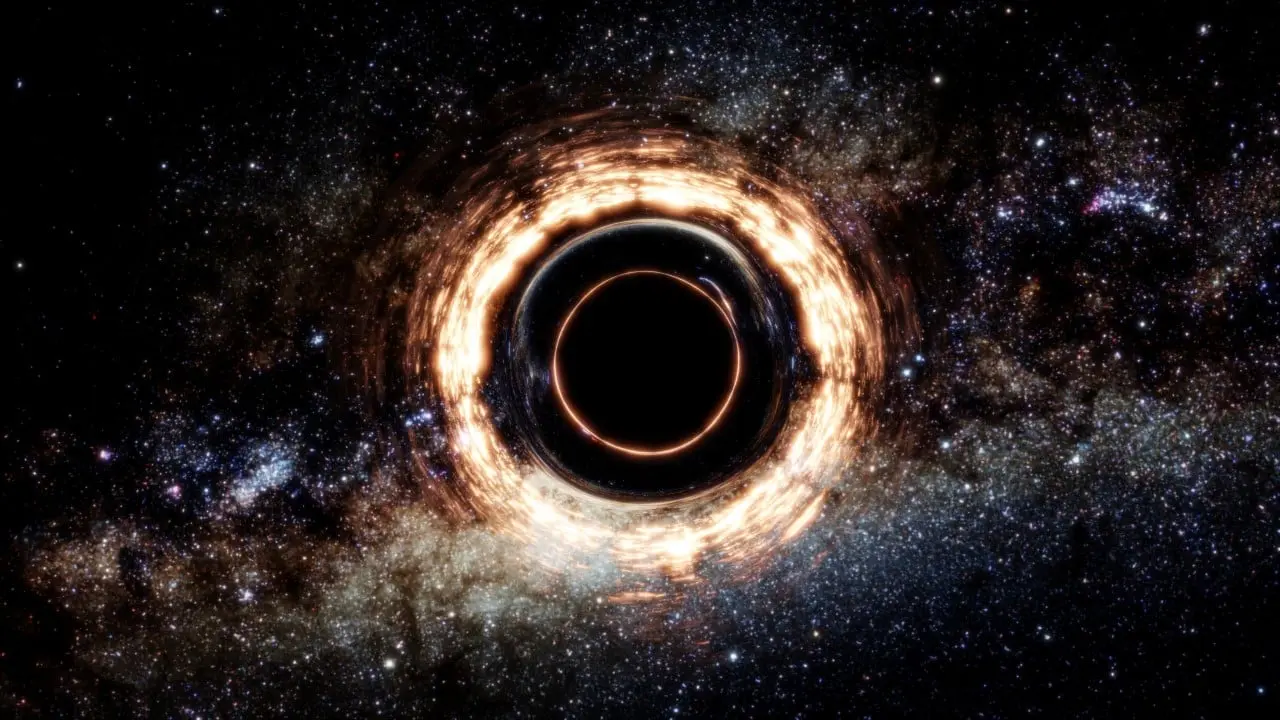
The detection of the largest burst of gravitational waves ever recorded has provided an unprecedented perspective on event horizons, the enigmatic boundaries where nothing can escape the pull of a black hole.
In January 2025, the gravitational wave signal called GW250114 was recorded by the LIGO, Virgo and KAGRA observatories. This cosmic phenomenon originated from the collision of two black holes, each with approximately 32 solar masses, generating ripples in space-time itself.
A team of scientists analyzed the captured signal and identified that a specific element in the gravitational waves corresponds to the combined event horizon of the black holes at the precise moment of the merger.
“We were able to measure the final sound emission from black holes at the moment of collision,” said Neil Lu, one of the study coordinators and a researcher at OzGrav, in an official statement. He explained that “within this signal, there is a discrete component, known as direct waves, that has not been clearly understood. Our recent assessment allows us to interpret this part and obtain unprecedented data from the vicinity of the event horizon.”
The recent discoveries open up a fascinating prospect: researchers can now employ gravitational waves as a tool to probe the enigmatic boundaries of black holes.
How event horizons become the point of no return
The notion of event horizon had its origin in the solutions to the equations of Albert Einstein’s theory of gravity, general relativity, formulated in 1915. Mathematician Karl Schwarzschild developed these solutions while serving in the German army, on the Eastern Front, during the First World War.
Schwarzschild identified a spherical boundary around a massive body where the escape velocity exceeds the speed of light. Known as the Schwarzschild radius, the size of this threshold is directly proportional to the mass of the object. To give an example, the Sun’s Schwarzschild radius would be approximately 3 kilometers from its center, while for Earth it would be just 9 millimeters. In planets and stars, this ray is contained within their interiors.
Differently, in a black hole, the Schwarzschild radius extends outside the body, functioning as an external limit that not even light can overcome: the event horizon. For any matter to escape gravitational attraction at this point, it would need to reach a speed greater than that of light, which, according to Einstein’s theory of special relativity, would require unlimited energy. Considering that nothing moves faster than light in the universe, nothing can leave this horizon.
Leia Também

VAR decides to cancel Colombia’s goal against Portugal after a thorough analysis of the tip of the boot, impacting the classification in Group K of the 2026 World Cup

Lautaro Martínez simply scores a great penalty in Jordan x Argentina at the 2026 World Cup

Rota officer and family member of Eloá Pimentel is ambushed by gunfire at a traffic light in ABC Paulista
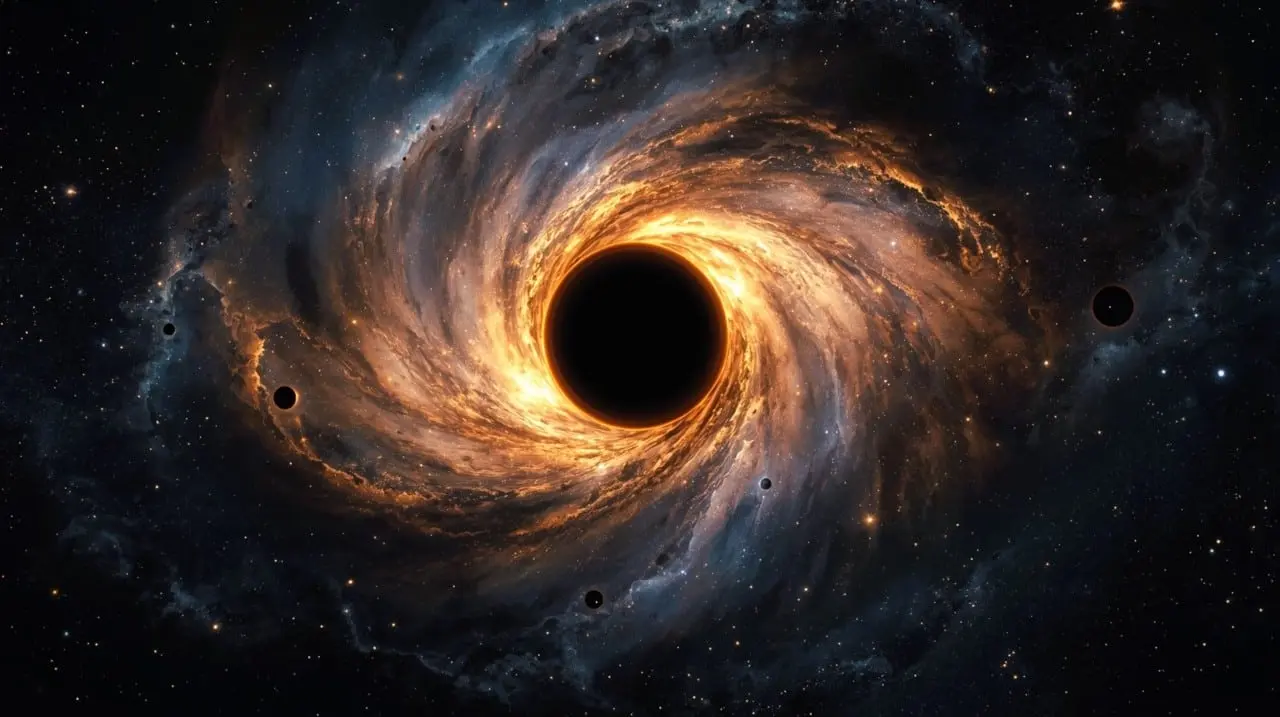
To understand the mysterious nature of a black hole, it is crucial to understand that no type of signal can surpass the speed of light. In this way, the event horizon behaves like a one-way barrier to any information. While a black hole can absorb data, the event horizon prevents its exit, meaning the interior of a black hole will always remain unobservable to us.
It is therefore not surprising that scientists are very interested in investigating event horizons and the phenomena that occur there. The objective is not only to unravel the physics of the matter that makes this irreversible journey to the center of a black hole, but also to understand the influence of these cosmic giants on the configuration of space itself.
The colossal gravitational force of black holes causes space-time itself to drag around them as they rotate, a phenomenon known as “frame dragging” or the Lense-Thirring effect. This imposes an additional condition on event horizons: not only can nothing escape this boundary, but nothing can remain at rest. This recent study is leading scientists to a deeper understanding of these complex dynamics.
“We analyzed GW250114, the most powerful binary black hole signal ever identified, about three times more intense than the first detected approximately ten years ago”, detailed Ling Sun, another co-leader of the team and an OzGrav researcher. She added that “our investigation demonstrates that this extraordinarily strong signal can serve as a powerful tool for examining the horizon of the resulting black hole, enabling the measurement of its two essential characteristics: the rotation frequency and the gravity at its surface.”
Furthermore, the results obtained have the potential to clarify the behavior of gravity in the most extreme conditions of the cosmos, specifically in the vicinity of a black hole.
“These measurements represent an initial advance for future examinations of general relativity, using direct waves”, concluded Lu.