
Study indicates that San Andreas and San Jacinto faults reach record levels of tension in a thousand years


The accumulated geological stress on the San Andreas and San Jacinto faults, located in Southern California, has reached unprecedented levels and, in certain areas, exceeded levels observed in the last thousand years.
This is the main conclusion of research recently published in the scientific journal “Journal of Geophysical Research: Solid Earth”. The work used computer models to reconstruct the region’s historical seismic activity, allowing us to estimate the energy currently retained in these structures.
The San Andreas fault is recognized worldwide for its length of approximately 1,300 kilometers, functioning as a boundary between the Pacific and North American tectonic plates. It is responsible for notorious seismic events, such as the one that devastated San Francisco in 1906.
For several decades, area residents and scientists have been awaiting the “Big One,” a large earthquake that is predicted to occur in the western United States.
The region examined in the study is densely populated and contains vital infrastructure for Southern California.
It includes important cities such as Los Angeles, the second largest in the country, as well as San Bernardino and Riverside, in the interior of the metropolitan area, and the Coachella Valley, where Palm Springs is located.
The authors of the study, however, emphasize that the work does not constitute a disaster prediction and, categorically, does not indicate a date for the occurrence of a major earthquake.
Geophysicist Liliane Burkhard of the University of Bern, Switzerland, leader of the research, clarified that the results “do not mean that faults need to rupture immediately or soon, and do not give us a date, a year or a countdown to the next earthquake.”
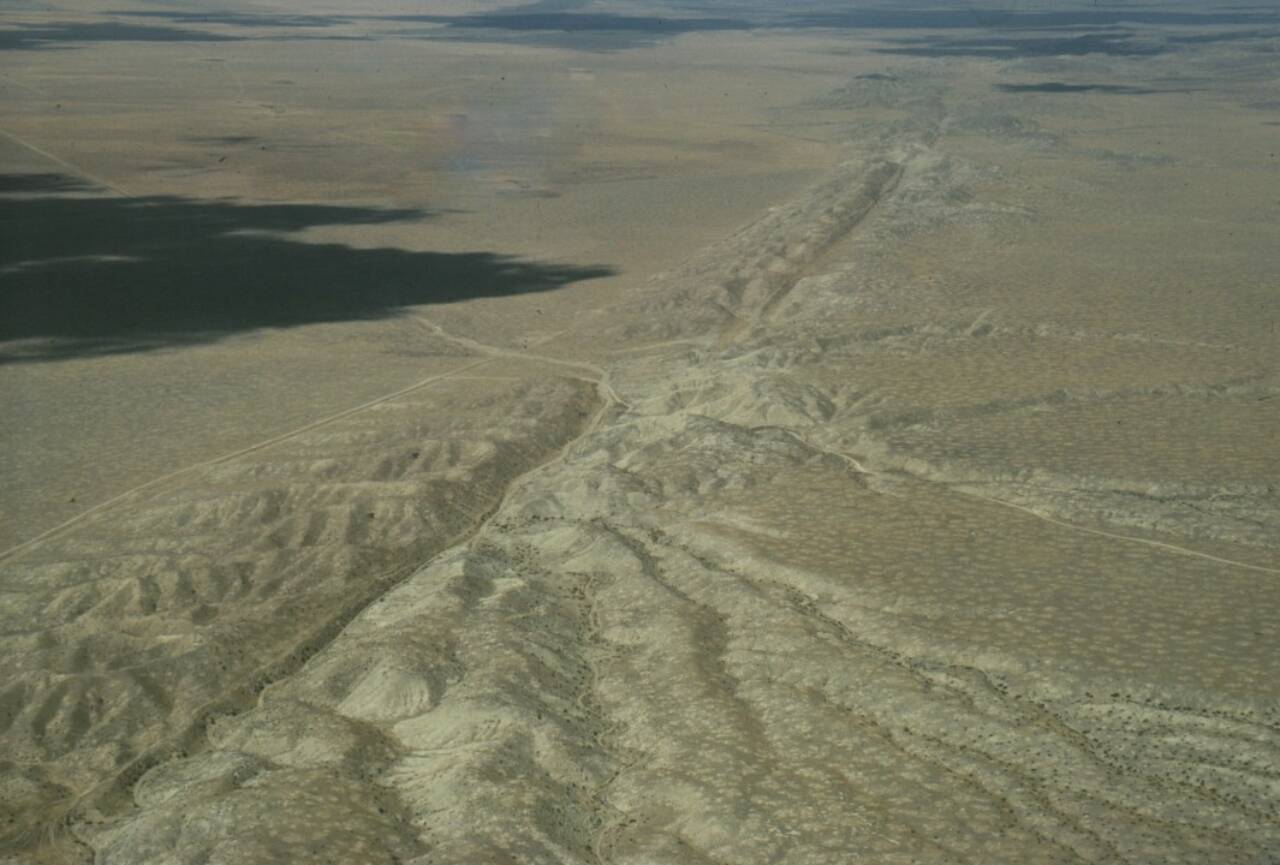
To arrive at these findings, Burkhard and his team developed a model that simulates the cycle of stress accumulation and release in faults over time.
The program gathered data from approximately a thousand years of seismic records, compiled from geological traces such as displaced sediments and tree growth patterns.
It is important to highlight that the results represent model estimates and are not direct measurements of the subsoil. The calculations are influenced by variables such as the speed of displacement of the faults, the depth of their locking and the properties of the rocks.
Burkhard explains that although the Pacific and North American tectonic plates move a few centimeters annually, this movement is not homogeneous. In certain sections, friction keeps the rocks fixed, preventing the plates from sliding.
Consequently, the deformation in these areas gradually increases. When the resistance of the rocks is overcome, the blocked segment ruptures, releasing part of the accumulated energy in the form of an earthquake.
In the southern portion of the San Andreas fault, the last major rupture recorded was in 1857, during the Fort Tejon earthquake, which reached magnitude 7.9.
Since that period, this section has not recorded an event of similar magnitude that would be capable of dissipating a significant part of the accumulated tension.
The dangerous convergence of the San Andreas and San Jacinto faults
Cajon Pass, located less than 100 kilometers northeast of central Los Angeles, was the main focus of the study’s analysis.
In this area, the southern section of the San Andreas Fault and the northern section of the San Jacinto Fault approach each other. The researchers indicate that this point can either stop a breakout or allow it to propagate from one fault to the next.
The probability of this propagation is conditioned, among other factors, by the difference in voltage levels on both sides. If the values are close, a breakout would have an easier time crossing the Cajon Pass.
Burkhard cautions that “our models indicate that current stress levels in key segments on both sides are becoming more similar. This could facilitate the continuation of a rupture that reaches Cajon Pass.”
She, however, emphasizes that this is only a physical possibility and not a certainty.
“It is not a prediction that the next earthquake will necessarily follow this path”, reiterated the researcher.
Historical records demonstrate both behaviors. The Fort Tejon earthquake of 1857 stopped at Cajon Pass. In contrast, the 1812 Wrightwood earthquake, with an estimated magnitude of about 7.5, may have extended through this area, hitting both faults.
The model developed showed that a segment of the San Jacinto fault reached 3.6 megapascals of tension, the highest value in the entire thousand-year reconstruction. In one part of the San Andreas fault, the level reached 2.8 megapascals, also surpassing previous peaks.
More than the isolated values, the researchers consider the approximation between the stress levels in these two geological systems to be fundamental.
According to Burkhard, an earthquake that crossed the Cajon Pass could reach magnitudes between 7.4 and 7.8, affecting a significantly larger area than a tremor restricted to just one of the faults.
This projection, however, is based on the model’s assumptions and does not mean that a seismic event of such magnitude is imminent.
What does it mean to be “critically charged”
The study describes some portions of the fault system as “critically loaded.” This terminology indicates that important sections accumulated high levels of tension compared to the thousand-year period analyzed.
Burkhard reinforces that this classification should not be interpreted as a sign that an earthquake will occur in the coming days, months or years.
The result only demonstrates that the physical conditions for a major rupture are present and need to be taken into account in long-term planning.
Geophysicist Liliane Burkhard emphasized that “the key message is preparation, not prediction.”
For this reason, the researcher advises that authorities and emergency teams incorporate the possibility of an earthquake involving both faults (and not just the San Andreas fault) into their prevention plans, focusing on the resistance of buildings, roads and water and energy infrastructure.
The recent earthquakes recorded on June 24 in Venezuela, Japan and California do not change this assessment.
Burkhard explains that the tremors occurred in different tectonic systems and have no direct connection between them.
She details that earthquakes redistribute stress in the vicinity of the rupture, but this effect decreases quickly with distance. Thus, the changes caused by events in Venezuela and Japan would be insignificant in Southern California.
The 5.6 magnitude tremor that occurred in the north of the state also occurred hundreds of kilometers from the Cajon Pass and outside the areas studied. According to geophysics, any permanent change in tension in the analyzed area would be minimal or non-existent.





