
Euclid Telescope reveals most detailed image yet of 60 million stars in the core of the Milky Way


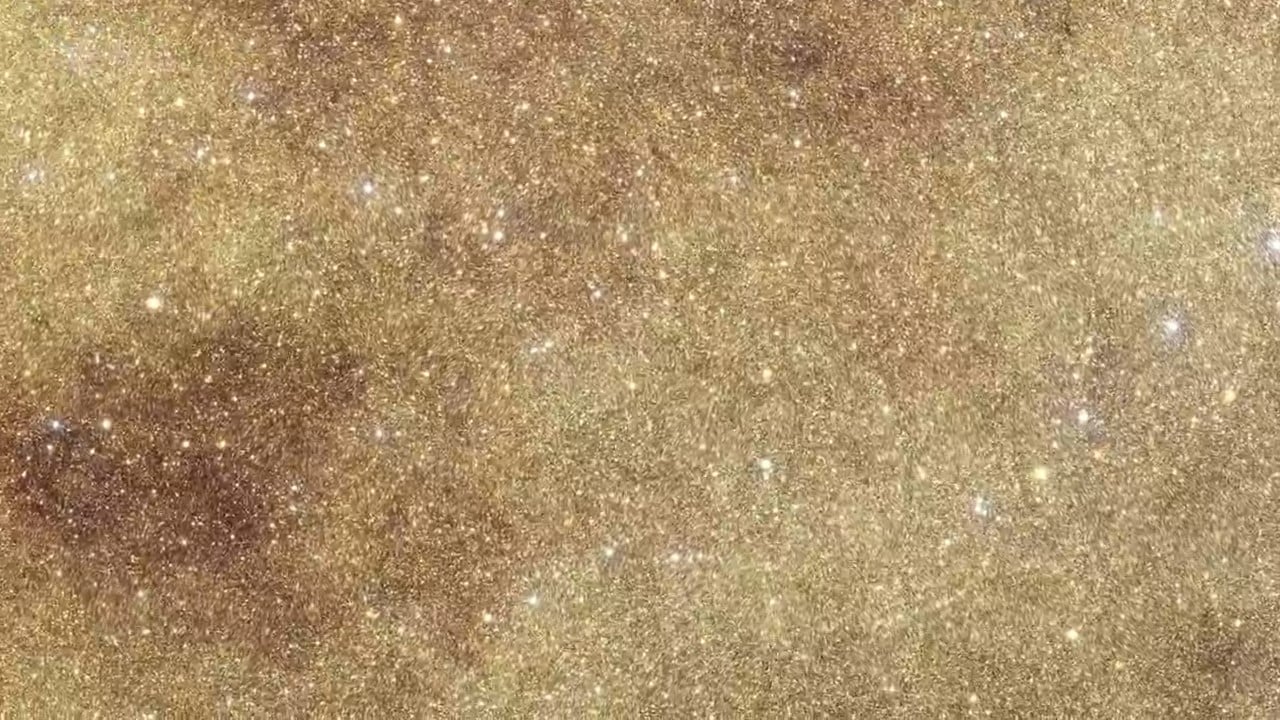
Millions of stars shine in the largest and most detailed depiction of the center of the Milky Way ever captured. This spectacular image, obtained by the European Space Agency’s (ESA) Euclid telescope, marks the beginning of an unprecedented phase in planetary exploration.
The stunning composition, which shows more than 60 million stars in the central region of our galaxy, was captured by a space telescope initially designed to investigate the mysterious forces that shape the universe.
Scientists have used ESA’s Euclid to produce the most extensive and detailed photograph ever taken of visible light emanating from the heart of the Milky Way. The uniqueness of the telescope’s camera lies in its ability to distinguish individual stars in the dense area known as the galactic bulge.
This monumental image signals the dawn of a new era in the detection of planets outside the Earth’s solar system, as researchers stated. The expectation is that the number of worlds identified will significantly exceed the thousands already recorded around distant stars.
Astrophysicist Dr Eamonn Kerins, from the University of Manchester’s Jodrell Bank Center for Astrophysics, commented about the Euclid telescope: “It was not designed with this purpose in mind, but it has proven to be an excellent tool for this work.” He added that “this data drives a new era of exoplanet discovery, in which we will expand from approximately 6,000 known exoplanets to more than 100,000 across the galaxy.”
The observations that resulted in the images were made after astronomers aimed the Euclid telescope at the center of the Milky Way for 26 continuous hours.
Costing 1 billion euros and launched in 2023, the telescope’s main mission is to create the most accurate 3D mapping of the cosmos and uncover the secrets of the dark forces that influence it.
In the most accepted cosmological model, only 5% of the universe is made up of ordinary matter. About 70% is attributed to dark energy, the force that accelerates universal expansion. The remaining 25% is designated as dark matter, an invisible substance that appears to concentrate around galaxies.
The stars were photographed by scientists in March last year, after the Euclid probe was pointed at the heart of the Milky Way during 26 hours of scrutiny. The final image is a composite of nine observation “points” taken by the probe’s visible light camera. Each of these points covers an area of the sky larger than that of the full Moon.
In addition to its aesthetic beauty, the collected image will significantly boost the search for exoplanets, that is, worlds that form outside the solar system.
The galactic bulge, the central region of the Milky Way, is a vast and compact structure predominantly populated by older and cooler stars.
One of the methods for detecting exoplanets involves observing their host star as it passes in front of a more distant star. Through a phenomenon known as gravitational microlensing, the attraction of the closer star bends the light from the more distant star, making it appear more luminous. If a planet orbits the nearby star, its additional gravity can generate a spike in brightness.
In August, NASA plans to launch the Nancy Grace Roman space telescope, named in honor of the agency’s first director of astronomy, who passed away in 2018. Astronomers expect to discover approximately 1,500 exoplanets using the gravitational microlensing technique with this new equipment.
The Euclid image will transform this search line by displaying the same stars before any overlay. This will allow astronomers to measure their speed of movement and prove the existence and mass of possible planets.
“Euclid’s single image can improve these measurements by up to three times, which for a single image is quite significant,” said Kerins.
The Roman telescope aims to identify another 100,000 exoplanets that transit in front of their host stars, causing a slight and temporary dimming of starlight.
The data provided by Euclid will be crucial for astronomers to confirm that the observed objects are indeed transiting planets, and not other phenomena such as binary star systems, where two stars orbit each other, which can produce analogous signals.





