
Astronomers find 12 billion-year-old interstellar comet that could rewrite galactic history


A recent remarkable finding in the Solar System is intriguing the scientific community. Space researchers report that the interstellar comet 3I/ATLAS, recognized as the third object with origins outside our planetary system, may have appeared an impressive 10 to 12 billion years ago. If this projection is confirmed, this celestial body would be considerably older than our planet and the Sun itself, possibly representing the oldest cosmic relic seen in the vicinity of the Solar System. Such a discovery offers a unique opportunity to understand the conditions of planetary formation in the early Milky Way.
Understand what makes the interstellar comet 3I/ATLAS such an unusual object
3I/ATLAS is categorized as an interstellar comet, which means that its formation occurred outside the borders of our Solar System and is currently just passing through. It represents the third confirmed interstellar visitor to be detected, following in the footsteps of 1I/ʻOumuamua and 2I/Borisov. Although this rarity already distinguishes it, the element that most captured the attention of experts was its particular chemical signature, combined with its impressive potential age.
In contrast to comets originating from our own system, which generally reflect the composition of the environment in which the Sun and its planets developed, 3I/ATLAS shows signs of having emerged in a significantly older planetary system with lower temperatures. Considering that these objects cross our region at high speed and rarely return, each analysis becomes an unparalleled opportunity to analyze materials formed in other vast expanses of the galaxy.
The scientific basis for the estimated 12 billion year age of comet 3I/ATLAS
The determination of its antiquity does not derive from mere trajectory calculations, but rather from a detailed analysis of the comet’s chemical composition. Experts employed data from advanced observatories such as the James Webb Space Telescope and the ALMA radio telescope to examine the proportion of specific isotopes present on the celestial body, notably the variations of hydrogen and carbon. These chemical constituents act as markers, revealing the environmental conditions of their formation.
The evidence obtained indicates a peculiar origin scenario: 3I/ATLAS apparently developed in an area with much lower temperatures, less abundant in metals and under greater ultraviolet irradiation than the nebula that gave rise to our Solar System. This chemical particularity points to formation during a remote era in the chronology of the Milky Way, a period in which the galaxy was going through a vigorous process of stellar creation.
- Estimated age between 10 and 12 billion years: significantly exceeding the 4.6 billion years of existence of the Solar System.
- Interstellar origin confirmed: the comet entered our system from outside, in a hyperbolic orbit.
- Unique chemical composition: isotopic analysis points to a formation environment radically different from ours.
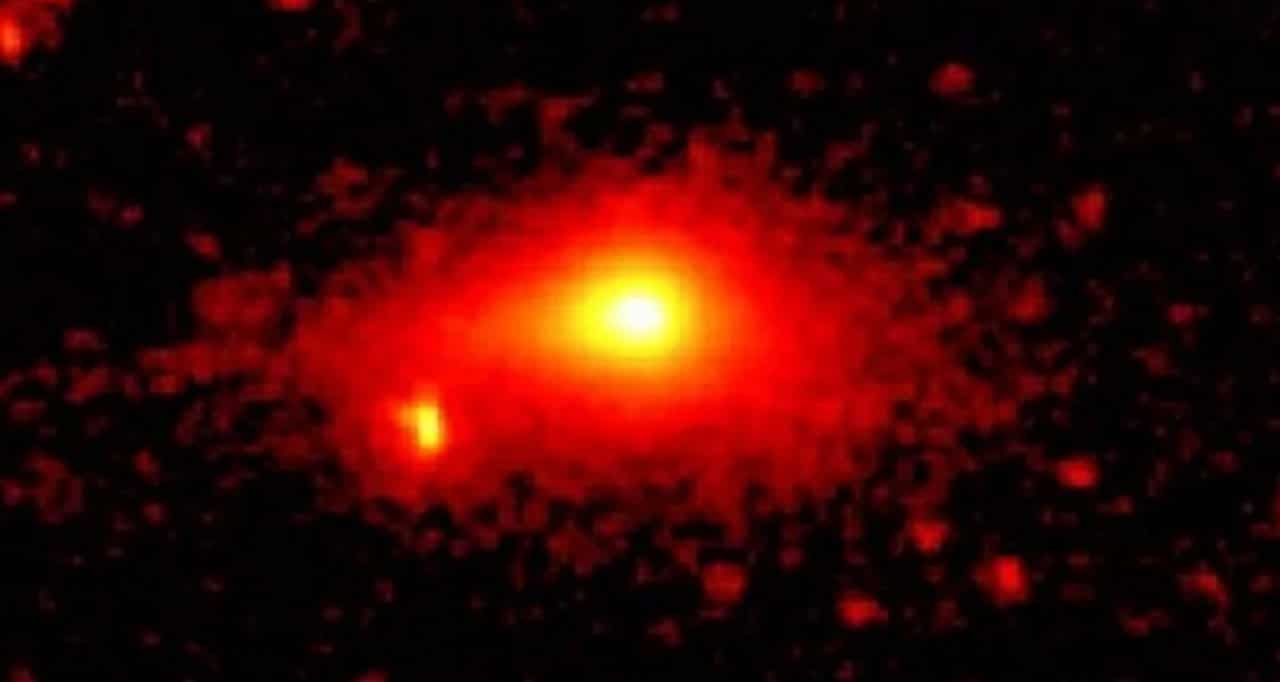
Details of the composition of 3I/ATLAS and what it tells us about its formation
A notable fact revealed by the research is the high concentration of deuterium present in the comet’s water. Experts note that 3I/ATLAS contains approximately 30 times more deuterium compared to comets generally found in the Solar System. This fact suggests that its formation occurred under conditions of extreme cold, approximately -243 °C, which allowed the preservation of a chemical composition that dates back to the first moments of galactic evolution.
Additionally, the carbon isotopic ratios and the identification of organic molecules corroborate the theory that this object is a trace of the planetary creation process around a different star. More than a simple block of space ice, 3I/ATLAS acts as a true time capsule, storing crucial information about the constitution of protoplanetary disks from remote eras.
How comet 3I/ATLAS could change our knowledge of the history of the Milky Way
Without a doubt, 3I/ATLAS represents a source of data that astronomers rarely encounter. The analysis of an interstellar comet of such age allows a direct comparison between the chemistry of our Solar System and the conditions of environments that developed long before the origin of the Sun. This unique opportunity to compare data from different cosmological epochs is what distinguishes it from other research, allowing us to understand in an unprecedented way the evolution of the elements that make up the planets throughout the history of the galaxy and which raw materials prevailed in older periods.
There is also the consideration that 3I/ATLAS could have originated in a distinct area of the Milky Way, possibly coming from a very old stellar population in the thick galactic disk. In more audacious proposals, certain researchers suggest that, given its probable age, even an extragalactic provenance cannot be completely disregarded, although the most accepted explanation remains its formation within our own galaxy.
- Access to the galactic past: the comet preserves materials that formed in the early stages of the Milky Way.
- Parallel with the Solar System: the chemical composition of the object helps to elucidate the particularities of our system.
- Potential origin in the thick galactic disk: an area often linked to older stars with lower metal content.
The future of comet 3I/ATLAS after its passage through the Solar System
Currently, 3I/ATLAS is on its way out of the Solar System and, following the pattern of other interstellar visitors, its passage is unique. This characteristic significantly restricts the observation period, increasing the importance of the data that has already been gathered. However, the episode inspires the astronomical community, as it demonstrates the ability of newly developed observatories to detect and analyze celestial bodies of origin outside our system with unprecedented accuracy.
With the start of operations on state-of-the-art instruments, such as the Vera C. Rubin Observatory, researchers expect to identify a greater number of interstellar visitors in the coming years. If this expectation comes true, 3I/ATLAS, which is currently an exception, could be consolidated as the prototype of a new class of cosmic fossils, essential for unraveling the genesis, development and dispersion of other planetary systems in the vast interstellar space.



