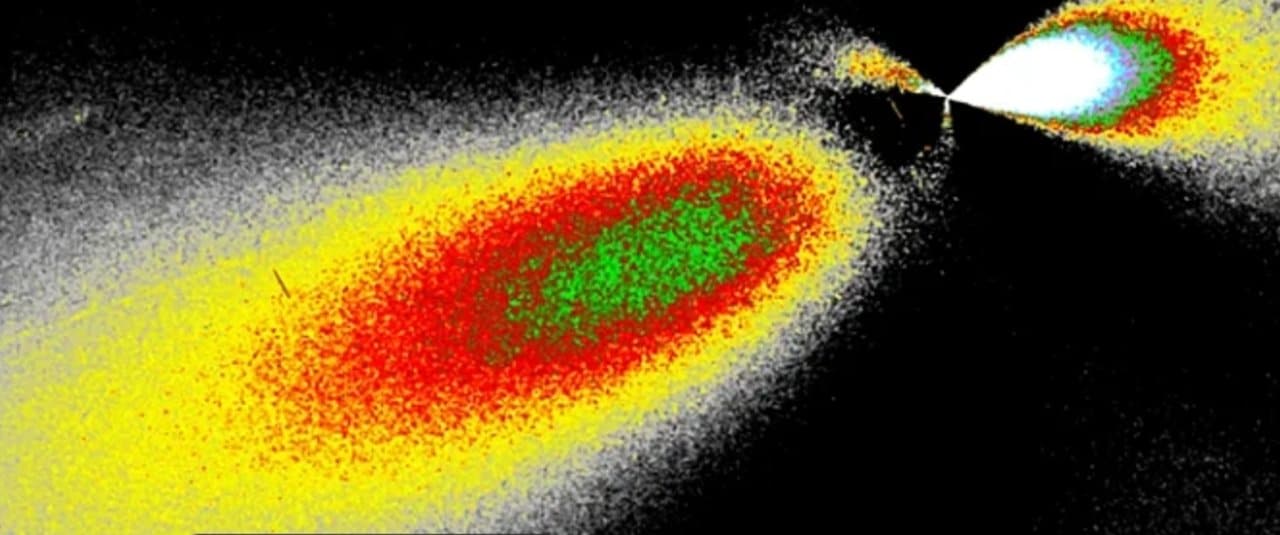
In a landmark astronomical event, a celestial object approximately 12 billion years old was identified in July 2025, crossing our Solar System. Detected by the Asteroid Terrestrial-impact Last Alert System (ATLAS), this comet immediately caught the attention of researchers due to its unique characteristics.
Named 3I/ATLAS, this body is the third interstellar object ever recorded by science. It originated around another star and, after a brief passage, is now leaving the Solar System at a speed of more than 60 kilometers per second, without returning.
The discovery, naturally, caused great worldwide repercussion, even generating unfounded speculation about the possibility of it being an alien spacecraft, which diverted the focus from its real scientific properties.
A recent study, published in the renowned journal Nature by a team of scientists led by Martin Cordiner, from NASA’s Goddard Space Flight Center, provided new data on the comet’s formation. The conclusions indicate that 3I/ATLAS is a true “galactic fossil”, having an age that exceeds that of our Solar System.
How interstellar objects are formed and what they represent
Planetary systems are dynamic and sometimes chaotic environments. In addition to the planets, they house a vast amount of residual material from their own formation. A considerable portion of this debris moves in unstable trajectories. In this way, the Solar System constantly expels smaller bodies into the space between the stars.
Comets and asteroids are often affected by the gravitational force of planets and, as a result, are ejected. Once outside their home system, they begin to navigate the galaxy, moving freely in interstellar space.
For a long time, the scientific community predicted that if planetary systems are common in the universe, the space between the stars should be filled with a vast population of rocky and icy objects. These would be residues of both ancient systems and more recent formations.
The vast majority of these interstellar objects will never come close to another star. However, due to their immense number, it is inevitable that some end up passing through the interior of star systems like ours, getting close enough for us to observe and study them.
The only three interstellar objects identified to date – 1I/‘Oumuamua, 2I/Borisov and 3I/ATLAS – are the first examples of this vast population that humanity has managed to detect. Although these bodies have been crossing our region since the birth of the Solar System, the technology needed to observe them has only become available in the last decade.

The surprising speed and probable ancestral origin of comet 3I/ATLAS
Astronomers quickly confirmed that 3I/ATLAS was moving at an impressive speed. At its closest approach to the Sun, it reached more than 68 kilometers per second. Even before being influenced by solar gravity, its speed already exceeded 58 km/s.
This orbital feature was the first evidence that the comet could have a peculiar origin and be a truly special celestial body.
Evaluating only its orbit in the galaxy, experts soon inferred that 3I/ATLAS could be older than the Solar System. The most likely hypothesis is that it was expelled from a star belonging to the “thick disk” of the Milky Way, a layer of the galaxy made up of older stars that formed long before our Sun.
The big question, then, was whether this premise about its antiquity could be conclusively verified.
Chemical analysis reveals age and formation of interstellar comet
The study recently published in the journal Nature used data from 3I/ATLAS observations made with the James Webb Space Telescope and the Atacama Compact Array. These instruments made it possible to analyze the comet at different wavelengths, including infrared and microwaves.
Such analyzes enabled scientists to investigate the gases released by the comet as it approached the Sun. It was discovered that the carbon molecules emitted by the object contained a significantly smaller amount of carbon-13 (a heavier isotope of carbon) than that observed in comets formed in the Solar System. Isotopes are variations of the same element that have the same number of electrons and protons, but differ in the number of neutrons.
This low proportion of carbon-13 is a strong indication that the comet is extremely old. But what’s the reason? The explanation is directly linked to the way material is processed inside stars in our galaxy.
Practically all the carbon present in the Milky Way is produced by stars much more massive than the Sun. At the end of their lives, this carbon, generated by nuclear fusion, is released back into the Cosmos, where it will be reincorporated in the formation of new generations of stars and planets.
However, there is a fundamental process: while stars produce carbon in their cores, they also convert carbon-12 (the most abundant isotope) into carbon-13, through a mechanism known as “hot background combustion”. Over time, the ratio of carbon-13 to carbon-12 throughout the galaxy increases.
The scarcity of carbon-13 in 3I/ATLAS, therefore, implies that it must have formed in a period when this proportion was lower, that is, around 12 billion years ago. This age places it in the most embryonic stages of our galaxy’s history, offering a glimpse into the chemical conditions of the early universe and the formation of the first stars and planetary systems.
Awaiting new discoveries with the Vera Rubin Observatory in Chile
Each of the three interstellar objects identified so far has turned out to be unique. The question that arises is: what does the future hold for us in terms of new discoveries?
The Vera Rubin Observatory, situated on a mountaintop in northern Chile, represents a crucial technological advance. It has the largest camera ever built, coupled to a telescope that operates with incredibly fast, wide-angle image capture capabilities.
This feature makes Vera Rubin an ideal tool for detecting interstellar objects as they cross the Solar System. Astronomers predict that the observatory will be able to identify dozens of these celestial bodies within the next decade.
Vera Rubin’s capability will allow it to detect objects that would otherwise remain unknown to us, as well as identify them much earlier than would be possible with current technologies.
By accumulating the detection of a larger number of these objects, it will be possible to study them as a population, and not just as individual bodies. This collective approach promises to reveal valuable information about the history of star and planet formation in our galaxy.