
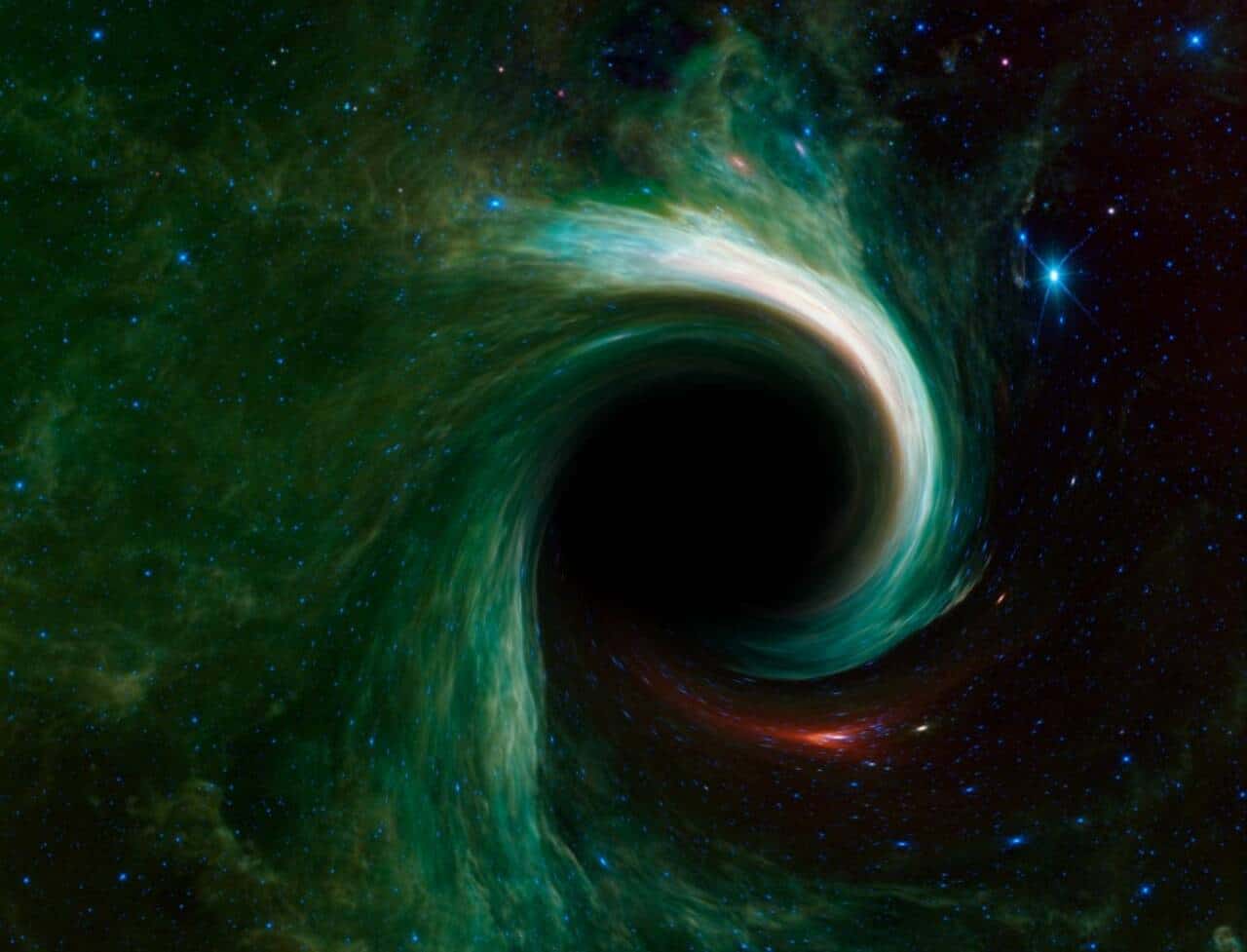
A black hole’s event horizon, a cosmic boundary where not even light can escape, has been one of the biggest enigmas in theoretical physics for decades.
These celestial formations remain the most mysterious objects in the universe, always full of unknowns and with the peculiarity of not releasing anything that crosses their gravitational barrier.
In a remarkable advance for science, researchers recently identified the “fingerprints” of a black hole’s event horizon, the theoretical dividing line that marks the point of no return.
This finding represents an unprecedented moment, as it is the first time that scientists have come so close to unveiling one of the deepest secrets of these celestial bodies, moving understanding from a purely theoretical concept to the field of empirical observation.
Published in the renowned journal Nature, the study was based on the analysis of data from GW250114, the most powerful gravitational wave ever recorded by the LIGO observatory, in January 2025, focusing on the intense final explosion of “direct waves” generated by the merger of two black holes.
Thanks to the ability to isolate these specific waves, researchers were able to identify activity in the immediate vicinity of the event horizon, something never before achieved.
Sizheng Ma, lead author of the research and scientist at the Perimeter Institute for Theoretical Physics in Canada, emphasized the importance of the finding by stating: “This concept of a black hole horizon normally appears in science fiction. But now we are actually able to access the region around the horizon with gravitational data. Sometimes I can’t believe this is actually happening.”
The final phase of black hole union is often described as similar to a “spoon stirring water”, where the space-time vortex generated produces gravitational waves that carry information directly from the area around the event horizon.
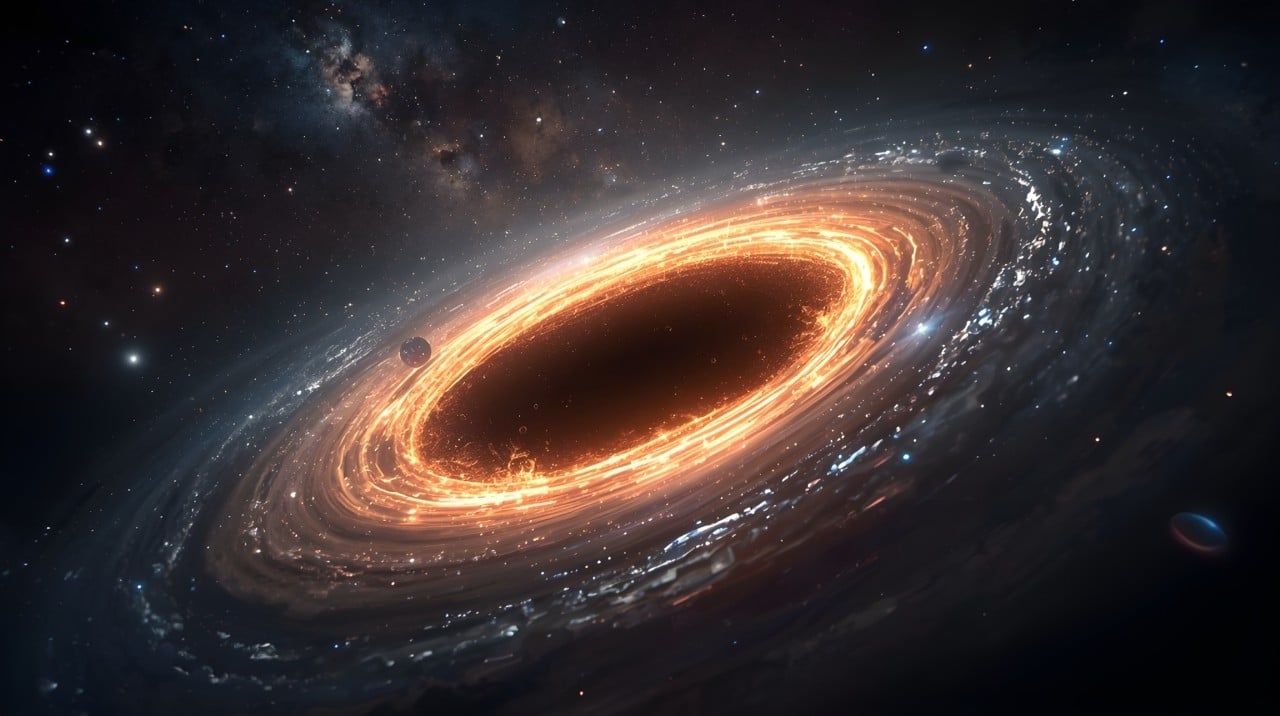
The results obtained align perfectly with the theory of general relativity formulated by Albert Einstein. The data confirmed the phenomenon of “frame dragging”, which is the distortion of space around a massive rotating object, such as a black hole.
This revelation generated a considerable impact on the scientific world, enabling researchers, for the first time, to “touch” the area close to the event horizon through data, investigate “quantum fluctuations” and look for possible deviations from general relativity, with the potential to unveil new fundamental laws of Physics.
Francesco Sannino, an Italian theoretical physicist dedicated to the study of black holes, considered the analysis “convincing” but highlighted the need for verification by other researchers. He added that “more generally, understanding the physics of black holes and their mergers is important as it can shed light on how space and time are interconnected at a more fundamental level.”





