
James Webb Telescope reveals unprecedented features of comet 3I/ATLAS from another star system

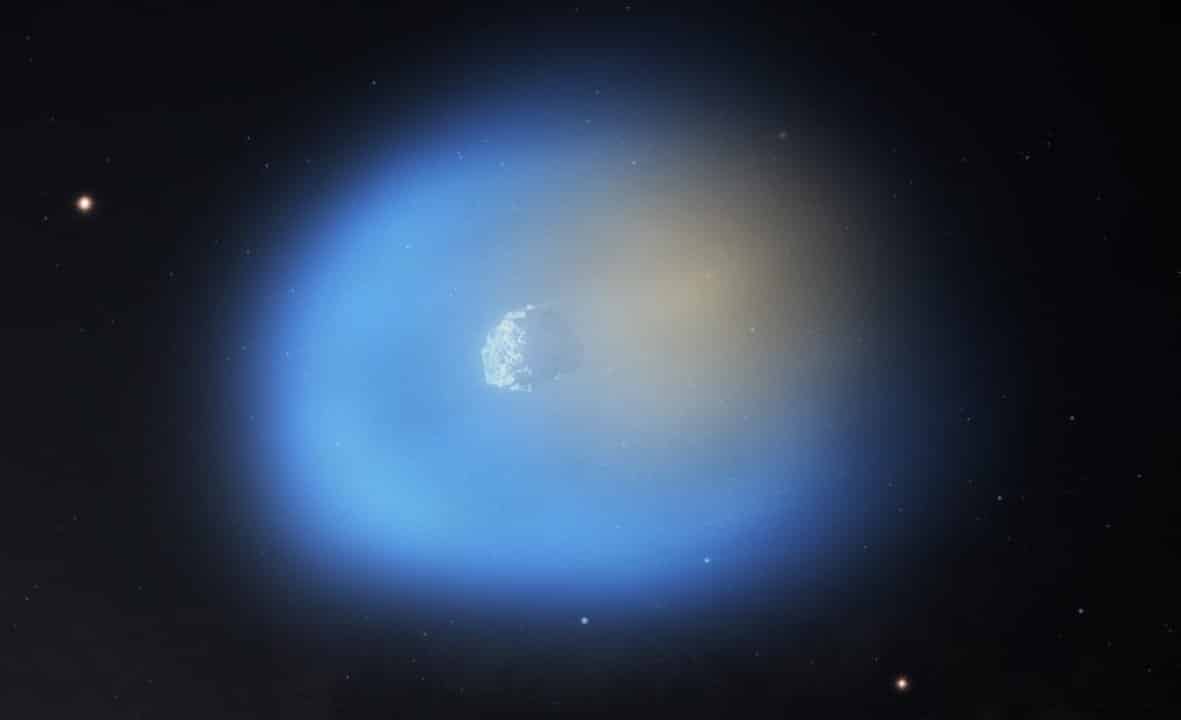
New observations carried out by the James Webb Space Telescope (JWST) confirm that comet 3I/ATLAS has a unique chemical composition, different from any object already cataloged in our Solar System. These analyzes reinforce, without a doubt, the interstellar origin of the comet, which crossed the vicinity of the Sun in 2025. The research offers valuable clues about the conditions of planetary formation in other galaxies.
Detected in July 2025 by the ATLAS system, 3I/ATLAS was the third object recognized for its origins from outside our star system. Its passage close to the Sun provided a unique window for scientists, allowing solar heat to make it brighter and facilitate the collection of detailed data by JWST’s high-precision instruments.
Unprecedented chemical composition found in object 3I/ATLAS
The James Webb Space Telescope analyses, carried out in December 2025, while comet 3I/ATLAS was moving away from our star, focused on measuring the proportions of several molecules. Among them, carbon and heavy hydrogen stand out. The ratios found between these elements do not coincide with the chemical profile of any comet or celestial body native to our Solar System, solidifying the conclusion that 3I/ATLAS originated in a completely different stellar environment.
These results, published in the renowned magazine *Nature* on June 22, are crucial for astronomy. The researchers were able to study the comet’s composition while it was still exhibiting activity, revealing “signatures” that are typical of interstellar molecular clouds. This discovery supports the theory that 3I/ATLAS was formed in a region with conditions significantly different from those that characterized our own protoplanetary disk, from where the planets and other bodies in the Solar System were born.
How James Webb unravels the mysteries of distant comets
The James Webb Space Telescope, with its advanced infrared instruments, has a unique ability to analyze the composition of celestial objects, even those that are small and distant. In the case of comet 3I/ATLAS, JWST was able to:
- Identify specific molecules:Measure the presence and abundance of carbon and heavy hydrogen, which are key indicators of a comet’s origin and formation environment.
- Analyze infrared light:Using the infrared light emitted or reflected by the comet to decipher its molecular “fingerprint”, as different molecules absorb and emit light at different wavelengths.
- Detect subtle variations:Noticing small variations in isotopic proportions, such as the ratio between hydrogen and heavy hydrogen, which provide detailed information about the temperature and chemistry of the environment where the object formed.
- Operate at high sensitivity:Its location in space and giant mirrors allow observations with incomparable clarity and sensitivity, overcoming the limitations of terrestrial telescopes.
The importance of the arrival of visitors from other star systems
The observation of interstellar objects, such as 3I/ATLAS and the previously known ‘Oumuamua, is extremely relevant to the scientific community. They are fragments of other planetary systems that travel through space and offer a direct opportunity to study the raw material of stars and planets outside our cosmic neighborhood. These “visitors” act as time capsules, carrying information about the physical and chemical conditions of their places of origin.
The fascination surrounding these objects is so great that, on certain occasions, unfounded speculations arise on social media, such as the possibility that they are extraterrestrial ships, similar to what happened with ‘Oumuamua. However, the robust chemical data provided by JWST in the case of 3I/ATLAS make it clear that it is a natural comet, albeit one of exotic origin, dispelling any rumors of an artificial nature.
The legacy of JWST observations for space science
As comet 3I/ATLAS continues its journey towards the most remote regions of the Solar System, never to return, astronomers continue the painstaking work of analyzing the vast data collected by JWST. Each new detection of an interstellar object represents an unprecedented chance to expand our understanding of the diversity and complexity of planetary systems that exist in our galaxy.
These observations demonstrate the remarkable effectiveness of state-of-the-art telescopes for studying such ephemeral visitors. Thanks to JWST’s capabilities, scientists were not only able to confirm the interstellar origin of comet 3I/ATLAS, but also obtained crucial information about the physical and chemical conditions prevailing in the star system from which it originated, deepening knowledge about the cosmos.



