
NASA scientists investigate secrets of comet 3I/Atlas as it passes through the Solar System

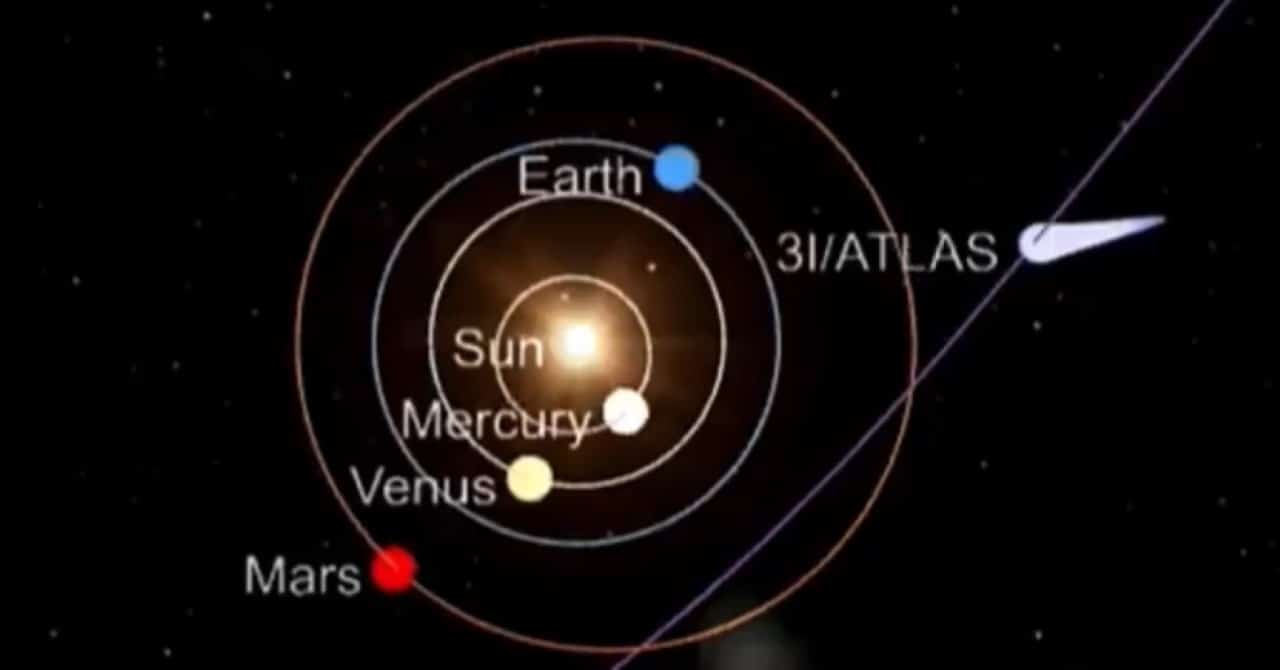
Researchers linked to the American space agency and several astronomical centers around the world are dedicating intense efforts to mapping comet 3I/Atlas. This foreign celestial body crosses our space neighborhood in the year 2026, bringing the potential to completely transform what we know about the genesis of worlds and the structure of remote stellar neighborhoods. Identified through a striking hyperbolic trajectory, the celestial body gives experts a rare chance to examine raw matter originating from outside our domain, a long-standing desire of scholars since the first travelers from outside the system were noticed.
The uniqueness of 3I/Atlas is directly linked to its starting point and the path taken to get here. Unlike the icy bodies that appear in the Oort Cloud or the Kuiper Belt, this visitor has no gravitational ties to the Sun, which proves its expulsion from an alien planetary system incalculable eons ago. This attribute transforms the star into a true preserved relic of a distinct cosmic scenario, holding fundamental evidence about the chemical and physical reactions responsible for sculpting other realities throughout the universe.

The ongoing analyses, enhanced by the use of cutting-edge equipment both in orbit and on the Earth’s surface, aim to decipher what the 3I/Atlas is made of, what its interior is like and the behavior of its temporary atmosphere, which exhibits activity well above the average for this category. Each new measurement represents a crucial piece in the puzzle that illustrates the vast plurality of the cosmos far beyond the boundaries we know.
First records and confirmation of the star’s external origin
The first signal from 3I/Atlas was captured in the last months of 2025, thanks to the Pan-STARRS system, designed to scan the firmament for moving elements. The certainty that it was an interstellar intruder arrived a few weeks later, when experts from various research centers calculated its route with mathematical exactitude, attesting to a hyperbolic curve with an eccentricity greater than 1, which nullifies any possibility of a previous link with solar gravity. This milestone generated a huge stir among academics, as each new celestial body of this type multiplies the opportunities to solve mysteries of deep space.
From that moment on, a true scientific marathon began. Wandering stars of this nature are known to travel at extreme speeds, leaving a very short gap for any kind of scrutiny. Research groups spread across the globe, encompassing facilities controlled by NASA, quickly adjusted the focus of their lenses to the 3I/Atlas, trying to extract as much information as possible before the visitor disappeared into the darkness definitively.
Core dimensions and chemical elements surprise experts
Initial calculations indicate that the heart of comet 3I/Atlas measures somewhere between 10 and 15 kilometers from tip to tip, a very significant size when compared to other space intruders already documented. Its coma, which consists of the cloud of dust and gases surrounding the nucleus, turned out to be much brighter and wider than projections indicated, signaling an intense evaporation of volatile materials as it approaches solar heat.
Preliminary assessments of the light spectrum point to the existence of water, cyanide and carbon monoxide, substances frequently found in local comets. However, the sensors also captured signals from more elaborate molecules and an atypical distribution of isotopes, strongly indicating that 3I/Atlas was born in a sector of the galaxy where the physicochemical rules diverged drastically from those present in the dust disk that formed the Earth.
This unique chemical pattern attracts a lot of attention from the academic community. If the data is consolidated, it will be clear that the star formed under severe temperatures or during a completely different phase in the life of its original star, giving scientists a direct window to observe how planets are born in other regions of the Milky Way.
History of foreign celestial bodies that crossed our path
Long before the arrival of 3I/Atlas, our neighborhood had already received a confirmed visit from two other travelers from outside: ‘Oumuamua, seen in 2017, and 2I/Borisov, identified in 2019. The first, marked by a stretched shape and the total lack of a gas cloud, broke classification paradigms and generated long discussions about what it really was. Borisov, on the other hand, acted exactly like a traditional comet, although its components pointed to a birth in a stellar system with an abundance of carbon.
3I/Atlas, by mixing traces of a giant comet with an active atmosphere and possible anomalies in its chemistry, adds a new layer of understanding to this group of visitors. Its presence helps create a more complete database on interstellar bodies, enabling cross-referencing of information that, in the future, could demonstrate which types of planetary fragments are most common around other stars.
Uninterrupted monitoring using American space technology
The United States space agency has placed a veritable fleet of instruments keeping an eye on 3I/Atlas. The James Webb Space Telescope (JWST), operating in the infrared spectrum, plays a vital role in identifying volatile substances in the comet’s cloud, delivering a detailed x-ray of its molecular structure. At the same time, the Hubble Space Telescope enters the scene capturing very high definition photographs, which makes it possible to analyze the physical shape of both the nucleus and the coma.
In addition to the equipment in orbit, a network of observatories fixed on Earth, such as the Very Large Telescope (VLT) and W. M. Keck, feeds the databases with photometric and spectroscopic records without interruption, measuring luminosity oscillations and the celestial body’s activity minute by minute. This joint effort between several nations is essential to ensure that no detail goes unnoticed during the rapid crossing of the 3I/Atlas.
The American institution also directed the lenses of the recently opened Nancy Grace Roman Space Telescope for the mission. Thanks to its gigantic field of vision, the equipment becomes the perfect tool for following the comet’s footsteps and spotting any pieces that may break away from the main body, guaranteeing a much more complete overview of the object’s reactions to heat.
All information captured is sent to state-of-the-art supercomputers, where advanced algorithms run simulations about the birth and journey of the 3I/Atlas. The purpose of these machines is to decipher what violent events drove him from his original home and how the structure survived the long crossing through the interstellar void.
Impacts of discoveries for the study of life and cosmic evolution
The scrutiny of 3I/Atlas represents a gigantic advance for astrobiology and the science that studies the birth of worlds. By investigating the materials of an object shaped in the orbit of another star, experts are able to place side by side the fundamental building blocks of distant systems and those in our own backyard. Such a comparison has the power to answer whether the recipe that created the Earth is a rule in the universe or whether there are brutal differences along the way. The identification of complex organic compounds, for example, would serve as a strong indication that the seeds of life are spread throughout the galaxy, raising the probability that other living beings exist. Each grain of dust and ice crystal from 3I/Atlas functions as a physical sample of an unreachable universe, delivering valuable answers about the multiplicity of realities outside the Solar System.
Technical difficulties faced by astronomy teams
Tracking wandering celestial bodies like 3I/Atlas imposes formidable barriers on scientists. The object’s absurd speed, coupled with the fact that it will only pass through here once, drastically reduces the useful time window for research. Anticipating the comet’s brightness level and reactions is fundamental, but almost always uncertain, which forces researchers to maintain a very high level of agility and adaptation during observation sessions.
Added to this, the extreme distance and small size of these travelers means that they emit a very weak light, requiring the exclusive use of the largest and most powerful telescopes in the world to capture any detail. The synchronization between dozens of research centers located on different continents and in outer space becomes the only way to keep the object under constant surveillance and guarantee a robust database.
Next steps for science in the hunt for new space travelers
The 3I/Atlas visit highlights the urgent need to create space missions focused on intercepting these travelers from outside. Even though sending a probe to 3I/Atlas is a logistical nightmare due to its late discovery, the success of analyzes carried out remotely has been accelerating the creation of technologies for immediate response missions, which would be ready to take off as soon as a new intruder was detected.
The tracking telescopes that are about to come into operation, equipped with more sensitive sensors and wide-scan lenses, are expected to multiply the number of interstellar asteroids and comets found. The expectation is that, over the next few decades, the volume of discoveries will guarantee the necessary advance time for space agencies to be able to structure much more daring interception missions.
Such investigations not only serve to fill the holes in human understanding about the creation of stars, but also nourish fascination with the immensity and complexity of the universe. It is a type of science that invites society to observe the night sky with a renewed dose of respect, admiration and desire to discover the unknown.
Peculiar facts that mark the passage of the celestial body
Although comet 3I/Atlas is the main focus of rigorous academics, it has also caught the attention of ordinary people due to its particularities. The prefix “3I” in its official record signals that this is the third interstellar body cataloged in history, respecting the nomenclature standards established by the International Astronomical Union (IAU).
- Scientific baptism: The term “Atlas” attached to the record derives from the ATLAS (Asteroid Terrestrial-impact Last Alert System) monitoring network, famous for making crucial discoveries in the celestial vault.
- Non-standard tone: Light analyzes indicate that the gas cloud around the nucleus has a bluish tone, suggesting the release of dust or gases that do not usually appear in comets native to our system.
- Expiry date: The time in which the 3I/Atlas can be seen from Earth is very short, transforming each hour of telescope viewing into an invaluable resource, given that the object has already begun its escape route away from the Sun.
- Debris trail: Unlike what happened with ‘Oumuamua, 3I/Atlas has been releasing a visible trail of particles, which makes research into the wear of its crust and the exact composition of this ejected material possible.





