
World’s largest nuclear fusion reactor takes shape in France to revolutionize energy production

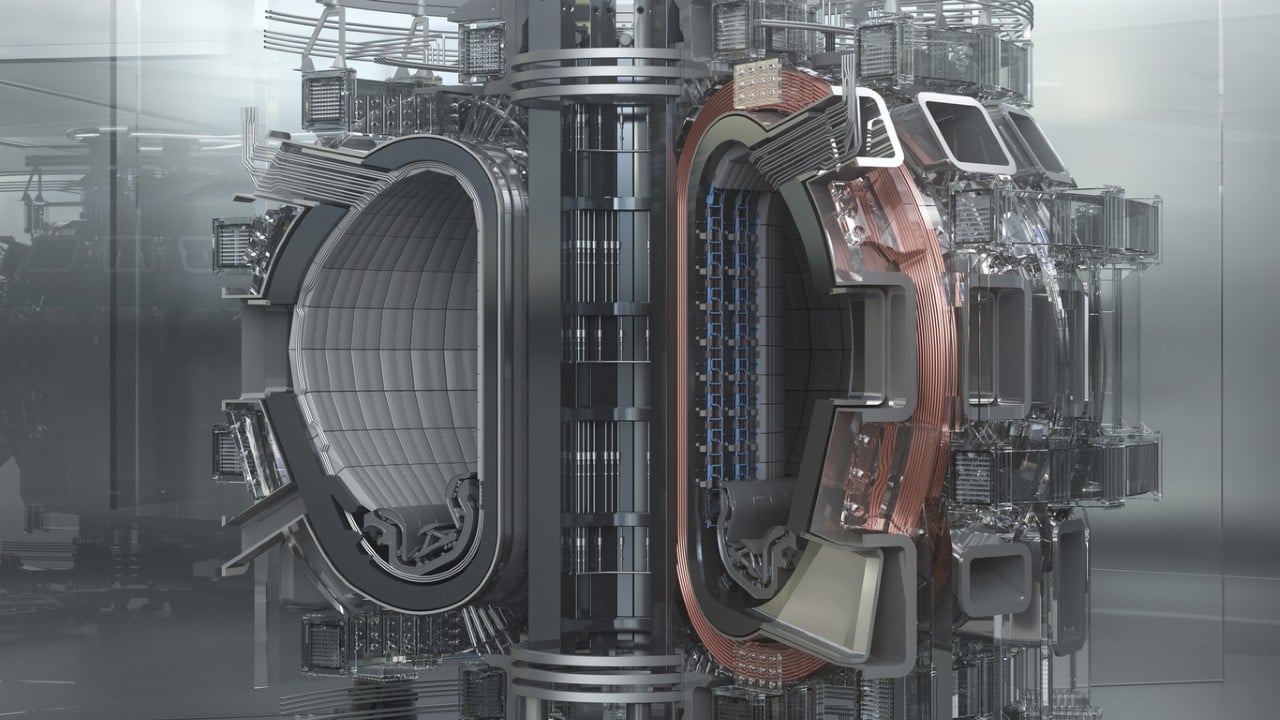
The International Thermonuclear Experimental Reactor (ITER), one of the largest and most complex scientific projects in the history of humanity, remains in an advanced stage of construction in France. Thirty-five nations pooled their resources and knowledge to build this gigantic magnetic fusion device. The main objective is to demonstrate the viability of nuclear fusion as a clean, abundant and large-scale source of energy, without carbon emissions.
Crucial advances in reactor heart assembly
In April 2026, important milestones were reached in the assembly of the ITER tokamak, the structure that will house the plasma. Four massive vacuum chamber modules were precisely positioned around the equipment’s central solenoid coil. Each of these wedge-shaped components is impressive in size: 13 meters high and weighing approximately 1,200 tons.
These structures have been meticulously designed to contain an enormous volume of plasma, which will be heated to extreme temperatures, inside a toroidal-shaped vacuum chamber. The stability and confinement of this plasma are guaranteed by powerful magnetic fields, a cutting-edge technology that is essential for the fusion reaction to occur in a controlled manner.
Global collaborative effort to search for new energy sources
The ITER project represents an unprecedented scientific and engineering collaboration, involving the participation of dozens of countries. This union of international efforts reflects the magnitude of the challenge and the global hope placed in nuclear fusion for humanity’s energy future.
The initiative aims not only to build a functional reactor, but also to develop the technical knowledge and technologies needed to build future fusion plants. This is critical to addressing critical issues of energy security, environmental sustainability and the growing demand for electricity across the planet.

The foundation of an engineering megastructure
Before assembling the complex internal components, building a robust structural base was an essential step. The foundation of the building that will house the tokamak involved the installation of intricate networks of reinforcing bars arranged in a circular pattern.
Over this intricate steel mesh, a 1.5 meter thick concrete slab was cast. This colossal foundation is designed to support the weight and forces generated by the tokamak machine, ensuring its stability and integrity. The acronym ITER itself, a Latin word meaning “journey” or “path”, symbolizes the long and challenging trajectory of fusion research.
Nuclear fusion: the promise of a game-changer for energy production
The search for nuclear fusion as a source of clean energy has been one of the greatest scientific ambitions of the last century. ITER sets out to be the first experiment to produce more energy than it consumes, a crucial milestone in proving its commercial and practical viability. Unlike nuclear fission, which is the process used in current atomic plants and which generates long-lasting radioactive waste, fusion unites light atoms.
This process, which is the same one that powers the Sun and other stars, uses abundant fuels such as deuterium, which can be extracted from water, and tritium. Furthermore, fusion does not produce greenhouse gases and offers an intrinsic safety profile: any failure in the system would result in the immediate cooling of the plasma and automatic interruption of the reaction, without risk of collapse. This combination of security, sustainability and an almost unlimited fuel supply makes fusion a bet for a truly clean and revolutionary energy future.
Technological challenges and perspectives for the operation
The construction and operation of a fusion reactor of the scale and complexity of ITER involves unprecedented technological and engineering challenges. Among them, the control of temperatures that reach millions of degrees Celsius and the manipulation of magnetic fields of immense power to confine the plasma stand out.
Although full completion and full-scale operation for commercial electricity generation are still decades away, the advances seen in the construction of ITER represent important milestones. Each step taken on this “journey” brings humanity closer to a new era in energy production.





