Lakers sign Walker Kessler in exchange valued at US$130 million; Jazz celebrate strategic negotiation

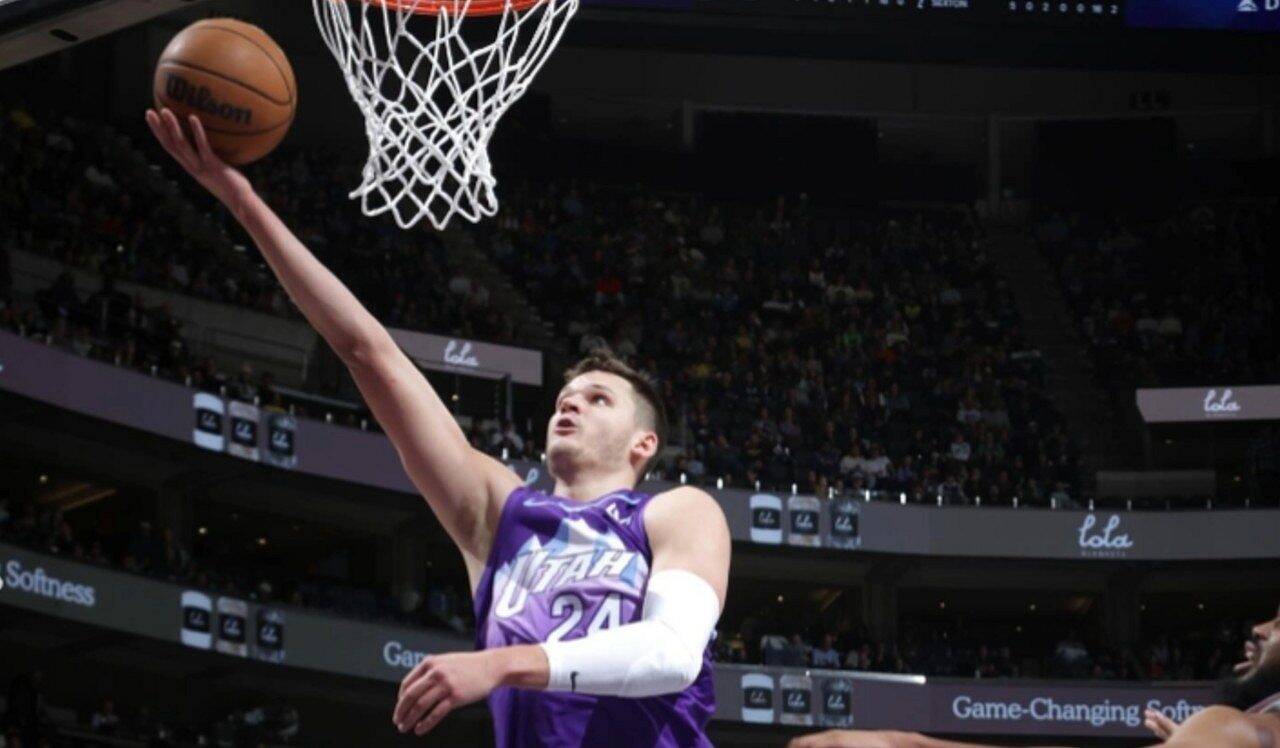
The Los Angeles Lakers are finalizing the acquisition of center Walker Kessler, who was a restricted free agent from the Utah Jazz, according to ESPN. Kessler is expected to sign a four-year contract with the Californian franchise, totaling US$130 million.
In return, the Utah Jazz will receive two unprotected first-round picks in the 2031 and 2033 drafts, as well as swap rights for first-round picks in 2028 and 2030.
The Lakers team had been left with a big gap in the pivot position since the departure of Anthony Davis in the negotiation that brought Luka Dončić. With Jaxson Hayes as the only reserve option at the time, the team had little presence in the paint. There was an attempt to resolve this shortage at the trade deadline when the team pursued Mark Williams, but the deal was canceled after the player’s physical.
Last offseason, the Los Angeles franchise signed Deandre Ayton in hopes that the former first overall pick would become the center of the future. Although Ayton improved throughout the season, his inconsistent defense, rebounding issues and fluctuating effort positioned him more as a temporary solution than a permanent one. With the possibility of opening maximum salary space this offseason, the Lakers prioritized finding a big-time player to play alongside Dončić.
With Kessler’s arrival, the Lakers are betting on an athlete who has already been on the team’s radar for a few years. Statistically, Kessler is recognized as one of the most dominant rim protectors in the NBA. He also stands out as an elite offensive rebounder, and while his volume is small, he has already shown flashes of his potential as a three-point shooter. Despite his offensive limitations, the transition from a Jazz team that has historically lacked strong veteran point guards to a Lakers team led by Dončić could boost his development in this regard, although his 54.5% free throw shooting is a significant red flag.
The Utah Jazz, in turn, are approaching a transition phase, moving from a role of constant reconstruction to a possible candidate to fight at the top of the Western Conference. However, following the extension of Lauri Markkanen to a max contract in the 2024 offseason and the arrival of Jaren Jackson Jr. at the trade deadline, the team already has considerable investment in its front office. Add to that a contract extension for rookie Keyonte George, who is now eligible, and the Jazz’s roster would become quite expensive if Kessler remained.
Analysis of the Lakers’ movement in the market
This deal represents a significant investment in Walker Kessler and demonstrates the Lakers’ confidence in having him as the ideal center to complement their talented point guard duo of Luka Dončić and Austin Reaves. The Los Angeles team was under great pressure to get a center of the type that Dončić had been looking for since his arrival, and the board paid a high price to complete the deal.
In an isolated analysis, $130 million, two unprotected first-round picks and two pick swaps constitute a high value for Walker Kessler. There is skepticism about his developmental ceiling beyond what has already been presented, and his injury issues add considerable risk for Los Angeles. Many people may evaluate this trade even more negatively, but it is possible to understand the perspective and justification on the Lakers’ side.
However, the best way to understand this trade for the Lakers is to see it in conjunction with the acquisition of Luka Dončić. With this integrated view, the assets spent on the Kessler trade make perfect sense. The team was able to bring in Dončić without having to give up too many draft picks, so to keep him happy and secure their preferred center, an “overpay” is considered acceptable. There was real pressure on Los Angeles to acquire Kessler (or Jalen Duren, who was even less available as a restricted free agent in Detroit), and the team didn’t want to face another summer of trying to improvise solutions to the hole in its tank.
On the court, the fit seems logical. While Kessler isn’t the explosive athlete that Dončić liked to have in Dereck Lively II, he is a strong blocker and an excellent target for lobs who doesn’t demand (or want) possession in other situations, making him the ideal offensive partner for Luka and Austin Reaves. Defensively, the Lakers desperately need a rim protector to anchor the defense in the paint, given the limitations of their outside defense, and Kessler will provide just that.
The challenge for new coach J.J. Redick will be to optimize the Lakers’ defensive strategy to maximize Kessler’s skills in that department. A heavy dose of drop coverage is expected to keep Kessler close to the rim, where he is most efficient. The Los Angeles team will need to improve coverage in scramble situations, be precise in exchanges and in communication to ensure that Kessler remains close to the paint.
What’s the problem for the Lakers? Considering the amount of money now committed to Dončić, Reaves and Kessler, this trio will have to be good enough to win a championship with secondary players around them. The team has exhausted its resources to assemble this group, and there won’t be many opportunities to add high-level talent beyond this core trio.
General manager Rob Pelinka is now fully committed to this core of players, and the pressure is on to bring an 18th title to Los Angeles with this lineup. All three will need to reach their full potential for that to happen, and there is skepticism about this squad’s ability to deliver that result.
Jazz movement guarantees maximum marks
The Utah Jazz handled this negotiation extremely effectively with the help of the Detroit Pistons. They set their terms in contract extension talks with Kessler and didn’t budge, and with the Pistons making it clear they would match any offer for Jalen Duren, the Lakers were forced to pay dearly to prevent Utah from doing the same. Kessler had been involved in trade rumors for over a year, and the Jazz never had to take a discount to trade him or sign him to a contract they didn’t want.
Obtaining two unprotected first-round picks, well into the future (in 2031 and 2033), is a huge feat. While the Lakers tend to bounce from one star to another, these are the most valuable picks available from Los Angeles. Utah continues to accumulate quality draft assets, with a first-round pick or trade rights in six of the next seven 2032 drafts being the only exception. Pick swaps may be false gold in some cases, but they still represent valuable assets for trades, and this deal opens up more avenues for Utah to acquire players both through the draft and in trades.
On the court, the Jazz will take a hit, which is why the grade isn’t a full A+. There is no obvious alternative to Kessler on the market after the recent rush for centers, and while they provided some security by re-signing Jusuf Nurkić, they will miss his rebounding power and rim protection. We’ll see some lineups with Jaren Jackson Jr. playing center, and the Jazz will likely sign another player to add depth, but for a team planning to make a leap next year, the loss of Kessler could lower their ceiling for the 2025-26 season.
That said, even though the team is ready to move forward now, this is still a team focused on the long term. They can continue to evaluate their roster and find the best possible fit for their young core, which now features second overall draft pick Darryn Peterson, and have the ammunition to be aggressive when an opportunity arises to add a center in the future.