NASA celebrates 250 years of the USA with stunning images of the universe in shades of red, white and blue


New cosmic images, captured in vibrant shades of red, white and blue, have been released by NASA. The initiative celebrates the 250th anniversary of the United States, which will take place on July 4th.
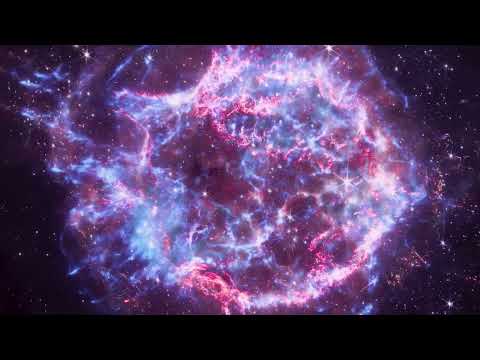
The spectacular photographs reveal four celestial wonders: a cluster of distant galaxies, the remarkable spiral galaxy Messier 94, a bright nebula within the Milky Way, and the remains of the supernova Cassiopeia A. Creating these compositions involved collaboration between the Chandra X-ray, Hubble, and James Webb observatories.
In addition to colorful views of the cosmos, the team responsible for Chandra also developed sonification. In these projects, data collected by the powerful X-ray telescope was transformed into sound, converting the images into a kind of celestial melody by mapping X-ray data onto different audio frequencies and musical instruments.

Galaxy cluster ZwCl 0024+1652 reveals details in space
In this composition, the galaxy cluster ZwCl 0024+1652 comes to life with intense blues and reds. The red in the image comes from X-ray data collected by Chandra, showing vast amounts of superheated gas around these galaxies, located about 4 billion light-years from Earth, in the constellation Pisces.
The photograph combines X-ray information from Chandra with optical data from the Hubble Space Telescope, shown in blue. Hubble data is crucial to revealing the presence of dark matter, according to a NASA statement.
Because dark matter does not interact with light, astronomers cannot photograph it directly. Its existence is detected by the gravitational influence it exerts on visible matter, that which interacts with light.
Observing the spiral galaxy Messier 94
The Chandra Observatory also probed deeply into the “eye” of the spiral galaxy Messier 94 (M94, or NGC 4736), sometimes nicknamed the Cat’s Eye Galaxy. This galaxy is located approximately 16 million light years away, in the constellation Canes Venatici, known as the “Hounds”.
In this image, X-ray data collected by Chandra has been combined with visible light photographs taken by ground-based telescopes. The images show Messier 94’s characteristic inner region, called the star-forming ring, where new stars are being born.
M94 is equally notable for its curious dark matter deficiency. “Astronomers still do not understand why it does not have the normal amount of dark matter, but the galaxy has been the subject of extensive research for this reason,” the agency clarified in a statement.
Discovering the NGC 3603 nebula
This image combines Chandra’s X-ray data with optical, infrared and ultraviolet light from NASA’s Hubble Space Telescope to display the shimmering cluster of gases and thousands of stars known as NGC 3603.
The nebula, found in our own Milky Way galaxy, is a vast region of gas and dust that surrounds a dense concentration of massive stars. NGC 3603 is 20,000 light-years away from our solar system, in the constellation of Carina, a Southern Hemisphere constellation named after the Latin word for a ship’s keel.
NGC 3603 contains some of the most massive stars known in the universe. “These enormous stars live quickly and die young, consuming their hydrogen fuel quickly and ultimately ending their lives in supernova explosions,” the agency said in a previous statement about the nebula.
Cassiopeia A supernova remnant
When some stars reach the end of their lives, they explode in massive events known as supernovae. Light from one of the most famous examples of a supernova reached Earth in the 17th century, manifesting as a bright spot in the constellation Cassiopeia. However, since this exploding star is about 11,000 light-years from Earth, this means that the supernova actually occurred more than 10,000 years ago, according to NASA.
Currently, the gases left over from this supernova are known as Cassiopeia A. Astronomers estimate that the star that generated the supernova was between 15 and 25 times the mass of the Sun.
In the image below, X-ray data from Chandra has been combined with infrared light collected by the James Webb Space Telescope to help visualize the luminous shell of gas in shades of red, white and blue.