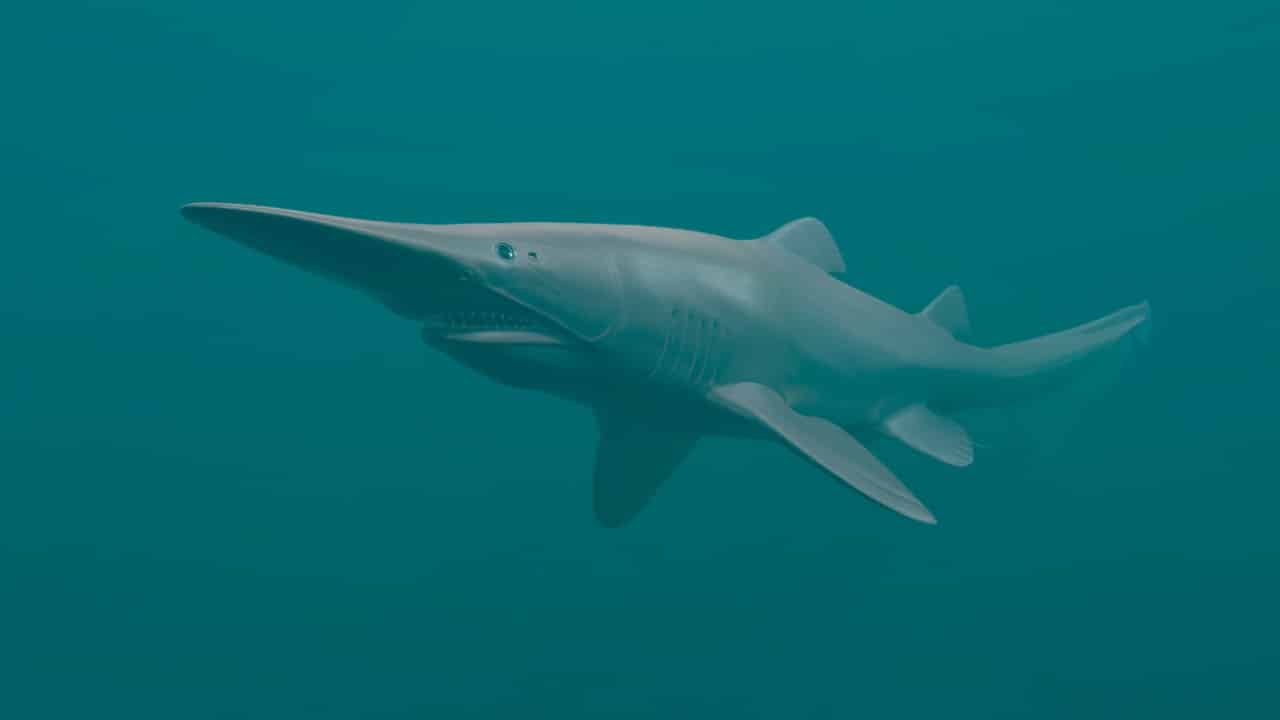
A mysterious and almost legendary creature from the deep sea has finally been captured on video in its natural environment, providing scientists with an unprecedented view. The goblin shark, known for its peculiar appearance and elusive nature, has had its first documented images in its own habitat, revealing details about its behavior and ecology that were previously only speculation. This event represents a significant milestone for marine biology, opening new doors for the study of species that inhabit the unexplored depths of the oceans.
The unprecedented sighting of an almost ghostly species
The team of researchers managed to record the goblin shark, *Mitsukurina owstoni*, using advanced submersion technology. The recording took place in a deep water environment, away from sunlight, where the pressure is immense and conditions are extreme. The images, considered the first of their kind, offer an intimate look at how this shark lives, moves and interacts in its ecosystem. Previously, knowledge about the species was mainly based on dead or accidentally captured specimens, often already damaged by the rapid rise to the surface.
Understanding the goblin shark: a living fossil from the oceans
The goblin shark is one of the most enigmatic creatures on the planet, often described as a “living fossil” due to its primitive features dating back millions of years. Its morphology is surprising, with a pink, flaccid body and an elongated snout that resembles a blade. However, the most distinctive feature is its protruding jaw, which can be thrust forward in a rapid movement to capture prey.
- Protractile jaw:Able to quickly extend to capture prey, a unique hunting mechanism in the shark kingdom.
- Pink color:Due to the translucency of the skin and the presence of blood vessels close to the surface, it is adapted to the absence of light in the depths.
- Elongated muzzle:Rich in electroreceptors that help the shark detect electrical fields emitted by its prey in the dark.
- Small eyes:They indicate a minimal dependence on vision for hunting in their habitat, where light is non-existent.
This creature lives at depths ranging from 100 to 1,300 meters, making direct observation extremely rare. Its diet consists of deep-sea fish, squid and crustaceans, which it locates using its highly developed sensors.
The importance of observing behavior in its natural environment
The new images are not just a curiosity; they provide valuable scientific data. By observing the goblin shark in its natural habitat, researchers can analyze its hunting method, the speed of its jaw, its locomotion and even its interactions with the environment and other species. This information is crucial to better understand the adaptation of creatures to extreme conditions and to fill gaps in knowledge about marine biodiversity.
Previously, many aspects of goblin shark behavior were inferred from studies of laboratory specimens or their captures. Direct visualization offers the opportunity to validate theories and discover novel behaviors, such as how it hides from predators or how it moves in search of food in such a vast and dark environment. This type of research is fundamental to conservation, as it allows a more complete understanding of the species’ ecological needs.
Technological advances and the promise of exploring the depths
The ability to capture these images is a testament to the significant advances in technology for remotely operated underwater vehicles (ROVs) and autonomous submersibles. High-resolution equipment, specialized lighting and greater underwater autonomy are allowing scientists to reach and document areas of the ocean that were inaccessible just a few decades ago. Most of the deep ocean remains unexplored, and each new tool opens a window into an unknown world.
These technologies not only facilitate the discovery of new species, but also allow us to monitor the impact of climate change and pollution on vulnerable deep-sea ecosystems. The goblin shark record serves as a reminder of the vast diversity of life still waiting to be discovered and studied in the oceans, a natural heritage that demands protection and understanding. The scientific community expects more mysterious creatures to be revealed as technological exploration advances.
The future of research in extreme ocean habitats
The discovery of the goblin shark in its natural environment energizes the search for knowledge about the ocean depths. Next steps will include detailed analysis of hours of footage, in hopes of identifying behavioral patterns, interactions with prey and predators, and the animal’s response to different environmental stimuli. This data will be compared with existing information on other species of deep-sea sharks, seeking to establish parallels and singularities.
There is still much to be understood about the oceans, especially in their deepest regions. This incident is not only a victory for technology, but also a reminder of human persistence and curiosity in uncovering the secrets of nature. The expectation is that this pioneering documentation will inspire new expeditions and investments in marine research, ensuring that more mysteries of the abyss are brought to light for the benefit of science and global conservation.