
Secrets of the solar system: comet 3I/Atlas reveals mysteries after approaching Earth in 2025


An enigmatic visitor from deep space, comet 3I/Atlas, has captured the world’s attention in 2025, revealing secrets that may be billions of years older than our own solar system. Images recorded by the Hubble telescope, on July 21 of that year, 446 million kilometers from Earth, generated much speculation about the object.
Approaching the planet, the comet inspired theories that ranged from a possible risk of collision to the controversial idea that it was an alien spacecraft.
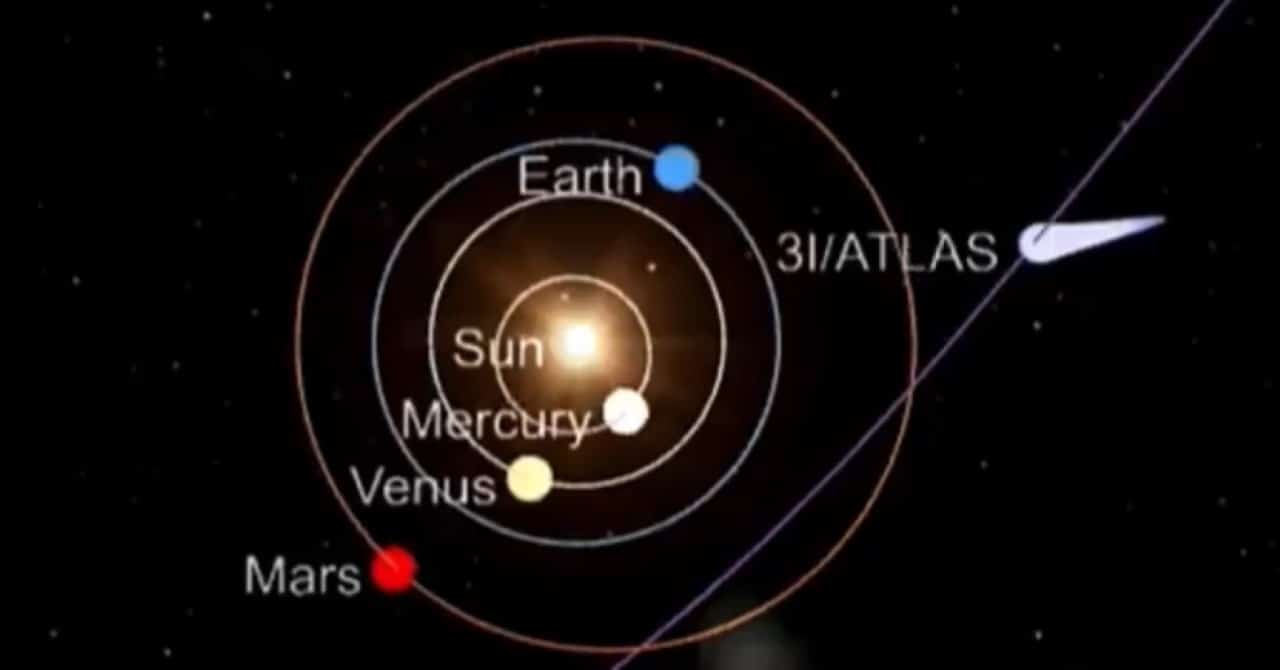
3I/Atlas reached its closest approach to Earth on December 19, 2025, a relative “closeness” in the vast astronomical context.
This favored position allowed telescopes and high-tech equipment to collect crucial data and images. Subsequent analyzes expanded knowledge about the comet and provided unprecedented insights into the formation of other stellar systems, something that would not have been possible by observing internal comets alone.
Unraveling the origin and composition of comet 3I/Atlas
Astronomer Jorge Marcio Carvano, from the National Observatory, explains that comets are formed by ice and dust in distant regions of planetary systems.
However, what makes 3I/Atlas special is that most of the comets studied so far formed within the limits of our Solar System.
Considered the third interstellar object detected, 3I/Atlas came from outside our cosmic neighborhood. Its discovery was made by observatories and research centers linked to several institutions.
The two previously identified interstellar objects were Oumuamua, in 2017, and Borisov, in 2019.
The presence of 3I/Atlas opened an unprecedented opportunity to understand the genesis of other planetary systems with characteristics different from ours.
Carvano contextualizes that comets, formed by grains of dust and ice, keep their material untouched because they never came close to the Sun.
By studying these celestial bodies, it is possible to investigate the primordial events in the formation of the Solar System, helping to understand the origin of the Earth and other planets.
There is evidence that suggests a connection between these cosmic objects and the presence of water on our planet, with research suggesting that asteroids or comets may have contributed to this.
Furthermore, Carvano adds that these bodies are rich in organic material, raising the possibility that they are related to the emergence of life in the Solar System.
For 3I/Atlas, all these considerations take on an even greater dimension due to their external origin.
The astronomer emphasizes that, as it comes from outside, 3I/Atlas offers the chance to understand these issues on a broader scale, studying the formation of other planetary systems and stars.
The obstacles of scientific research to collect data from the 3I/Atlas
It is important to consider, however, that the vast knowledge gained from the comet required a considerable period of research.
This process involved complex image capture, precise measurements and, subsequently, months and years of data analysis and interpretation.
A crucial date for this work was December 19, 2025, when comet 3I/Atlas reached its smallest distance from Earth, estimated at approximately 270 million kilometers, almost twice the distance between Earth and the Sun.
This opportunity allowed instruments such as the Hubble Space Telescope to carry out detailed observations, recording essential information about 3I/Atlas.
To illustrate the difficulty, even seemingly simple estimates become complex when it comes to stellar distances.
The calculation of the comet’s size is an example: initially, NASA projected a diameter between 300 meters and 5.6 kilometers for 3I/Atlas.
Professor Carvano reported that more recent observations and models point to a smaller size, between 600 and 800 meters in diameter, revising initial estimates.
This calculation was complicated by the fact that the comet, as it moved and approached the Sun, was surrounded by a large cloud of gas and dust.
Comets, made of ice, undergo sublimation (direct transformation of ice into gas) when they approach a star, due to heat and radiation.
Along with releasing gases, the comet also releases part of the dust that was contained inside.
This dynamic is what forms the bright trail known as the “comet’s tail,” which, in the case of 3I/Atlas, has been the subject of intense controversy.
The controversy over the origin of 3I/Atlas and the speculation of the alien spacecraft
On certain occasions, this interstellar object has exhibited unusual behavior in releasing gases and dust particles.
Carvano explains that, normally, comet tails are driven away from the Sun by solar radiation and winds.
However, 3I/Atlas showed a peculiarity by releasing gases and dust towards the Sun, a phenomenon nicknamed “reverse tail” or “topknot”.
This anomaly fueled theories, some suggesting that the 3I/Atlas could be a sophisticated extraterrestrial spacecraft.
However, this statement was categorically refuted by the consensus among astronomy researchers and scientists.
During a press conference in November 2025, NASA’s Amit Kshatriya addressed the issue, calling it a simple “rumor.”
He declared that the object “is a comet. It has the typical appearance and behavior of a comet. And all available evidence points to it being, in fact, a comet.”
Carvano adds that it is understandable that an object from outside the Solar System presents patterns and behaviors that are slightly different from what we are used to.
The astronomer explains that “even with this peculiarity of the tail in the direction of the Sun, we have already had the opportunity to observe similar phenomena in comets that belong to our own Solar System.”
He added that, as it is “an object that comes from outside the Solar System, we already expected it to have a composition different from the average comet we know”, reinforcing the expectation for singularities.
Amid news and rumors, Carvano expressed the conviction that new interstellar objects will be identified in the coming years, passing through the regions of the Milky Way.
He notes optimistically that, “we currently have more advanced telescopes and are able to process the data more efficiently, which makes discovering this type of object enormously easier.”
The astronomer noted that we live in an “era of great enthusiasm for the in-depth study of comets”, celebrating advances in research capacity.
At the time of its discovery, the 3I/Atlas recorded an impressive speed of 221 thousand km/h. His calculated trajectory indicated that this was the first and probably only time that he would make a “close” pass to Earth.





