
Mars: Scientists reveal discovery of rare extraterrestrial gem in 4.4 billion-year-old Martian meteorite

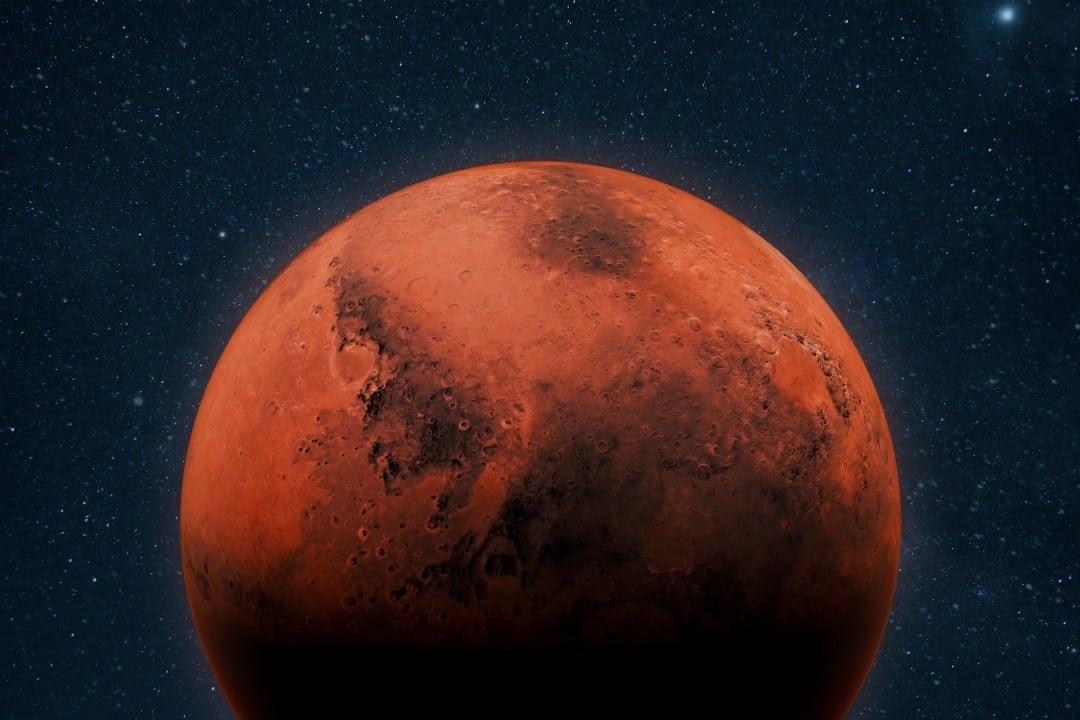
A 4.4 billion-year-old cosmic jewel has been identified by an international team of researchers: it is the first garnet-type gem of extraterrestrial origin found. The precious stone was hidden inside the Martian meteorite Northwest Africa (NWA) 8171, marking a first for planetary science.
Analyzing fragments from Mars that reach Earth is the only direct way scientists have to study the composition of the Red Planet’s lithosphere without the need for space missions. Among the few rocks that resist travel and entry into our atmosphere, NWA 8171 holds an essential mineralogical clue about the primordial conditions of our solar system.
By investigating a piece of this ancient rock, a global team of scientists, led by Dr. Tanya Kizovski, confirmed the presence of the mineral garnet. The specific variety, called andradite, is rich in iron and calcium, differing from commercial ruby gems in that it has greenish and yellowish tones.
On Earth, garnet is a mineral of great relevance to geologists, as it acts as a natural record of intense episodes of heat and metamorphism. Its presence in rocks makes it possible to unravel the thermal history and geological transformations of a planetary body, providing crucial information about the geological evolution of planets, including in scenarios beyond our own.
The detection of garnet in a sample from Mars is an exceptionally rare event, which calls existing geological models into question. The discovery suggests that the ancient Martian crust may have been the scene of much more complex and dynamic geological phenomena than previously imagined.
Details of the analysis of the NWA 8171 meteorite with laser technology
The innovative study, whose results were published in the journal *Geochemical Perspectives Letters*, had Dr. Tanya Kizovski as its main investigator. She worked in partnership with colleagues from the Royal Ontario Museum (ROM) and Brock University, both in Canada, as well as experts from the universities of Portsmouth and Open University (United Kingdom), and the University of Trieste (Italy).
Known as Northwest Africa 8171 (NWA 8171), the meteorite is classified as a regolith breccia, a rock formed by the fusion of dust, debris and impact material accumulated on the Martian surface during the Noachian eon. With an age estimated at at least 4.4 billion years, it is seen by astronomers as a primordial vestige of Mars’ history.
To analyze the inside of the valuable sample without causing damage, scientists employed a combination of advanced techniques. They used the University of Portsmouth’s Electron Microscopy and Microanalysis Unit, in conjunction with the Royal Ontario Museum’s specialized laser ablation equipment, revealing the gemstone’s unusual chemical composition with microscopic precision.
The researchers observed that the microscopic structure of the garnet is divided into two distinct regions. One area is predominantly composed of the garnet itself, mixed with other minerals, while the second consists of a completely different combination of materials, isolated from the first.
This two-phase structure indicates that the rock was formed on Mars through multifaceted processes. It would have gone through several cycles of extreme heat, intense pressure and gradual cooling before acquiring its unique internal configuration.

Understand the possible paths for garnet formation on Mars
The identification of this silicate on Mars opens up an intriguing geophysical debate about the circulation of thermal energy on the planet. Dr. Kizovski highlighted that “garnet is a classic example of a mineral commonly found in metamorphic rocks on Earth.”
For garnet to form under terrestrial geological conditions, the original rock needs to be exposed to extremely high temperatures and colossal pressures. However, on a planet like Mars, which does not have active plate tectonics comparable to Earth’s, the occurrence of such a “natural furnace” requires astrobiologists and geologists to explore alternative energy sources.
Researchers investigate several physical possibilities to elucidate the phenomenon. Kizovski detailed the potential origins: “On Mars, the heat and pressure required to form garnet by metamorphism could have come from the impact of a meteorite on the Martian surface, the rise of magma into the Martian crust, or a combination of both factors.”
A second theory under consideration suggests an oxidizing metasomatic event. In this process, heated chemical fluids circulate through rocks, altering their original mineralogical composition.
Uncovering the True Origin: The Martian Gem’s “Stowaway” Dilemma
Despite the enthusiasm over the discovery of the garnet, science requires caution. The occurrence of this mineral does not necessarily mean that Mars has large deposits, since a regolith breccia is a rock that is formed by the fusion of different types of rocks into a single mass.
Considering that the Martian surface is a vast “deposit” of cosmic debris, there is a scientific possibility that the grenade is not of Martian origin. It could be a preserved fragment of an asteroid that collided with the planet, becoming embedded in the rock.
To resolve the “stowaway” issue, scientists plan to analyze the sample’s isotopic signature. Kizovski explained the next step of the research: “Measuring the oxygen isotopes of the rock containing the garnet will help us confirm whether it is indeed of Martian origin or whether it came from the impact of an exotic meteorite.”
If the isotopic signatures are consistent with those on Mars, planetary science will finally confirm the presence of this previously unrecorded mineral on the Red Planet. Otherwise, if it is a well-preserved extraterrestrial fragment, it could provide unprecedented data on the chemical makeup of bodies that impacted the inner solar system.
Regardless of the outcome of the analysis, the detailed study of NWA 8171 has already significantly expanded the horizons of extraterrestrial geology. Scientists stated that “this new type of garnet-bearing rock could offer insights into how Mars evolved throughout its history and provide new insights into the ancient environments that favored the formation of garnet and other related minerals.”



