NASA’s Curiosity rover uncovers sulfur crystals in Martian rock, revealing new data on the planet’s geology

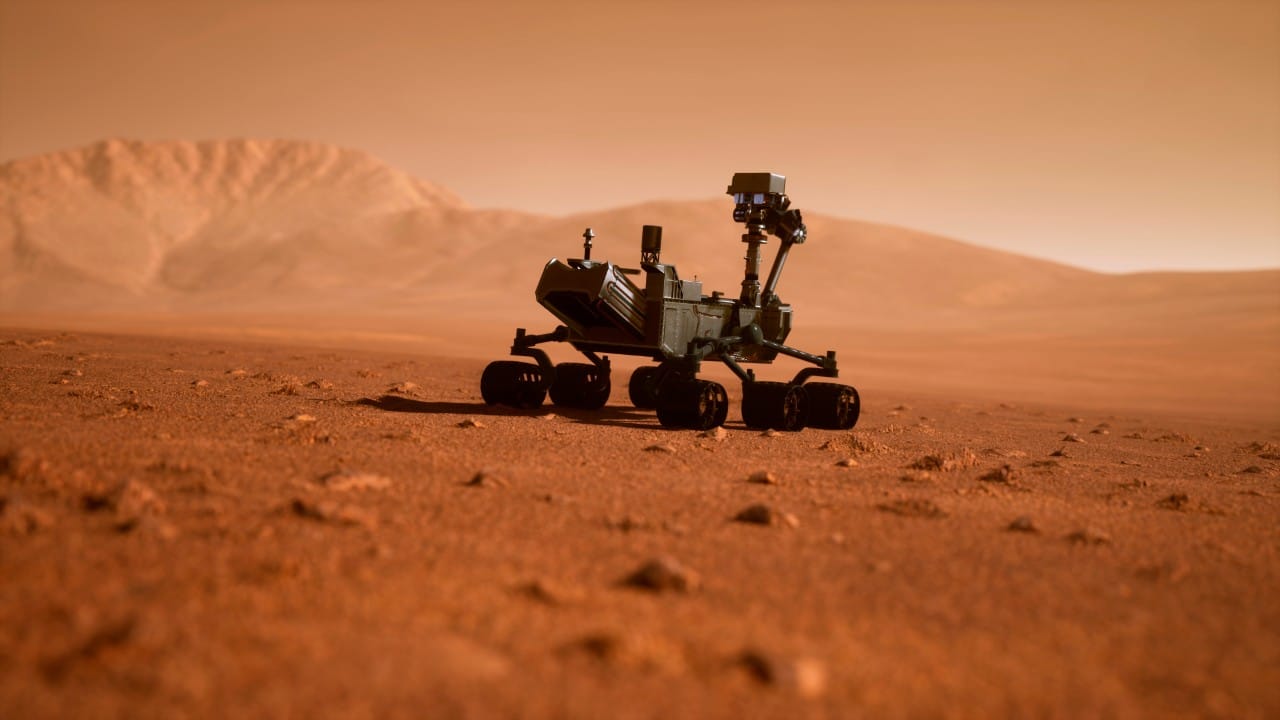
New evidence of the geological composition of Mars has emerged with a remarkable discovery by NASA’s Curiosity rover. The rover identified sulfur crystals inside a rock on the red planet, following an incident that led to the fragmentation of the rock formation. The find offers valuable insights into geological processes and the history of water in the Martian environment.
The discovery occurred on May 30, 2024, which corresponds to the 4,200th Martian day, or sol, of Curiosity’s mission. While passing over a rock, the rover accidentally crushed it, exposing the internal crystals. The revelation was made possible thanks to onboard cameras and spectrometers, which closely analyzed the newly exposed material.
Uncovering the “Lago do Condenado” rock in Martian soil
The crystalline material was found inside a rock formation that was nicknamed “Convict Lake”, in honor of a location in the Sierra Nevada, California, in the United States. Detailed compositional analysis was performed by Curiosity’s Alpha Particle X-ray Spectrometer (APXS), which confirmed the presence of elemental sulfur.
The images that revealed the crystals were captured by the Mars Hand Lens Imager (MAHLI), a high-resolution camera installed at the end of the rover’s robotic arm. MAHLI recorded the scene on June 4, 2024, on Sol 4205, providing scientists with an expanded and detailed view of the exposed minerals.
The importance of sulfur in geology and the search for life on Mars
The identification of elemental sulfur on Mars is crucial data for researchers. On Earth, sulfur is an abundant element and is involved in a wide range of geological processes, including volcanism and hydrothermal environments. Its presence on the red planet could indicate similar conditions in the past.
These crystals can form through volcanic processes or through the interaction of water with sulfur-containing minerals. In environments with water, sulfur can also be a fundamental component for microbial life. Therefore, this discovery adds a new piece to the puzzle of the history of water and the potential habitability of Mars, reinforcing the idea that the planet once had a much more dynamic and wet environment.
Instruments crucial to Curiosity’s discoveries
The Curiosity rover is equipped with a series of advanced scientific instruments that allow detailed analysis of Martian soil and rocks. Two of these instruments were fundamental to this recent discovery:
- Mars Hand Lens Imager (MAHLI):A color camera capable of taking close-up photos of rocks and soil, similar to a jeweler’s loupe. It is essential for examining mineral textures and compositions on a small scale.
- Alpha Particle X-ray Spectrometer (APXS):This instrument detects X-rays emitted by chemical elements on the surface of rocks and soils. It is used to determine the elemental composition of samples, revealing which minerals are present.
These technologies allow scientists on Earth to conduct a remote “laboratory” on Mars, without the need to return samples for in-depth study.
The Curiosity rover’s long-duration mission to the red planet
Curiosity was built by NASA’s Jet Propulsion Laboratory (JPL), which is managed by Caltech in Pasadena, California. The mission, led by JPL on behalf of NASA’s Science Mission Directorate in Washington, has been a resounding success since its 2012 landing.
Originally designed for a two-year mission, Curiosity exceeded expectations, operating for more than a decade. Its main objective is to investigate the climate and geology of Mars, in addition to determining whether the planet once had environmental conditions favorable to microbial life. Ongoing discoveries, such as that of sulfur crystals, contribute significantly to this understanding.
Understanding the Naming of Martian Features
NASA and the international scientific community use naming systems for geographic features on Mars, which facilitates communication and cataloging of discoveries. Rocks, craters and other formations are often named after places on Earth, such as cities, rivers or, in this case, mountainous regions.
The nickname “Convict Lake” for the rock where the sulfur was found follows this tradition. It establishes a cultural and geographic connection to familiar locations while humanizing the exploration of a distant planet. This practice helps create a detailed and accessible map of the Martian landscape, allowing scientists to identify and reference specific points with greater clarity.