
Researchers discover tenth species of shark that walks the seabed in Papua New Guinea


A scientific expedition carried out in the crystal clear waters of Papua New Guinea resulted in the cataloging of a fascinating marine animal: a cartilaginous fish capable of moving across the oceanic substrate using its fins. This finding brings to ten the total number of known lineages of this peculiar group of benthic predators. The newly described animal presents a set of morphological traits and lifestyle habits that completely separate it from its closest relatives, surprising biologists who explored the region. The formal identification brings new data about the hidden biodiversity in the reefs of the Indo-Pacific, one of the richest and most complex areas on the planet in terms of marine life.
Morphological details and the encounter during nocturnal exploration
With a slender body that can reach a hundred centimeters in size in adulthood, the predator displays camouflage perfectly adapted to its habitat. The brown skin is adorned with a complex pattern of dark spots interspersed with fine white lines, allowing the animal to blend in easily with the colorful rocks and corals of the ocean floor. This visual configuration was the first indication that the researchers were faced with something unprecedented, as it drastically differs from the rosette-shaped marks, typical of other geographic variations already documented by science.
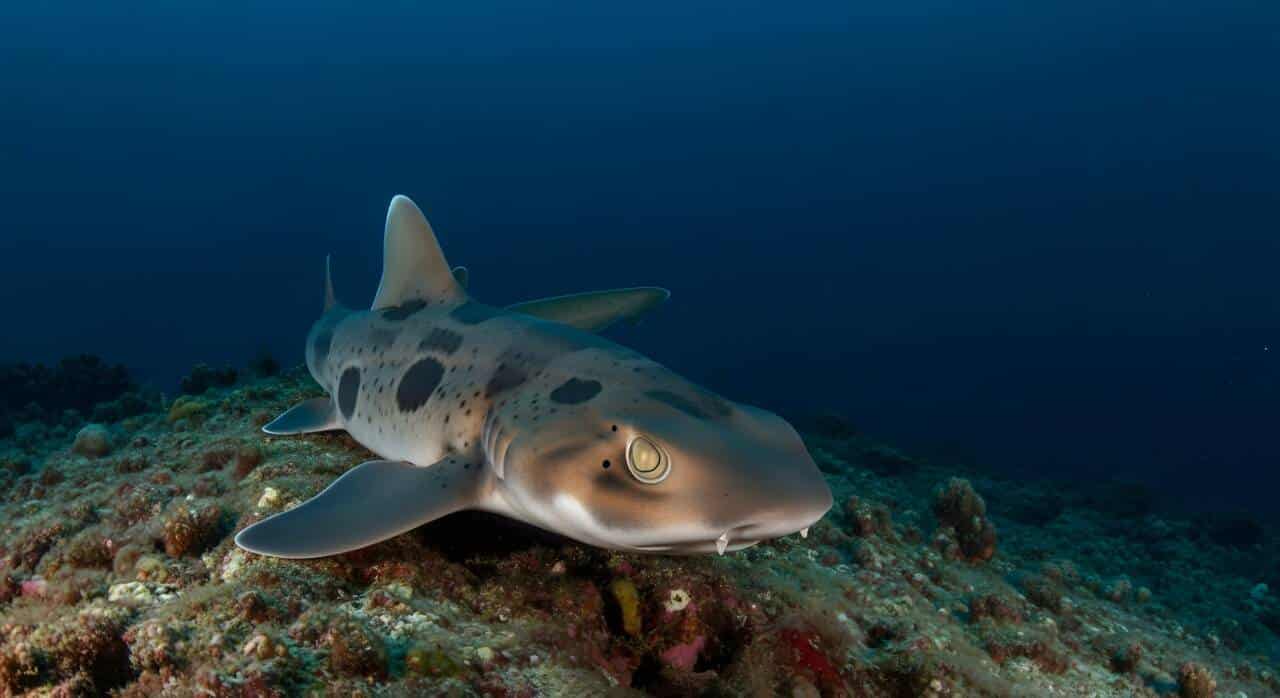
The first contact with the creature occurred during a night dive in Milne Bay, a coastal province famous for its vast biological diversity. Marine biologist Jessica-Ann Blakeway reported that the team was looking to map the distribution of other populations when they noticed the unusual visual pattern illuminated by underwater flashlights. Far from the frightening image often associated with large pelagic predators, these small reef inhabitants have a harmless appearance and an extremely docile behavior, breaking deep-rooted stigmas about the aggressiveness of these animals.
Extreme physiological adaptations for survival out of water
The most striking characteristic of this group is not only their crawling locomotion, but their impressive ability to withstand harsh environmental conditions. Propelling itself with its pectoral and pelvic fins through wave movements, the fish patrols the seabed in search of food. After the initial recording in March 2025, scientists searched the perimeter and located twelve more individuals within a span of forty-eight hours. DNA analyzes carried out later confirmed the genetic divergence, culminating in the official publication of the discovery in the specialized journal Journal of the Ocean Science Foundation in mid-June.
The true evolutionary difference of this lineage lies in its tolerance to hypoxia, a crucial adaptation for those who live in tidal zones. When the ocean level drops drastically, many of these animals end up confined in small, warm, shallow pools, with very low oxygenation. In order not to perish, they developed a fascinating biological mechanism that ensures the maintenance of their vital functions for long periods outside the ideal environment.
- Drastic reduction in heart rate to conserve as much energy as possible during outdoor exposure.
- Slowing down the respiratory rate, allowing the brain to continue functioning even with minimal oxygen levels.
- Ability to crawl over exposed rocks to navigate between isolated pools of water during low tide.
- Specialization in capturing small crustaceans, annelids and fish trapped in these temporary environments.
Academic honor and the relationship with coastal communities
The scientific baptism of the animal as Hemiscyllium dudgeonae carries special significance for the academic community. The nomenclature was chosen to honor Christine Dudgeon, a researcher linked to the University of the Sunshine Coast, in Australia. With a twenty-year history dedicated to the exclusive study of these small benthic predators, it was she who had the trained eye to notice the subtle differences in the pigmentation of the first specimen seen in Milne Bay. The recognition immortalizes the work of one of the world’s greatest experts on the subject.
Outside of laboratories and scientific publications, the animal was already part of the daily lives of native populations in the coastal region. Locals use the traditional term kadedekedewa to refer to the creature. Loosely translated from the area’s dialects, the word means something close to dog shark or lazy shark, a folkloric description that perfectly captures the fish’s lethargic nature and dragging method of locomotion across the sands of the seabed.
Geographic isolation and the red alert for marine conservation
The separate evolution of these species is closely linked to the complex geological history of the Indo-Pacific. The data collected by biologists indicate that the intense movement of tectonic plates over millions of years has fragmented habitats, creating insurmountable natural barriers for animals that do not usually swim in the open sea. This forced isolation resulted in extremely restricted distribution areas. Interviews conducted with fishermen and residents of the islands confirmed that the different lineages, such as the recently discovered one and its close relatives, do not share the same territory, occupying exclusive ecological niches separated by a few kilometers of distance.
This geographical limitation, however, becomes an Achilles heel in the face of rapid modern environmental changes. Because they depend exclusively on healthy coral reefs and shallow waters, these populations suffer direct impacts from coastal degradation, warming waters and overfishing that destroys the marine substrate. The current scenario is worrying: half of all known species in this group are already on the Red List of the International Union for Conservation of Nature, categorized as being at imminent risk of disappearing forever.
The decline of these small predators acts as a thermometer for the health of the entire reef ecosystem. Experts involved in the research reinforce that, as they have a biology that is naturally resistant to variations in temperature and oxygen, the fact that they are suffering population declines indicates a severe environmental collapse. If such adaptable animals are losing the battle for survival, the projection for more sensitive marine organisms is alarming, requiring immediate protective measures for Oceania’s coral nurseries.





