

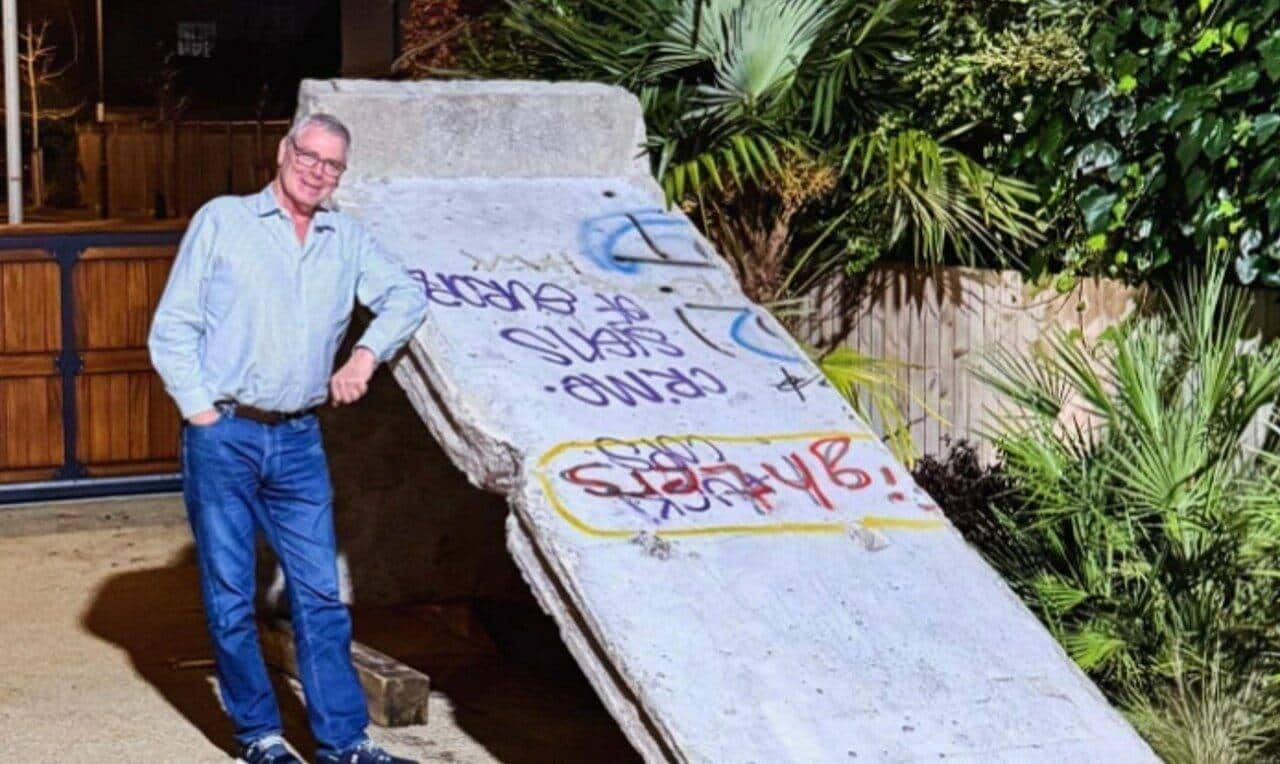
London authorities have notified a 65-year-old British citizen of the need to remove a piece of the historic Berlin Wall that he installed on his property. Steven Thorpe received an official communication last Saturday, classifying the fragment’s presence as “unacceptable”.
The block, which is around 4 meters high and weighs approximately two tonnes, was purchased by Thorpe from a farmer in Germany and placed in his garden earlier this year. However, the piece exceeds the permitted limit of 2 meters for walls and fences, as stipulated by the English capital’s urban planning regulations.
The owner plans to challenge the decision. He argues the council described the item as a “large reinforced concrete structure”, ignoring its value as a “heritage artefact or sculpture”. Thorpe also refutes the measurements indicated in the notification, stating that the piece has 3.1 meters installed, and not 3.6 meters as claimed, and that the real difference in relation to the limit is smaller than that reported. This bureaucratic impasse illustrates the growing tension between the preservation of historic pieces and the rigid application of urban planning regulations in private spaces.
The city council’s letter claims the block causes “harm to the well-being of neighboring property due to its disproportionate scale, oppressive feeling of confinement and austere industrial appearance”.
Thorpe faces a possible fine of up to £20,000, the equivalent of around R$140,000. He insists that the artifact is barely noticeable due to the density of his hedge, but pledges to move it if forced to do so.
Fragments of the Berlin Wall spread globally
For about three decades, the Berlin Wall symbolized the division between the city’s western, democratic areas and the communist-ruled eastern regions, a border established by the Allies after World War II. The structure became one of the most striking icons of the separation imposed by the Cold War, until its fall in 1989.
In the 32 years that followed the demolition, parts of the imposing concrete construction were dispersed across several countries. Fragments of the wall, which at its peak reached 5 meters high and 165 kilometers long, can be found in dozens of nations, including South Africa, Australia, Brazil, Singapore, the United States, Japan, Mexico, Qatar and Russia. According to the digital project The Wall Net, which monitors the location of these pieces, the fragments are highly valued by history enthusiasts and defenders of democracy, with some being donated to museums and others acquired by collectors.





