
Stunning image reveals two rare Magnapinna giant squid more than 4,000 meters in the Atlantic

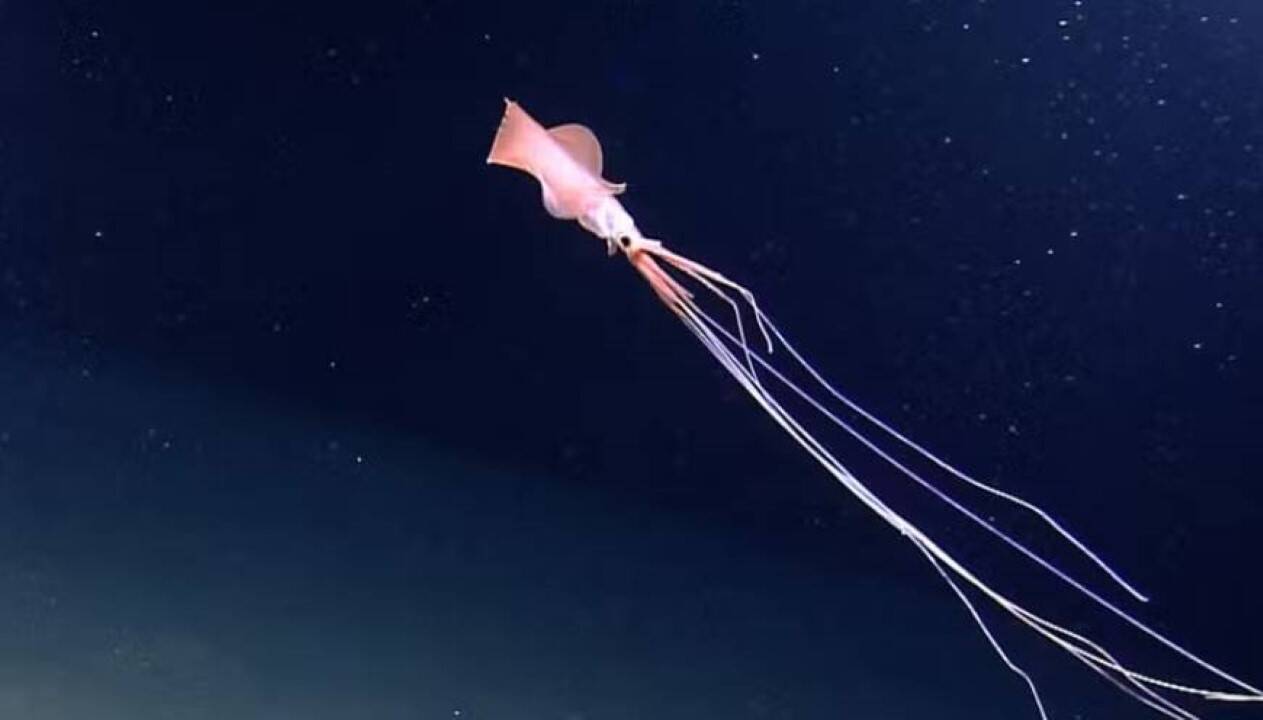
An extraordinary discovery marked a recent scientific expedition in the Atlantic Ocean: the record of two rare giant squids of the genus Magnapinna. The creatures were filmed in high definition at a depth of approximately 4,300 meters, a remarkable feat that offers an unprecedented look at these mysterious animals. The team of researchers from the Schmidt Ocean Institute, in the United States, was responsible for this singular moment.
The meeting took place in the Doldrums Fracture Zone, a vast chain of underwater mountains located north of the Equator. This region is known for its intense geological activity, which results from the meeting of tectonic plates. The depth and extreme conditions of the site make any sighting a rarity, and seeing two specimens together is something even more exceptional for science.
The enigmatic world of the Magnapinna squid
Great-finned giant squids, known scientifically as Magnapinna, are one of the most enigmatic and least understood groups of cephalopods by researchers. They are characterized by their long filaments that extend from the arms, forming a distinct “elbow”, and by their fins that resemble ears, hence the popular name. Their peculiar morphology allows them to adapt perfectly to the high pressure and total darkness environments of the deep oceans.
To date, only a few dozen sightings of these squids have been confirmed globally, which highlights the difficulty of locating them in their natural habitat. Each new record is valuable for understanding their biology, behavior and geographic distribution, adding pieces to a complex puzzle. The presence of two individuals in the same location may indicate behavioral or reproductive patterns that are still unknown.
- Main features of Magnapinna:
- * They have extremely long and thin arms, with filaments that can be up to 15 times the length of their mantle.
* They exhibit an “elbow” posture in their arms, a distinctive feature.
* They inhabit the abyssal and hadal zones of the oceans, at depths that can exceed 6 thousand meters.
* Their method of hunting is still poorly understood, but it is believed that they use their long arms to capture prey in the water column.
* They are rarely seen, which makes them one of the most elusive and studied animals in the deep sea fauna.
The scientific importance of the Doldrums Fracture Zone
The Doldrums Fracture Zone is not just a meeting place for tectonic plates; it represents an underwater ecosystem of great scientific value. The intense geological activity in the region, with faults and seismic movements, can give rise to hydrothermal vents and underwater volcanoes. These extreme environments are often cradles of unique biodiversity, made up of organisms adapted to conditions that would be inhospitable to most forms of life.
These areas are crucial to understanding how life can flourish in sunlight-free scenarios, relying on chemosynthesis rather than photosynthesis. The discovery of the Magnapinna squid in this location reinforces the idea that underwater mountain ranges and fracture zones are true natural laboratories. They are home to species that are still unknown and offer insights into the evolution of life on the planet, which attracts the interest of oceanographers and marine biologists.
Cutting-edge technology to uncover the oceanic abyss
The feat of recording the Magnapinna squid was only possible thanks to advanced underwater exploration technology. The Schmidt Oceanic Institute team’s SuBastian remotely operated underwater vehicle (ROV) played a key role in this mission. Equipped with high-definition cameras, powerful lighting systems and robotic manipulators, these ROVs allow scientists to explore environments that are inaccessible to human divers due to extreme pressure and low temperatures.
Operating an ROV at 4,300 meters depth is a significant technical challenge. It requires precise engineering and navigation skills to maneuver equipment in total darkness and under crushing pressure. These technology platforms not only capture images and data, but can also collect samples and perform experiments in situ, expanding the reach of ocean research.
Implications of dual registration for marine biology
The sighting of two Magnapinna squid together is particularly significant. Previous observations, although rare, generally recorded a single individual. The presence of a pair can offer important clues about the social or reproductive behavior of the species, something that is almost completely unknown. Scientists speculate that it could be a couple, juveniles or a rare coincidence in an area with greater population density, stimulating new hypotheses for study.
These visual records are essential for documenting the morphology, movements and interaction of these creatures with their environment. Every image and second of video contributes to a global database that helps monitor the health of deep-sea ecosystems and identify threats. The continued exploration of remote areas of the ocean is a reminder of how little we still know about marine life and the importance of protecting it.





