
450-million-year-old fossil with preserved soft tissue reveals secrets of marine animal


Long before the first dinosaurs roamed the Earth and plants or animals colonized the Earth’s surface, starfish-like creatures known as crinoids were thriving in the oceans. These organisms, which resemble marine flowers and are attached by a stalk, were among the first to develop in the oldest coral reefs on the planet, more than 450 million years ago.
The study of fossils of these beings has provided scientists with valuable insights into their evolution and the origin of complex life. However, the common process of fossilization generally preserves only the toughest parts of animals, such as shells or bony plates, leaving soft tissue and much of their biology a mystery.
Now, an incredibly unusual discovery by paleontologists at the University of Oklahoma offers an unprecedented glimpse into some of the oldest animals to populate the oceans.
The preservation of soft tissue in fossil records is an extremely rare event. After the death of an animal, structures such as skin, eyes or internal organs are the first to decompose, leaving only the mineralized components that, with luck, will resist geological time.
Dr. Lena Cole, a paleontologist and assistant curator of invertebrate paleontology at the University of Oklahoma’s Sam Noble Museum of Natural History, explained that most fossils are made up exclusively of hard parts. She highlighted that soft tissue is only preserved in environmental conditions that act like a “natural refrigerator” or a “vacuum sealer”, circumstances that are incredibly difficult to occur.
This exceptional process, which requires rapid burial and very specific geochemical conditions to inhibit bacterial activity, was what made it possible for the tube feet of a specimen of *Dendrocrinus simcoensis* to survive to this day.
The discovery, detailed by Cole and colleagues in a study, positions this specimen as one of only two known cases of soft tissue preservation in fossilized crinoids. Furthermore, it is the oldest example found to date. Cole stated that “a preservation like this is literally one in a million.”
There are millions of crinoid fossils catalogued, but this is only the second time soft tissue has been found. This statistic underscores the fortuitous nature of the discovery, as the conditions needed to halt the decomposition process for hundreds of millions of years were ideal, requiring an almost miraculous convergence of environmental factors.
The age of the preserved material is another factor that increases the importance of the study. Dr. David Wright, co-author of the study and also a paleontologist and assistant curator of invertebrate paleontology at the same museum, commented that “it is incredible that these soft tissues have survived for more than 450 million years.”
To illustrate the antiquity, Wright added that “these soft tissues are more than 200 million years older than the oldest dinosaur.” This geological longevity turns the specimen into a true time capsule, providing direct information about the functional anatomy of organisms that thrived in the Paleozoic seas, long before the emergence of terrestrial vertebrates.
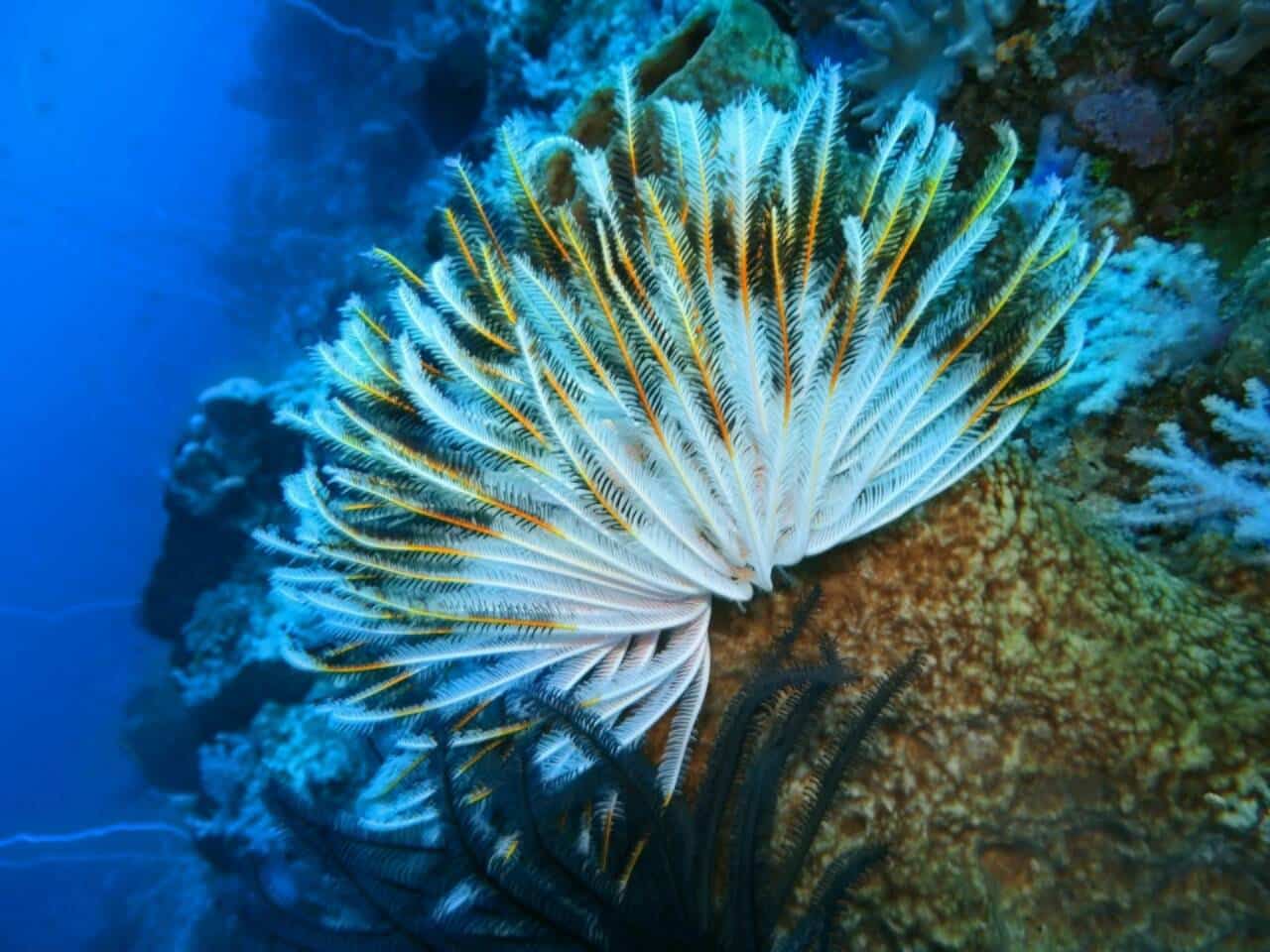
The tube feet, structures preserved in this fossil, are crucial elements for the life of crinoids. These small extensions, organized along the animal’s arms, are responsible for feeding, interacting with ocean currents and occupying specific ecological niches.
Variation in the size, spacing, and structure of tube feet is not random; it reflects the particular adaptations of each species to its habitat and feeding strategy. Wright explained that, “because crinoid tube feet are used for feeding, they can be understood in a similar way to the way we think about mammalian teeth.” This functional analogy allows paleontologists to infer ecological aspects of extinct species that do not have a direct modern equivalent.
A detailed analysis of these structures in *Dendrocrinus simcoensis* revealed anatomical patterns that diverge significantly from those observed in modern crinoids. Cole highlighted that “comparisons with living crinoids show that the anatomy of this ancestral species was very different.”
This discovery offers a new perspective on the evolution of the group and how their feeding strategies have changed over hundreds of millions of years. The species has adapted to changes in marine ecosystems and mass extinctions that have shaped the history of life on Earth.
In addition to the specimen’s intrinsic value, the discovery provides crucial clues about the ecology of the Early Paleozoic oceans, a period when crinoids were fundamental components of reefs. Wright noted that “the fossilized remains of long-extinct species can exhibit characteristics that are far beyond the variation we observe in living species.”
This morphological disparity emphasizes the importance of fossils for understanding evolutionary history in its entirety, and not just the final segment represented by current fauna. “By comparing the ecological lifestyles of extinct and modern species, we can understand how patterns of adaptive evolution have changed over time and what factors have shaped the modern biosphere,” the researcher concluded.
Given the rarity of soft tissue preservation in primitive echinoderms, each new discovery significantly expands knowledge about ancestral ecosystems, evolutionary pathways, and trophic relationships.
A notable aspect of this research is that the discovery did not happen during a field excavation, but rather inside a museum. Contrary to the common image of the paleontologist working under the sun, many of the most important advances emerge in repositories, where already assembled collections await reevaluation with new techniques and questions.
Wright said new fossil discoveries ultimately come from fieldwork, but museum collections play a vital role in this type of integrative research. He explained that “we don’t always know the full significance of the specimens we collect,” and that new technologies, ideas, or expertise often find surprising ways to use existing specimens to make new discoveries.
The fossil of *Dendrocrinus simcoensis* with soft tissue remained for years at the Musée de paléontologie et de l’évolution in Montreal, a small institution that is maintained entirely by community donations. However, its true scientific importance was revealed when crinoid experts Dr. Cole and Wright examined it up close during a research visit.
Cole highlighted that “this discovery highlights the importance of museum collections and the community support that keeps them alive.” She added that, “without the dedication of the many people who care for these collections, this research would never have been possible,” exemplifying how collaboration between institutions and the long-term preservation of materials are crucial to scientific advancement.
The invertebrate paleontology collections that Drs. Cole and Wright oversee at the Oklahoma Museum of Natural History are home to more than a million specimens, with new fossils added each year. Given this volume of material, it is understandable that many other species and discoveries are yet to come, stored in museum drawers and showcases.
“That’s why we work to make our collections accessible to researchers around the world,” concluded Wright. He concluded by emphasizing that “there are too many fossils to be studied in a single person’s entire career. There are more discoveries to be made than can be covered in a lifetime.”





