
Space agency details unprecedented composition of celestial body 3I/Atlas and changes view of science

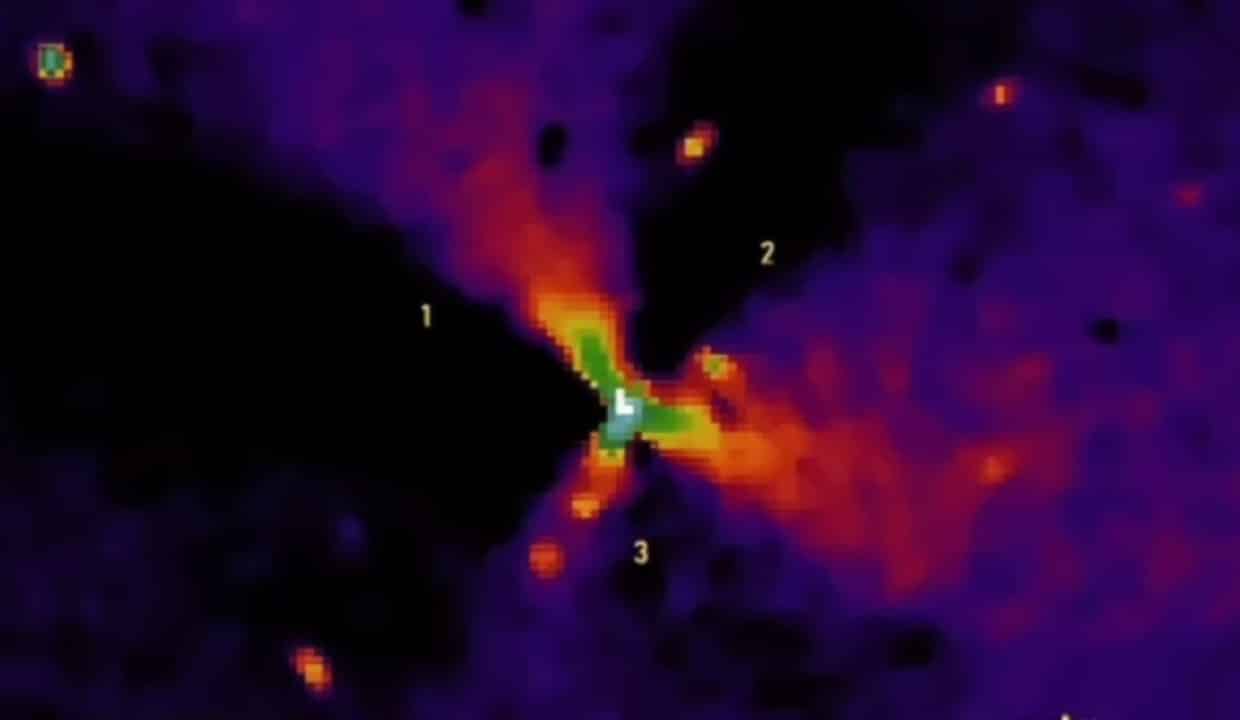
Researchers from the North American space agency have gathered, by this year 2026, an unprecedented database regarding the celestial body 3I/Atlas, a traveler from outside our neighborhood that continues to challenge astronomers around the world. The detailed monitoring, carried out by a complex system of equipment on the ground and in orbit, exposed fundamental details about the chemical structure and the path taken by the rock, delivering fresh answers about how worlds far beyond our Sun are born. The complete scan of this element, which has crossed trillions of kilometers since its birth around an unknown star, forces science to rethink the rules of galactic movement and how matter spreads throughout the cosmos. This wandering body delivers a rare chance to analyze pristine dust and ice from an alien landscape, completely free from the thermal and radioactive interference that affects meteors in our own neighborhood.
First records of the third wandering body identified by science
Officially classified as the third element from outside our system to cross Earth’s orbit, 3I/Atlas had its presence noted a few years ago, but its true identity was only revealed thanks to the technological leap in the most recent equipment. The “3I” label places the visitor in an extremely select group of astronomy, joining the famous Oumuamua and 2I/Borisov, each of which provided valuable clues about distant star systems. The success in calculating its route with mathematical precision, which definitively attested to its birth in another galactic neighborhood, represented a gigantic triumph for modern observatories, proving that our ability to monitor the deep sky has reached an unprecedented level of excellence.
Unlike celestial bodies that are born in the Oort Cloud or the Kuiper Belt, 3I/Atlas does not suffer the gravitational attraction of our main star. The breakneck pace of his movement — which easily exceeds the 100,000 kilometers per hour mark — and his hyperbolic curve prove that he is a nomad ejected from another corner of the Milky Way, making his visit an astronomical event of epic proportions. Analyzing the thermal and magnetic shock it suffered when approaching our Sun, no matter how short the exposure time, provides researchers with essential metrics on the resistance of these travelers when crossing high radiation zones during their crossings through the void of space.
Chemical investigation tries to pinpoint the exact birthplace of the rock
The address from which 3I/Atlas departed remains a complex puzzle, although supercomputer simulations and spectrum readings suggest a nursery located hundreds of light years from Earth. Experts analyze the chemical fingerprint left by the object’s trail of gas and dust to try to link these elements to known profiles of young stars and planet-forming disks. This close scrutiny helps shape the climate and physics of the original environment that expelled the rock, opening a door to understanding the infinite ways planets take shape in the different arms of our galaxy.
The main hypothesis defended by scholars points out that the traveler was thrown from his home after an event of extreme gravitational violence, possibly a “collision” with a supermassive planet or a binary star. This type of expulsion is considered normal in systems that are still organizing themselves, where the magnetic tug of war between larger bodies ends up kicking smaller debris into the interstellar darkness. The fact that we managed to capture such an event reinforces the importance that each new visitor has for science, functioning as physical proof of dynamics that shape the structure of countless neighborhoods throughout the universe.
Deciphering the starting point of 3I/Atlas gains urgency because it works like an armored safe, storing the exact chemical recipe of the place where it was forged. It is a true time machine coming from coordinates that our current probes would take millions of years to reach. The information extracted from this passage allows astronomers to confirm, indirectly, that there are gas giants in other corners of the cosmos with enough force to throw mountains of ice into space, proving that the dance of exoplanets is much more chaotic than previously imagined.
State-of-the-art equipment guarantees the success of space monitoring
The field of studies on the object was dominated by NASA, which deployed an arsenal of lenses capable of seeing in multiple frequencies of light. The Hubble and James Webb super telescopes (JWST) took the lead in the mission, delivering extremely high-definition photographs and breaking the comet’s light to reveal the secrets of its nucleus and its gas corona. The power of the infrared-focused NIRSpec instrument aboard the James Webb was able to cut through the dense cloud of debris to identify minerals that would have been missed by any other human equipment, dramatically increasing our understanding of the visitor’s innards.
To close the siege, bases installed on the Earth’s surface, such as the Very Large Telescope (VLT) in the Chilean desert and the Keck Observatory at the top of Hawaii, joined forces to the project, monitoring the melting of the object’s tail minute by minute. The crossing of information generated by telescopes in space and on Earth guaranteed an impeccable route calculation and a 3D reading of how 3I/Atlas reacted to the scorching heat of our star. This networking model is the only viable way to extract the maximum amount of science from such a quick and unique passage.
The United States’ deep space antenna network was also strained to the max, supporting a heavy flow of data between satellites in orbit and laboratories on the ground. This ultrafast communications bridge gave teams the chance to crunch the numbers almost live, allowing mirrors to be repositioned in time to record the rock’s most intense gas explosions. The fine tuning between different governments and universities has proven that the global community can act in unison when the objective is to unravel the great enigmas of the cosmos.
The use of neural networks and artificial intelligence to scan the terabytes of captured images has shortened research time from years to a few months. This trained software was vital for fishing out tiny variations in brightness and chemical signature that human eyes would never notice in traditional spreadsheets. The mass adoption of these digital tools has turned the page on modern astrophysics, ensuring that researchers are able to squeeze useful data from each photon recorded by the lens, bringing to light truths that would otherwise remain hidden.
Chemical mixture reveals ingredients different from those found in our neighborhood
The light radiography of 3I/Atlas revealed a very exotic chemical cocktail, mixing molecules based on carbon, solid water, carbon dioxide and silicate dust. What caught our attention was the dosage of these ingredients, which completely deviates from the pattern seen in meteors that orbit our own Sun. This anomaly in the recipe indicates that the traveler’s birthplace operated under unique pressure and temperature rules, possibly with a different supply of heavy metals or a much more extreme climate, which ended up dictating the formation of its nucleus.
One of the most impactful findings of the mission was the identification of an anomalous ice structure, practically non-existent in the frozen rocks of our cosmic neighborhood. This detail suggests that the celestial body was born in the darkest and coldest confines of its home system, or that it suffered a radiation bombardment very different from that which occurs in our Oort Cloud. The record of more complex carbon molecules than usual also heats up the discussion about the ability of other stars to manufacture the basic building blocks of biology, indicating that the chemistry necessary for life may be spread throughout the Milky Way.
Escape route and the traveler’s next steps towards darkness
The route followed by 3I/Atlas was drawn with almost zero margin for error, attesting to its acceleration curve and its imminent departure from the domains of our Sun. The point of greatest heat and proximity to our star is in the past, and the rock is now accelerating back into the interstellar void, losing brightness every day. Even though the spectacle was not visible without equipment, enthusiasts armed with powerful lenses managed to record the bright trail of dust during the peak approach. The exact mathematics of its path lets science know where it will be thousands of years from now, leaving the target ready for when we invent even more revolutionary telescopes.
Direct impact on theories about the formation of new worlds
The unraveling of the 3I/Atlas data is rewriting the books on how cosmic dust clumps together to form planets. By placing a piece of rock forged in another star under the microscope, experts are able to compare the local chemistry with that of an alien nursery. This crossing of information takes theories off paper and delivers physical proof of how solar systems are born, something that until yesterday was a pure exercise of imagination. Mapping the variety of these outsiders is the first step toward drawing a definitive atlas of our galaxy and understanding where life is most likely to thrive.
Scientific heritage left by passages of extrasolar rocks
The passage of 3I/Atlas, added to the previous flybys of Oumuamua and Borisov, builds an invaluable legacy for researchers. Each of these space nomads, carrying their own chemical oddities, helps to thicken an archive of alien samples that come to us for free, saving billions of dollars in collection missions. They prove once and for all that deep space is far from being an empty desert, functioning more like a busy highway where pieces of destroyed worlds travel without stopping, carrying the memory of their dead stars.
The relentless hunt for these celestial bodies serves as fuel for engineers and physicists to create increasingly sensitive sensors. The idea of launching a ship to pair up with an interstellar comet and steal a piece of its ice is no longer a movie script and is now an official goal on the drawing boards of space agencies. An expedition of this caliber would deliver the final verdict on what other solar systems are made of and, who knows, could carry the proof





