
Alien comet 3I/ATLAS awakens near the Sun and launches jets of water

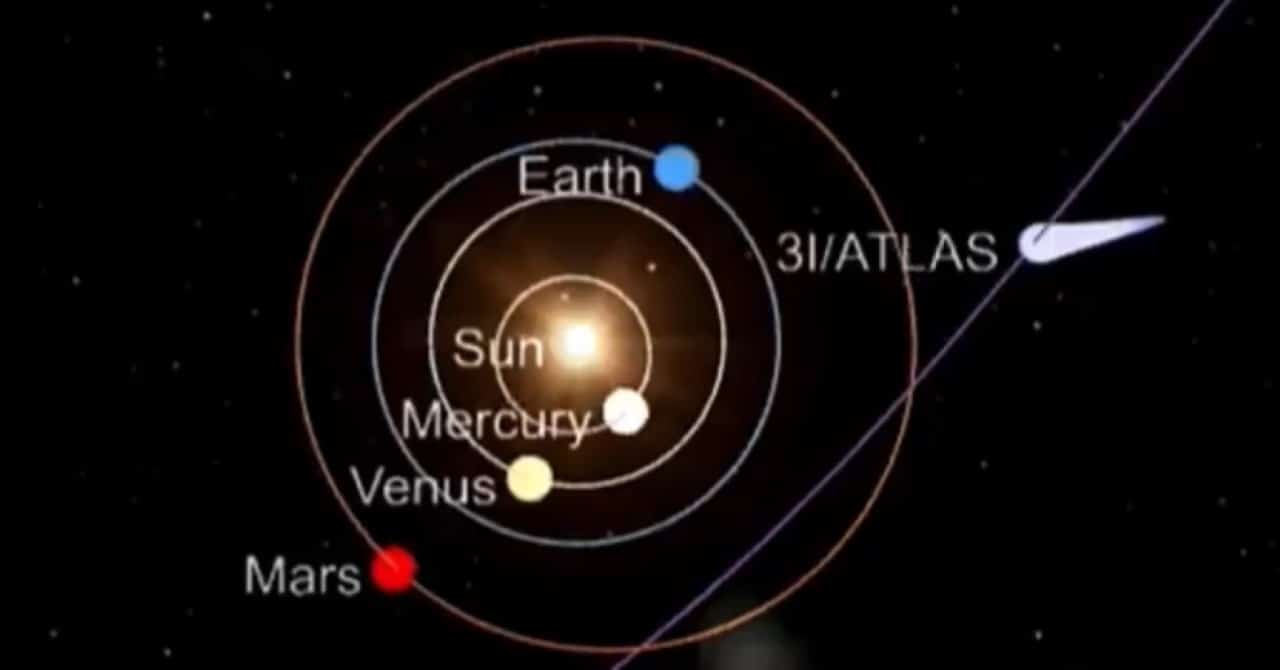
Identified as the third visitor from outside our cosmic neighborhood, the astronomical body 3I/ATLAS has recently undergone a stunning metamorphosis in its composition. Thanks to constant monitoring carried out by NASA’s SPHEREx space telescope, scientists noticed that the piece of rock went from being a frozen, lifeless block to becoming an intense source of dust and volatile elements. This radical change happened precisely when the traveler reached its closest point to our Sun, at which point the extreme heat melted the deepest layers of its core.
The awakening of this alien core created a dense fog of gases around the structure, which paved the way for telescopes on Earth and in space to make a complete chemical scan. The sudden thermal shock melted ancient ice that had traveled intact through the darkness of the universe, launching a mixture of organic and mineral compounds directly into the void of space. For researchers, capturing this exact moment acts as an open-air laboratory, offering valuable clues about how matter is organized in unexplored corners of the Milky Way.
To be able to read this information clearly, astronomers used high-technology sensors focused on the visible and infrared light bands, capturing the heat emitted accurately. Being able to document the transformation of a solid substance into a gaseous substance in a scenario of almost zero gravity and freezing temperatures is considered a great achievement for modern science. Furthermore, tracking this path provided a gigantic database of how rocks that roam free across the galaxy behave, without being tied to the orbit of any star.
Steam jets shoot after closest approach to the star
Recent surveys on visitor behavior have shown an absurd jump in the amount of liquids ejected into the cosmos. When scientists crossed current information with measurements made in August last year, they discovered that water vapor emission increased twenty-fold. This frightening growth highlights the exact moment in which the comet’s ice reserves could not withstand solar radiation and evaporated almost instantly.
All this thermal stress completely changed the appearance and dynamics of 3I/ATLAS in front of the telescope lenses. What once seemed like just an opaque and dull asteroid has gained a shiny crown of debris, taking on the classic visual identity of large comets. This aggressive expulsion of material ended up functioning as small thrusters, creating physical forces that slightly deviated the celestial body’s original route through the universe.
The sublimation process happens when an ice stone turns into gas without going through the liquid phase, something very common in a vacuum due to the absence of atmospheric pressure and sudden heat. In the 3I/ATLAS scenario, heat managed to penetrate through cracks in the parched surface, reaching internal pockets that burst under high pressure. It is exactly this cosmic pressure cooker that justifies the explosions recorded by satellites during the so-called perihelion, the hottest point of the trip.
When studying the cloud of debris generated by these explosions, the team noticed that the material was not spread equally in all directions. Fissures located in the part of the comet facing directly towards the Sun acted as escape valves, launching directed jets. This natural propulsion acts like an uncontrolled engine, which turns the work of calculating the object’s future trajectory into a true mathematical nightmare for astronomers.
Ingredients of life are detected in visitor’s dust
The interstellar object’s peak brightness created the perfect setting for applying refined light-reading techniques. The 3I/ATLAS chemical x-ray yielded a surprising list of ingredients, including essential building blocks for the emergence of life, which strengthens the theory of panspermia, where biological ingredients hitchhike across the universe. Being able to see such complex molecules in a tiny and extremely fast target is a giant step towards understanding what the worlds beyond our system are made of.
During the analysis, sensors detected the existence of methanol, formaldehyde and cyanogen floating in the rock’s temporary atmosphere. Finding these substances is definitive proof that complex chemical reactions are taking place in the comet’s guts or shell. As if that weren’t enough, the detection of gases such as ethane and methane consolidates the idea that this traveler’s heart is a veritable salad of exotic ice mixed with pure carbon.
The fact that this outsider carries practically the same chemical recipe as the comets that were born in our solar backyard changes the way science sees the creation of the universe. Finding water and carbon in a piece of rock forged light-years away indicates that the planet factory uses the same instruction manual everywhere in our galaxy.
To discover all this, scientists use spectroscopy, a tool that works like a barcode reader, where each chemical element flashes a different color when illuminated. The absurd quality of the recent images allowed the team to separate what was just the reflection of the dust from what was actually the light emitted by the gases. Having this level of sharpness is crucial so that astronomers do not announce false discoveries when trying to read the secrets of such dark objects.
Extreme speed prevents capture by our system’s gravity
Since the telescopes’ automatic alarms first went off, 3I/ATLAS tracking has proven that it follows a hyperbola-shaped path, meaning the Sun doesn’t have enough gravitational pull to hold it back. Tearing through the void at an impressive 57 kilometers per second, there is no doubt that it came from another star system. This orbital mathematics decrees that the visit is a unique event in human history, with no chance of the celestial body turning around and coming back.
Unlike traditional comets like Halley, which are trapped in an eternal cycle of coming and going around the Sun, this space tourist has plenty of energy to escape our gravitational bubble. The breakneck pace of the journey ensures that he will soon plunge back into the darkness between the stars, quickly closing the curtain on this astronomical spectacle. The entire volume of information sucked up by computers in these few months of visit will require decades of study to be completely understood.
Flying at 57 kilometers per second not only serves as an interstellar passport, but also turns observation into a race against the clock. As hyperbolic rocks do not give a second chance, space agencies needed to connect their equipment into an uninterrupted global surveillance network. This rotation between the largest telescopes on Earth ensured that no sighs of gas or sudden brightness were missed during the close pass over our neighborhood.
How the new celestial body compares to the old visitors
Studying 3I/ATLAS brings enormous weight to science when we place its data side by side with the pioneers ‘Oumuamua and 2I/Borisov. While the first visitor looked like a dry cigar with no tail, and the second one behaved exactly like an ordinary comet from day one, the new object falls somewhere in between. It took a while to wake up, but when it finally felt the heat of our star, it exploded into activity in spectacular fashion.
The amount of water and carbon monoxide measured by instruments earlier this year gives even more strength to the idea that the bricks that build worlds are the same everywhere. Knowing that three completely different rocks, thrown from opposite corners of the deep universe, have the same chemical basis as our local asteroids is proof that the galaxy follows a standard recipe.
The science of classifying these outsiders is still in its infancy, as we depend on how lucky they are to pass close to Earth. Putting 3I/ATLAS on this select list gives mathematicians a much more solid database to try to guess how much space debris is floating around out there. Current models suggest that the icy zones of other stars, similar to our Oort Cloud, spit billions of chunks of ice into space during the birth of their planets.
The lenses remain pointed at the comet as it accelerates toward the exit of our solar system. As the distance to the Sun increases, the temperature in the rock’s shell rapidly plummets, closing the fissures and turning the object into a mute block of ice once again. The lone traveler will resume his silent march through the absolute dark, until, millions of years from now, he ends up crossing the path of another bright star in the immensity of the Milky Way.



