
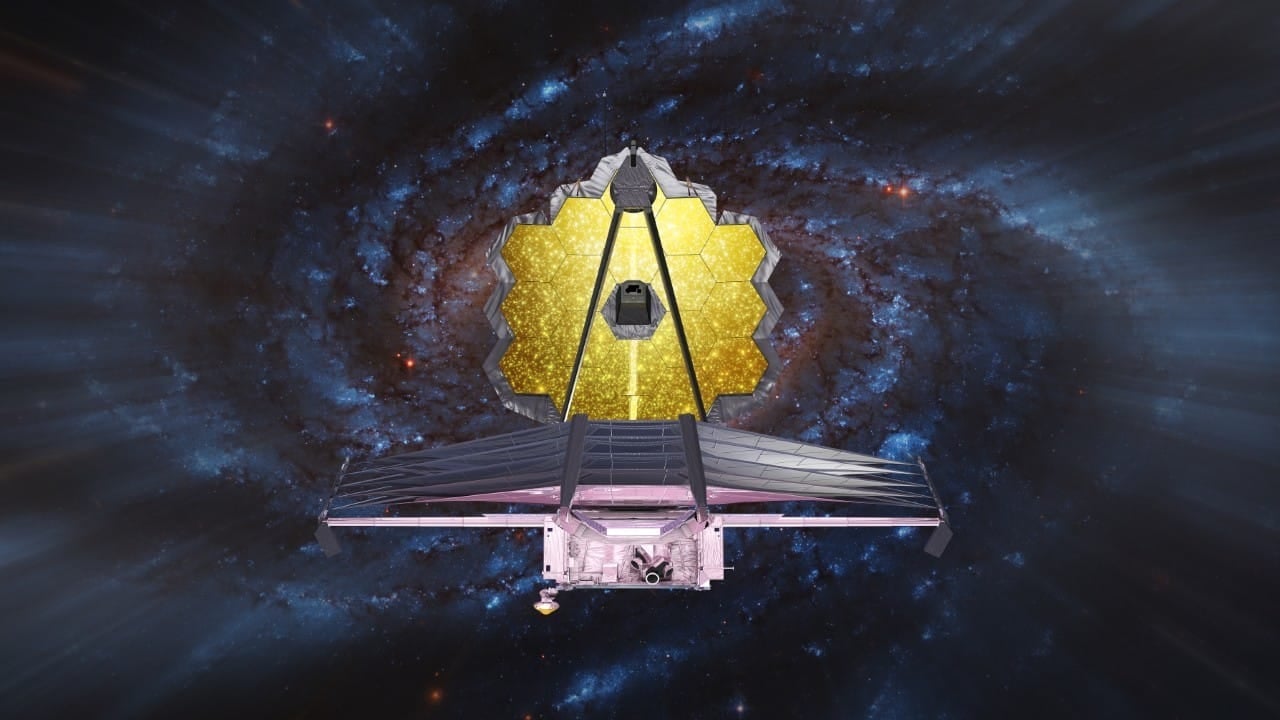
The James Webb Space Telescope (JWST) made a discovery that challenges established cosmological models, by capturing a group of at least five galaxies in the process of colliding. This extraordinary event occurred approximately 800 million years after the Big Bang, a period considered surprisingly early for such complexity. The observation revealed the ejection of heavy elements into intergalactic space at a much earlier stage than predicted, indicating that the young universe was more chaotic and chemically mature than previously imagined.
JWST’s infrared capability has allowed astronomers to penetrate cosmic dust and observe these distant phenomena with unprecedented clarity. The detection of these collisions and the subsequent dispersal of elements such as oxygen, carbon and iron at such an early stage of universal formation provides crucial evidence that the processes of chemical enrichment and star formation were occurring more vigorously and accelerated than current theoretical models suggest. This new perspective requires a reassessment of theories about the evolution of the first galaxies and the distribution of matter in the cosmos.
Cosmic collisions and galactic formation
The identification of multiple galaxies in the process of merging so early in the history of the universe is a significant milestone for astrophysics. Traditionally, early galaxies were believed to be smaller and more isolated, growing gradually through the accretion of gas and dust, with major mergers becoming more common at later times. However, James Webb’s data indicates much more intense dynamics, with gravitational interactions already shaping the structure of the early cosmos.
These collisions are not mere random encounters; they are catalysts for the formation of new stars and the spread of chemical elements. When galaxies collide, the clouds of gas and dust inside them are compressed, triggering bursts of star formation. Furthermore, the resulting gravitational forces can eject material, including heavy elements forged inside massive stars that explode as supernovae, into the intergalactic medium.
More on this story: James Webb’s discoveries point to a primordial universe that is more intricate than expected
The spread of heavy elements
The presence and distribution of heavy elements, or “metals” in astronomical terminology (any element heavier than hydrogen and helium), are fundamental to understanding cosmic evolution. These elements are the building blocks of planets, asteroids and, eventually, life. Standard theory suggests that the universe began with hydrogen and helium, and the heavier elements were gradually synthesized inside stars and dispersed by supernovae over billions of years.
The discovery of heavy elements being “hurled” out of these colliding galaxies, just 800 million years after the Big Bang, significantly advances the timing of this spread. This implies that the first generations of massive stars responsible for producing these elements formed, lived and exploded into supernovae much more quickly than predicted, and that galactic interactions played a crucial role in their initial distribution.
Implications for cosmological models
Current cosmological models, based on previous observations and computer simulations, describe a relatively homogeneous early universe with galaxies in the most rudimentary stages of formation. James Webb’s revelation of such an active and chemically enriched galactic environment at such an early stage requires substantial adjustments to these theories. The “mess” and “maturity” observed suggest that the mechanisms of galaxy formation and evolution are more efficient and complex than previously assumed.
This could lead to new understandings about the density of dark matter, the formation of the first large-scale structures, and the rate of star formation in the early universe. Scientists now need to investigate how this intense activity may have influenced the reionization of the universe, the period when neutral hydrogen was ionized by radiation from the first stars and galaxies, making the universe transparent to light.
James Webb’s power of observation
The James Webb Space Telescope is a revolutionary tool for astronomy, specifically designed to observe the universe at infrared wavelengths, allowing it to see very distant and therefore very old objects. Light from such distant galaxies is stretched by the expanding universe, turning infrared by the time it reaches JWST.
Its unprecedented sensitivity and resolution allow astronomers to capture fine details of events that occurred billions of years ago. This ability is crucial to unlocking the mysteries of the early universe, including the formation of the first stars, galaxies and the origin of essential chemical elements. With each new image and spectrum, the JWST continues to rewrite our understanding of cosmic history.
Learn more: Black hole star, unprecedented object, is detected at the beginning of the universe by JWST
Challenges and future research
Despite the excitement about this discovery, many challenges remain. Scientists now need to refine their simulations and theoretical models to incorporate this new reality of a more dynamic young universe. New observations will be essential to confirm the ubiquity of these heavy element collision and ejection events.
Detailed analysis of the light spectra of these galaxies will allow researchers to more accurately determine their chemical composition and star formation rates. Understanding the mechanics behind these collisions and how they drove the spread of heavy elements is a crucial step in piecing together the puzzle of the universe’s evolution. Research will continue to delve deeper into understanding how the universe went from a primordial soup of hydrogen and helium to the rich and diverse cosmos we observe today.
The complexity of the early universe
The view of a “messy” and “mature” young universe at such an early stage suggests that the processes that led to the formation of complex structures were more efficient than previously thought. This could have implications for the search for life on other planets, as the presence of heavy elements is a prerequisite for the formation of rocky planets and organic molecules. If these elements were widely distributed earlier, the conditions for the formation of habitable worlds may have emerged earlier than previously thought.
Data collected by James Webb provides a fascinating glimpse into a critical period in cosmic history, revealing that the complexity of the universe began to manifest itself much earlier. The telescope’s ability to probe these distant eras will continue to provide valuable insights, shaping our understanding of the origins of the cosmos and Earth’s place in it. Future observations promise to reveal even more secrets about the universe’s infancy and the mechanisms that led it to its current configuration.