
Euclid Telescope discovers 31 of the oldest quasars ever seen and challenges theories about the beginning of the Universe

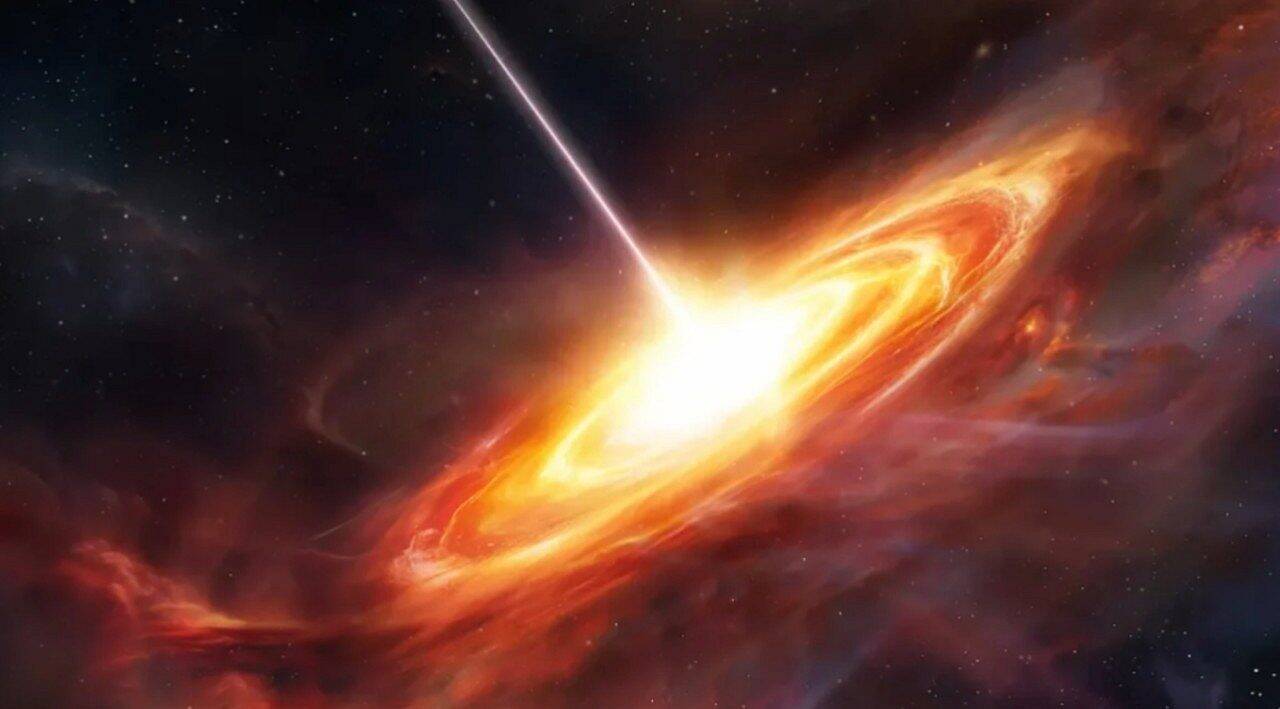
The European Space Agency’s Euclid space telescope made one of the most remarkable discoveries of its recent mission, revealing 31 of the oldest quasars ever recorded, including the two most distant examples ever confirmed. The discovery expands the history of observing these extremely luminous objects and adds a new challenge to an old mystery: how the universe managed to form supermassive black holes so quickly after the Big Bang.
Quasars are among the most luminous objects in the known universe, driven by supermassive black holes that actively feed on surrounding gas and dust. As material spirals toward the black hole, it heats up and radiates enormous amounts of energy, allowing quasars to outshine entire galaxies and remain visible across billions of light-years of cosmic distance, and are crucial for observations of ancient times.
The brightness of the first quasars in the childhood universe
The two most distant quasars identified in this new batch stand out even among the group. Both shone with the luminosity of approximately a trillion suns at a time when the universe was only about 670 million years old, a mere 5% of its current age. Their light has traveled toward Earth for about 13 billion years, meaning the images captured by Euclid show these objects as they existed when the cosmos itself was still in its infancy, according to a report published by NASA Science detailing the mission’s findings.
This period places the newly identified quasars among the first galaxies and black holes to form after the Big Bang, a period astronomers call the cosmic dawn. Finding actively feeding supermassive black holes so early presents a real challenge to existing models of galaxy and black hole formation, which often have difficulty explaining how objects with masses billions of times greater than that of the sun could come together in such a comparatively short cosmic period.
Unprecedented acceleration in the discovery of quasars
What makes this announcement notable, beyond the individual quasars themselves, is the impressive speed with which Euclid has been finding them. Since its launch in 2023, the telescope has effectively doubled the total number of known ancient quasars, objects with redshifts of 7 or greater — a measurement astronomers use to determine how far back in cosmic time an object’s light originated. Before Euclid began its research work, it took more than ten years of combined effort by astronomers to identify approximately the first ten quasars at this redshift threshold.
This acceleration reflects the scale of Euclid’s search capabilities. Instead of targeting individual objects one at a time, the telescope is designed to map huge swaths of the sky, allowing it to capture rare and extremely distant objects, like ancient quasars, in quantities that targeted searches simply can’t match. The 31 quasars identified in this latest batch represent a substantial fraction of all such objects known to science, brought together in a fraction of the time it took to build the previous catalog.
The persistent enigma of supermassive black holes
The existence of supermassive black holes, billions of times the mass of the sun, active and feeding within the first billion years of the universe, remains one of the most persistent open questions in astrophysics. Standard models of black hole growth, built around the gradual accretion of surrounding matter over long periods, have difficulty explaining how these objects reached such enormous masses so quickly after the universe’s earliest moments.
Researchers studying the newly identified quasars are treating each one as a data point that could eventually help resolve this tension, whether by revealing patterns in how the initial black holes grew, pointing to alternative formation mechanisms, or simply expanding the sample size enough to test existing theories more rigorously. A larger catalog of confirmed ancient quasars gives astrophysicists more material to work with than the small number available before the Euclid search began.
Next steps in the Euclid mission and future revelations
Euclid’s main mission is designed to last years, mapping billions of galaxies across a large portion of the sky, primarily to study dark matter and dark energy. The discovery of ancient quasars represents something of a secondary benefit of this broad search approach, as the telescope’s wide field of view is well suited to capturing rare and extremely distant objects that narrower, more focused telescopes would be much less likely to encounter by chance.
Astronomers involved in the project indicated that Euclid’s ongoing survey work should continue to reveal additional ancient quasars as it covers more of the sky. This means that the current tally of 31 objects, including the two oldest ever confirmed, is likely a milestone rather than a final total. Each additional detection adds another element to an increasingly detailed picture of how the universe’s first giant black holes formed.
Building a complete picture of the cosmic dawn
Ancient quasars are not the only tool astronomers use to study the universe’s first galaxies, but they offer a distinct advantage: Their extreme brightness makes them detectable at cosmic distances that would leave an ordinary galaxy too faint to observe with current instruments. This visibility advantage is precisely why quasars have become a prime target for probing the era known as the cosmic dawn, the period when the universe’s first stars, galaxies and black holes began to form from a previously dark and largely featureless expanse of gas.
Combining Euclid’s wide-field quasar survey with more detailed follow-up observations from other telescopes, including instruments capable of measuring a quasar’s mass and feeding rate more precisely, gives researchers multiple independent lines of evidence to work with. This combination is expected to be more relevant in the coming years, as astronomers try to move beyond simply counting ancient quasars to explain, in concrete physical terms, how black holes of such astonishing mass managed to come together so early in the history of the universe.



