

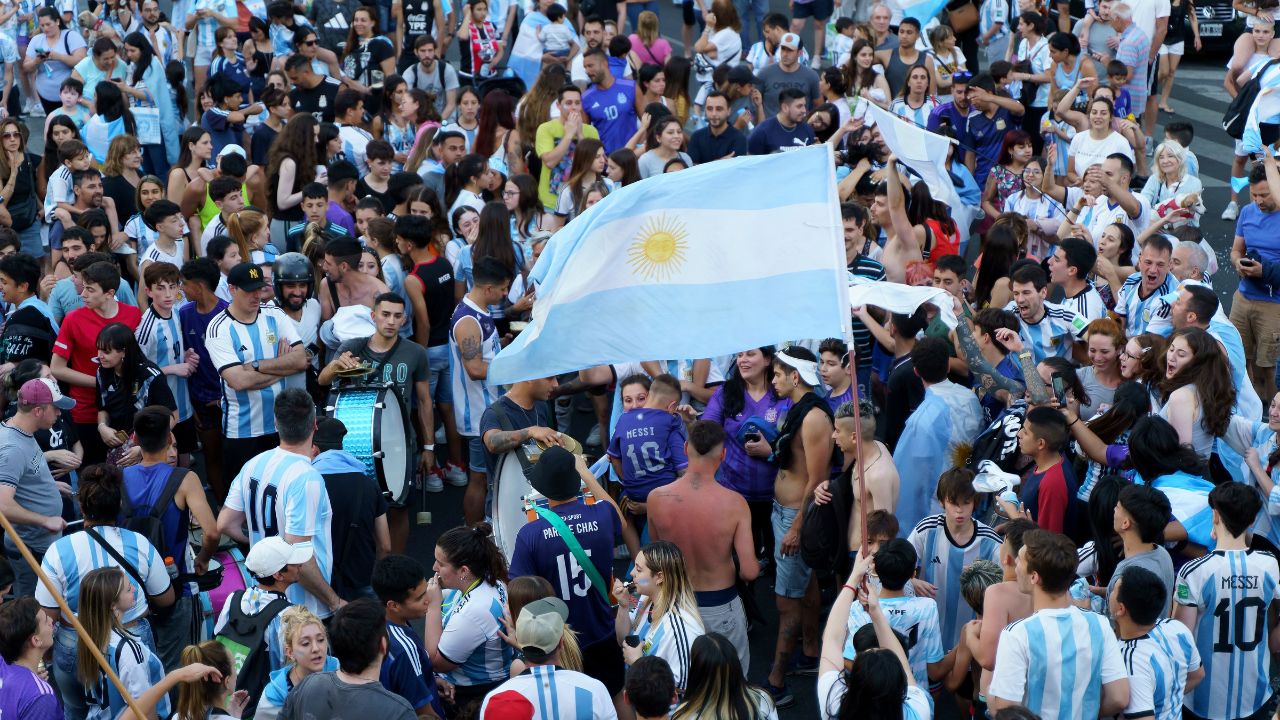
After Argentina qualified for the World Cup semi-final, tension increased with anticipation of the clash against England. Coach Lionel Scaloni didn’t even allow a reporter to finish a question about the historic rivalry, intensified by the Falklands War, demonstrating the importance of the topic for the sporting and cultural scene.
Directly, Scaloni stated that the “message is that it is a football match”, requesting that the context of the war not go beyond sport, in an attempt to depoliticize the imminent clash.
However, on the streets of Atlanta, in the United States, where the match will take place, the reality among Argentine fans is different. The subject of historical rivalry is always present in conversations and emotions, reverberating from the past.
Matías Marin, a 22-year-old born after the conflict, illustrates the passion, explaining that he and his friends extended their trip, originally planned to end in Kansas after the victory over Switzerland, just to watch the game against England. This financial and logistical effort demonstrates the profound significance of the confrontation for Argentine national identity.
The controversy over the Falkland Islands, located approximately 600 kilometers from Patagonia, is older than organized football. Argentina’s failed attempt to regain the islands in 1982, which resulted in the loss of 650 lives, raised tension to a level that transcended the battlefield and manifested itself intensely in sport, fueling national trauma.
The Malvinas issue already permeated the Argentine team’s trajectory in the World Cup, being one of the pillars of the song sung by the fans. The song expresses that the desired four-time championship would be “for the Malvinas, for Diego (Maradona) and for the last one for Leo (Messi)”, highlighting the fusion between sport and historical memory in an inseparable way.
Daniel Dure, a former soldier who left the armed forces three years before the conflict, openly revealed his preference for losing to Brazil compared to England, reinforcing the depth of the wound that the war still represents, even more than four decades later.
Although the Malvinas theme is a point of national unity, its influence in the football sphere divides opinions among fans. Part of the fans agrees with Scaloni’s position, arguing that politics should not interfere in the game.
Alexis Morales, 47, acknowledged the presence of the “historical component”, but stressed that a football game “will not change what happened back there”, nor resolve the claim over the sovereignty of the Falklands, suggesting that the field is not the stage for that resolution.
This mix of emotions is largely attributed to the figure of Diego Maradona, who, before the quarter-finals of the 1986 World Cup, transformed the confrontation into a national reckoning. With the goal known as the “Hand of God” and one of the most beautiful in the history of the World Cup, it provided a collective catharsis that symbolized redemption for many Argentines, marking the subsequent duels with a strong political connotation.
Scaloni’s concern is well-founded, as tempers are quite high. Last Sunday, in Miami, there were reports of fights between members of the large Argentine community and English fans, who were watching the match against Norway.
Leandro Guerrero compares the rivalry with Brazil, which he describes as “just sporting”, to that with the English, whom he refers to by the term “pirates”, emphasizing the origin of the British corsair past and the historical intensity of the conflict that lingers in the collective memory.



