
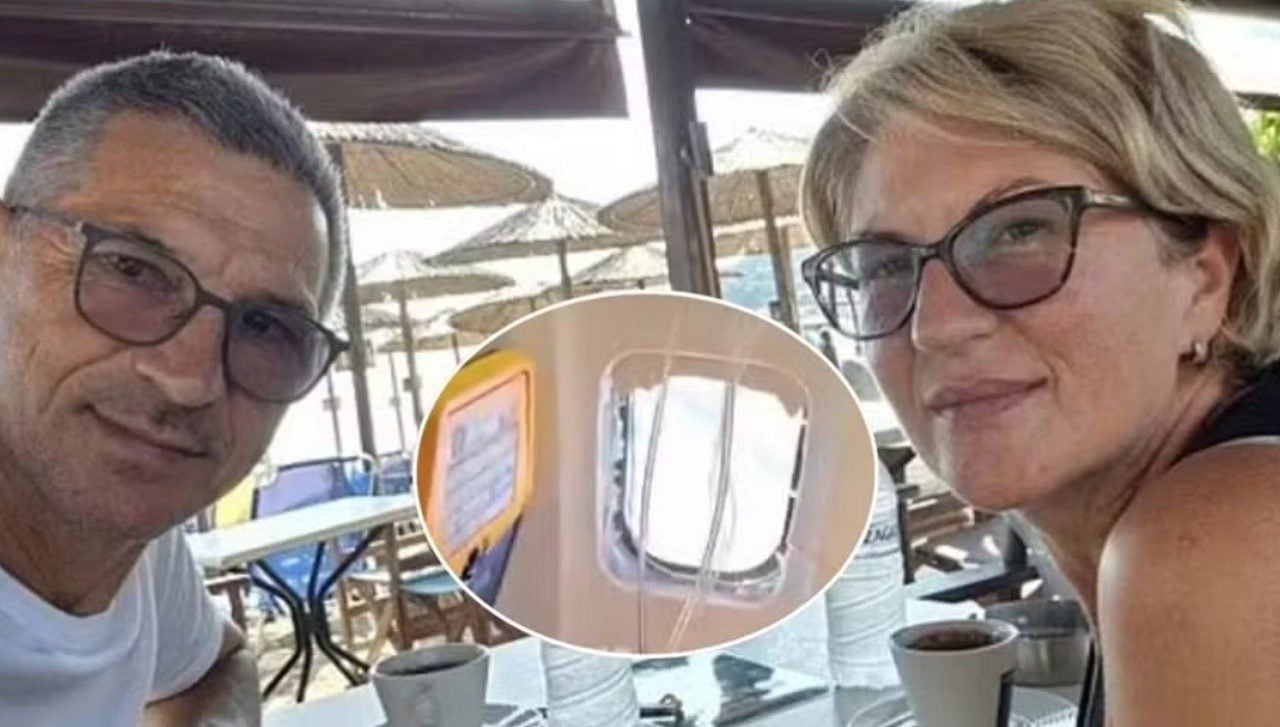
A routine trip turned into a desperate fight for survival last Friday, July 10, 2026, inside a Ryanair aircraft. During the journey, the window next to Ljubiša Karović suddenly shattered, causing the passenger to be pulled out due to the violent depressurization. In an act of bravery, his wife, Svetlana Grković, grabbed her companion’s legs with all her strength, later declaring that, if the worst happened, they would both leave together.
Panic at heights and suspected engine failure
The commercial flight had taken off from the city of Thessaloniki, in Greek territory, and its final destination was Memmingen airport, in Germany. According to reports from the victim’s wife, the terror began when an unidentified object, which the occupants believed to be a fragment detached from the engine, collided violently against the glass of Ljubiša’s seat. The immediate impact destroyed the acrylic structure, sucking the man’s body into the outer fuselage in a matter of seconds.
Faced with the absolute chaos that took over the cabin, the Serbian citizen did not hesitate and acted purely out of instinct for preservation. She locked her arms around her husband’s lower limbs, preventing the aerodynamic force from pulling him definitively from the chair. When recalling the moments when her partner’s life depended solely on her hands, she classified the experience as a scene of indescribable horror.
Joint action by passengers prevented a greater tragedy
The passenger’s survival was only possible because other people on board realized the seriousness of the situation and left their seats to intervene. Several travelers joined forces with Svetlana, creating a human chain to pull the man’s body back into the plane, facing the immense negative pressure generated by the hole in the fuselage. This quick collective response determined the non-lethal outcome of the accident.
Another determining factor in avoiding total ejection was the fact that the victim had his seat belt properly fastened around his waist. Aviation experts constantly recommend that the equipment remains buckled throughout the journey, precisely to protect occupants against severe turbulence or explosive decompressions, like the one that occurred in this specific case.
Physical impacts after exposure to extreme cold
The wife estimates that her husband’s body was exposed to external conditions for about five long minutes before it was fully recovered. Immediately after the rupture, the aircraft’s automatic system released the oxygen masks on the ceiling, ensuring that other travelers did not suffer from hypoxia, as at cruising altitudes the air is extremely rarefied and temperatures can plummet to minus 50 degrees.
After the emergency landing, rescue teams took the man directly to a hospital, where he remains hospitalized in a state of deep shock. The medical team is now assessing the extent of the physical damage caused by the frostbite and the force of the wind to his face and torso, closely monitoring the evolution of his clinical condition.
Flight details and aviation emergency protocols
Although explosive decompression events due to broken windows cause great public concern, statistics show that these structural failures are very rare events in the modern aerospace industry. Regulatory agencies require rigorous maintenance to prevent material wear, and pilots are extensively trained to descend the aircraft to a safe altitude within minutes as soon as the pressure loss alarms go off.
- Company responsible for the operation: Ryanair
- Scheduled route: Thessaloniki (Greece) to Memmingen (Germany)
- Date of occurrence: July 10, 2026
- Direct victims of the incident: Ljubiša Karović and his wife Svetlana Grković
- Estimated duration of external exposure: About five uninterrupted minutes
The long road to the couple’s emotional recovery
Far beyond the physical injuries, the traumatic event will leave severe psychological scars on the family’s routine. The memory of the minutes in which she fought against the force of the winds to not lose her husband will continue to haunt Svetlana, requiring both of them to seek intensive psychiatric care to overcome the post-traumatic stress generated by the near tragedy.
The attitude of the woman, who ignored her own risk of death to anchor her companion inside the destroyed cabin, highlights the strength of the bond between the two. If it weren’t for his mental resilience and physical agility in the first seconds after the glass broke, the outcome of the European trip would have been fatal for the passenger.





