
Railway engineering: 7.3 km, 682 carriage Australian train still holds world record


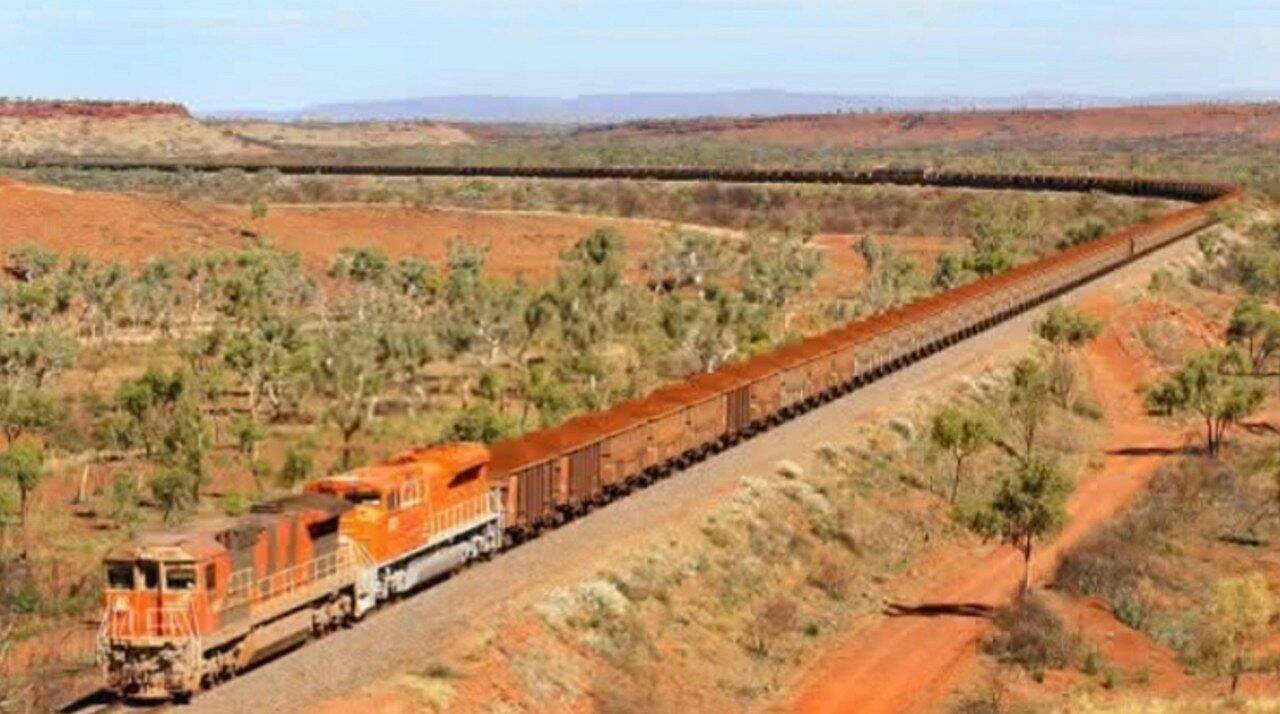
An epoch-making railway engineering operation was carried out in Western Australia in June 2001. On that occasion, mining company BHP introduced a freight train with impressive specifications: 682 wagons, eight locomotives and a total length of 7.3 kilometers.
The gigantic convoy covered a distance of approximately 275 kilometers, connecting the Newman and Yandi mines to the port of Port Hedland, located in the Pilbara region. Weighing around 100,000 tons, this train secured its place in the Guinness World Records as the longest and heaviest ever operated, a feat that remains unmatched even after more than twenty years.
Why the Australian train wasn’t made to break records
Although the data is great, the primary purpose of this journey was not to set a new milestone in the record books. The mining company BHP sought to validate Distributed Power (DP) technology, designed to improve efficiency in the transport of large-volume rail cargo.
This innovative system allows several locomotives to be strategically distributed throughout the train, operating in perfect synchronization, even if they are kilometers away from each other. Remarkably, the record-breaking train’s eight locomotives were supervised and controlled by just one driver.
According to information from the company itself, the implementation of this technology contributed to reducing tension in the couplings, increasing the stability of the composition and reducing fuel consumption.
How a driver managed to operate a 7-kilometer train
Each of the locomotives used in the experiment was the General Electric AC6000CW type, with the capacity to develop more than 6 thousand horsepower. Together, these machines propelled a train equipped with 5,648 wheels during a journey of approximately ten hours.
The coordination of such a monumental structure resided in advanced electronic communication between the cars and an optimized braking system. While traditional trains rely on air circulation through extensive tubes to trigger braking, with a delay of several seconds, on the Australian train the signals were sent simultaneously to the entire formation.
To accommodate the passage of this train, the railway network between Yandi and Port Hedland required modifications. These adaptations included strengthening the tracks, creating gentler curves and building segments capable of withstanding an unprecedented load.
The Australian desert has turned into a huge railway laboratory
The train’s route crossed the Pilbara region, known for being one of the most remote and hottest areas in Australia. At certain times, temperatures exceed 45°C, and the presence of dust storms and vast uninhabited areas added complexity to the operation.
The train transported only iron ore, without any provision for passengers or rest spaces. This experiment was fundamental in solidifying a logistical model that, over the years, would prove vital to Australia’s mining industry.
Today, corporations such as BHP and Rio Tinto use trains that are partially automated or managed by remote systems. These operations employ satellite technologies and artificial intelligence to move millions of tons of ore to ports located in the Indian Ocean.
Why the Australian record has not yet been broken
In recent decades, some nations have sought to emulate Australia’s achievement. In 2025, India inaugurated the Rudrastra train, measuring 4.5 kilometers, with 354 carriages and seven locomotives. Despite being a remarkable composition, its numbers fell considerably short of those achieved by the Australian train.
Other historical examples include a South African train that, in 1991, reached 7.19 kilometers in length and had 660 carriages. However, none of these attempts were able to surpass the mark established by BHP.
Technical engineering studies have indicated that operating trains of excessive length causes an almost unsustainable level of mechanical stress to couplings and track infrastructure. For this reason, the mining company today uses shorter trains, generally less than 3 kilometers long and approximately 270 wagons.
In this way, the train that originally emerged as a test of technology became one of the most impressive feats in railway history, a record that remains untouched to this day.





