
Roman space observatory will search for star-eating black holes at the dawn of the universe

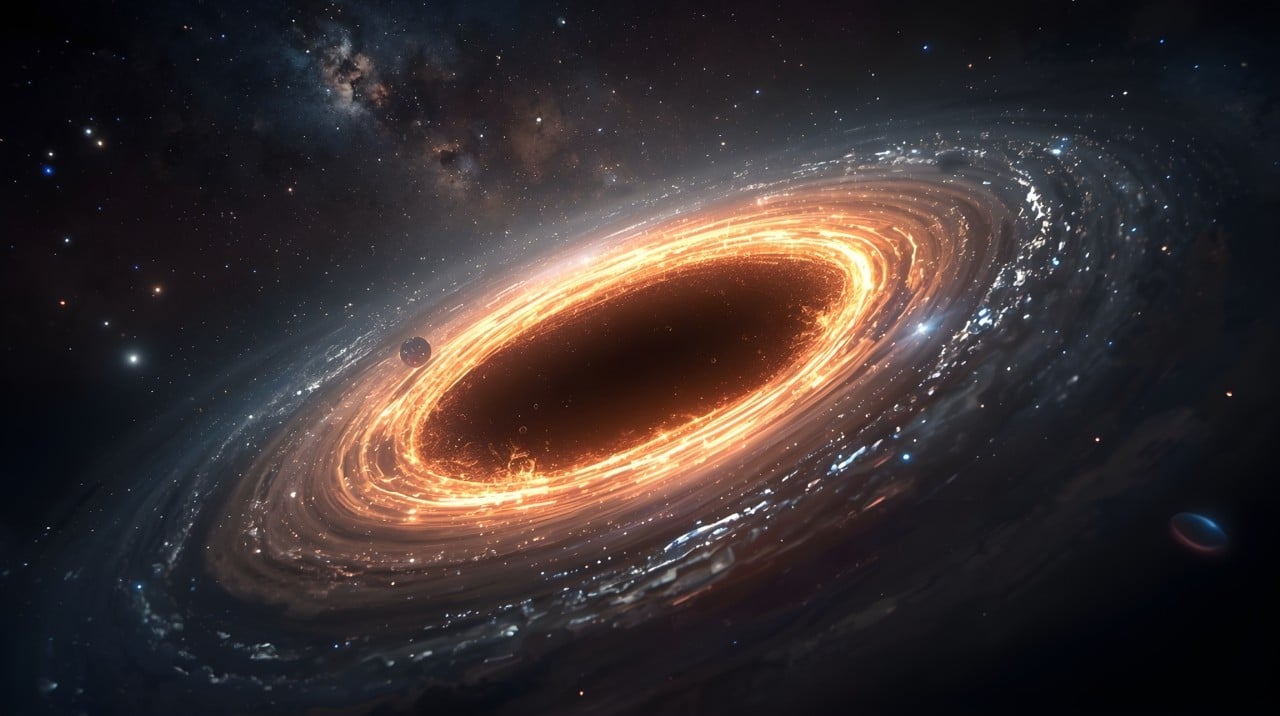
Scientists are working to unravel how black holes located at the centers of galaxies originate and develop. To advance this knowledge, the detection of cosmic giants that existed in the early days of the universe is essential. Recent research indicates that NASA’s Nancy Grace Roman Space Telescope will have the ability to locate these ancient objects, observing them as they were up to 11 billion years ago.
Scheduled to launch on August 30, 2026, the Roman telescope will focus on the light emitted by matter orbiting black holes before being absorbed. However, lower-mass supermassive black holes are more difficult to see due to their lower luminosity. Occasionally, they disintegrate and consume an entire star, producing a glow so intense that it outshines its host galaxy, an event known as a tidal disruption (TDE).
Mitchell Karmen, lead author of the study published in “The Astrophysical Journal”, highlights that the Roman telescope will represent a milestone in the science of transient phenomena. The observatory’s high sensitivity will allow the discovery of multiple tidal disruption events at significantly greater distances and at earlier phases of cosmic history.
How the Roman telescope will detect tidal disruption events
Roman’s “High-Latitude Time-Domain Survey” will cover an area of the sky equivalent to 90 full moons, with observations taken at regular intervals. By revisiting the same celestial regions, astronomers will be able to identify a large number of transient phenomena, such as TDEs. These events are characteristic of lower-mass black holes, ranging from 100,000 to 100 million solar masses, which tear a star apart before devouring it.
Karmen’s team predicts that the frequency of TDEs will increase as the Roman telescope probes the early universe. A peak is estimated around 11 to 12 billion years ago, a period when star formation was most intense. The telescope will perform its observations at near-infrared wavelengths, which is ideal for capturing light from very distant TDEs, whose radiation has been stretched by the continued expansion of the universe.
While the Vera C. Rubin Observatory will detect thousands of TDEs annually in the visible light range, Roman is expected to find up to a hundred, but with the advantage of observing them at much greater distances. This ability will be crucial for differentiating between different hypotheses about the origin and growth of black holes.
Understanding the origins of supermassive black holes
There are two predominant theories for the formation of supermassive black holes. The first, called “light seeds”, proposes that they arise from the extinction of massive stars and increase in size over time. According to this perspective, each young galaxy would already have a black hole at its core.
The second theory, known as “heavy seeds”, suggests that a black hole could be born with a considerably greater initial mass through the direct collapse of a vast cloud of gas. This process would be less common, which would explain the lower occurrence of supermassive black holes in more primitive galaxies.
“Tidal disruption events provide us with a tool to investigate the population of low-mass supermassive black holes, which can help us distinguish between these models,” said Mitchell Karmen.
Suvi Gezari, co-author of the study, adds: “Just as Webb transformed our understanding of distant galaxies, Roman is about to revolutionize our understanding of transient phenomena with high redshift.”



