
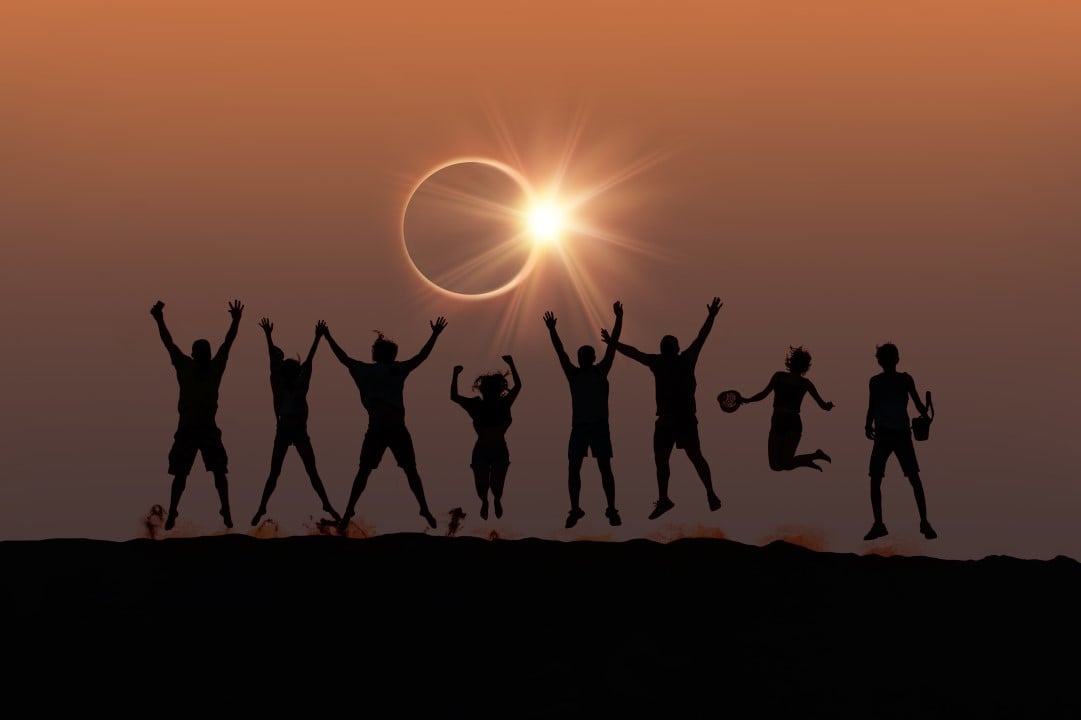
At certain times, atotal solar eclipseseems to cause a sudden interruption that breaks any everyday life. It doesn’t matter if you are on the top of a hill, in a supermarket parking space or on the terrace of your home: suddenly, the dialogues stop. The ambient temperature drops gently, bringing an icy breeze that reminds us of the immensity of the cosmos. This is when the central star of our system, always present in our days, begins to have its silhouette reduced as if a mysterious bite was slowly consuming it.
In broad daylight, the city’s public lighting comes on unexpectedly. The shadow projections take on unusual contours, sharper and with well-defined lines on the ground. Nearby, a child asks in a low tone whether the phenomenon is normal, leaving the adults around without an immediate response. In the sky, a completely dark circle is positioned exactly to the millimeter over the star, transforming the colors of the environment for brief moments.
At the moment when daytime luminosity is replaced by dim light, the scientific community points out that we are witnessing one of the most impactful space spectacles today. However, the most profound impact of this event usually goes far beyond the technical data or the researchers’ explanations.
On the same topic: Where to watch today’s total solar eclipse: follow the live broadcast by NASA
The moment sunlight gives way to darkness
Those who have witnessed the complete hiding of the Sun rarely use scientific concepts to report what they felt. The narratives usually focus on the physical sensation of chills, the tremor in the legs and the emotion of seeing mature people crying silently as they watch the projection of the penumbra quickly advance across the earth’s surface at impressive speed.
Cartographically, the trajectory of the phenomenon can be summarized as a narrow path crossing land masses and seas. For those observing from the ground, the sensation is that the celestial vault has descended upon us, dimming the natural tones of the environment and giving an alien appearance to ordinary scenes. During this short interval, the star appears to be a dark circle surrounded by a bright crown of white light, causing even the most scattered observers to look away from their screens.
An astronomy expert reported that the initial moments of the total lockdown resemble the experience of entering a monumental temple built on nothing but wind and stillness.
On the previous occasion that an alignment of this magnitude crossed areas inhabited by large populations, a huge number of people moved to experience the temporary darkness. Several highways experienced kilometer-long traffic jams in the early hours of the morning, while small towns located along the route of the phenomenon were transformed into festive camps full of photographic equipment and portable observatories. Local hotel establishments that used to face difficulties in tourism guaranteed full occupancy well in advance.
More on this story: Check out the main cities and countries that will see the total solar eclipse on August 12, 2026
The US space agency’s real-time broadcast channels recorded historic audience peaks. At the same time, social media was flooded with amateur recordings capturing the public outcry as the Sun’s outer, ethereal layer revealed itself around the dark circumference. Electricity distribution sectors in multiple municipalities closely monitored abrupt fluctuations in photovoltaic generation caused by the sudden dusk generated by the alignment.

This is an event that goes beyond the interest of groups dedicated to space science. It’s one of those rare opportunities for community integration where people who live side by side but have never spoken to each other share eye protection devices on sidewalks to gaze at the sky.
However, behind all this commotion, there is an incredibly precise and direct physical mechanism. Although Earth’s natural satellite is four hundred times smaller than our star, it is also around four hundred times closer to us, creating an illusion of identical dimensions in the celestial vault. At the moment when straight alignment with our planet occurs, the lunar silhouette covers the solar disk in an absolutely precise way.
Learn more: Rare total solar eclipse phenomenon reaches 15.2 million on July 12
During a very short period of time and restricted to a narrow geographic range, the bright disk is entirely hidden by the passage of the Moon. This phenomenon makes the day take on the characteristics of a moonlit night, allowing the visualization of bright celestial bodies, in addition to causing a noticeable cooling in the atmosphere. The behavior of the local fauna changes as if the evening had been artificially accelerated, proving that what resembles sorcery is pure physics, temporal precision and spatial dynamics in harmony.
According to experts, the difference between the next occurrence on August 12, 2026, which will be the first total solar eclipse visible in continental Europe since 1999, is not limited to its visual beauty. The great relevance lies in the unprecedented possibility of analyzing the solar corona and the star’s electromagnetic storms under ideal conditions, taking advantage of the fact that the star will be in its period of maximum magnetic activity.