
Interstellar comet 3I/ATLAS displays unusual levels of methanol and brings clues to other solar systems


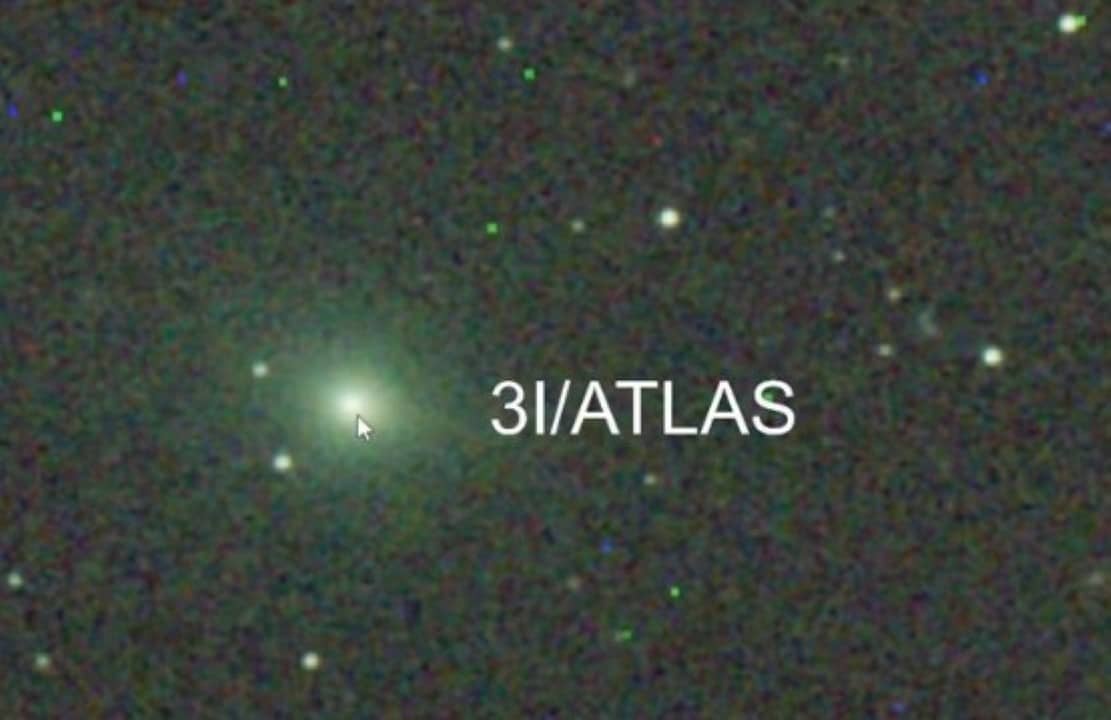
The interstellar comet 3I/ATLAS has once again attracted the attention of the scientific community after recent observations brought to light a surprising peculiarity in its chemical composition.
Astronomy experts have found that this celestial body has an atypical concentration of methanol, a simple alcohol, exceeding the levels commonly found in most comets that orbit our Solar System.
The revelation is the result of the work of an international team of scientists who employed the Atacama Large Millimeter/submillimeter Array (ALMA), one of the most advanced radio observatories on the planet, located in the Atacama Desert, in Chile.
In addition to its intriguing nature, this finding represents a significant advance, as it will help researchers understand the chemical structure of celestial bodies originating in distant star systems.
Understand the importance of comet 3I/ATLAS for science
As explained by astronomer Nathan Roth, from American University (USA) and leader of the study, the analysis of celestial bodies such as 3I/ATLAS makes it possible to obtain data on cosmic environments that would otherwise be inaccessible for direct investigation.
He highlighted, in a statement, that “observing 3I/ATLAS is similar to collecting a fingerprint from a solar system different from ours.”
Research details the detection of unusual methanol
Throughout the research, scientists followed the comet at different times at the end of 2025, the period when it approached the Sun.
As solar radiation heats the comet’s frozen surface, gases and dust particles are released into space.
Such material creates a bright cloud around the nucleus, known as a coma, which becomes capable of analysis by telescopes.
In this way, the researchers investigated the chemical signatures in the cloud, focusing on two identified organic molecules: methanol (CH₃OH) and hydrogen cyanide (HCN).
Both substances are often found in comets and are useful for reconstructing the chemical environment present during the formation of these celestial bodies.
However, the comparative analysis between these molecules demonstrated a peculiar finding. Data collected by ALMA indicates that methanol is between 70 and 120 times more present than hydrogen cyanide.
The researchers add that this proportion elevates 3I/ATLAS to the list of comets with the highest abundance of methanol ever recorded.
The astronomical community interprets this chemical imbalance as an indication that the frozen material that formed the comet originated under conditions different from those that led to the formation of comets in our own Solar System.
Previous observations, carried out with the James Webb Space Telescope, had already highlighted another particularity of 3I/ATLAS: its gaseous cloud was predominantly composed of carbon dioxide when the comet was far from the Sun.
ALMA’s high-resolution images also provided insights into the precise locations from which molecules are emitted.
The hydrogen cyanide appears to emanate directly from the comet’s nucleus, a pattern often observed in comets in the Solar System.
Methanol, in turn, exhibits distinct dynamics. Although some of it also originates in the core, another part is released by tiny grains of ice dispersed in the surrounding gas cloud.
Such fragments act as frozen deposits that, when heated by solar radiation, release methanol into space.
Although a similar mechanism has already been observed in certain comets in the Solar System, this is the first time that scientists have been able to detail the process in an object of interstellar origin.
What is known about the nature of comet 3I/ATLAS
3I/ATLAS was spotted in July 2025 by a telescope from the ATLAS project, located in Chile, and immediately sparked interest in its origin: it did not form in our Solar System.
This is only the third documented interstellar comet, following ʻOumuamua (in 2017) and Borisov (in 2019). Such celestial bodies are seen as authentic cosmic travelers, having formed in other star systems and been expelled into deep space billions of years ago.
Based on its trajectory and speed, astronomers estimate that 3I/ATLAS could be up to 3 billion years older than the Sun, consolidating its position as a fundamental relic for understanding the formation of other planetary systems.



