
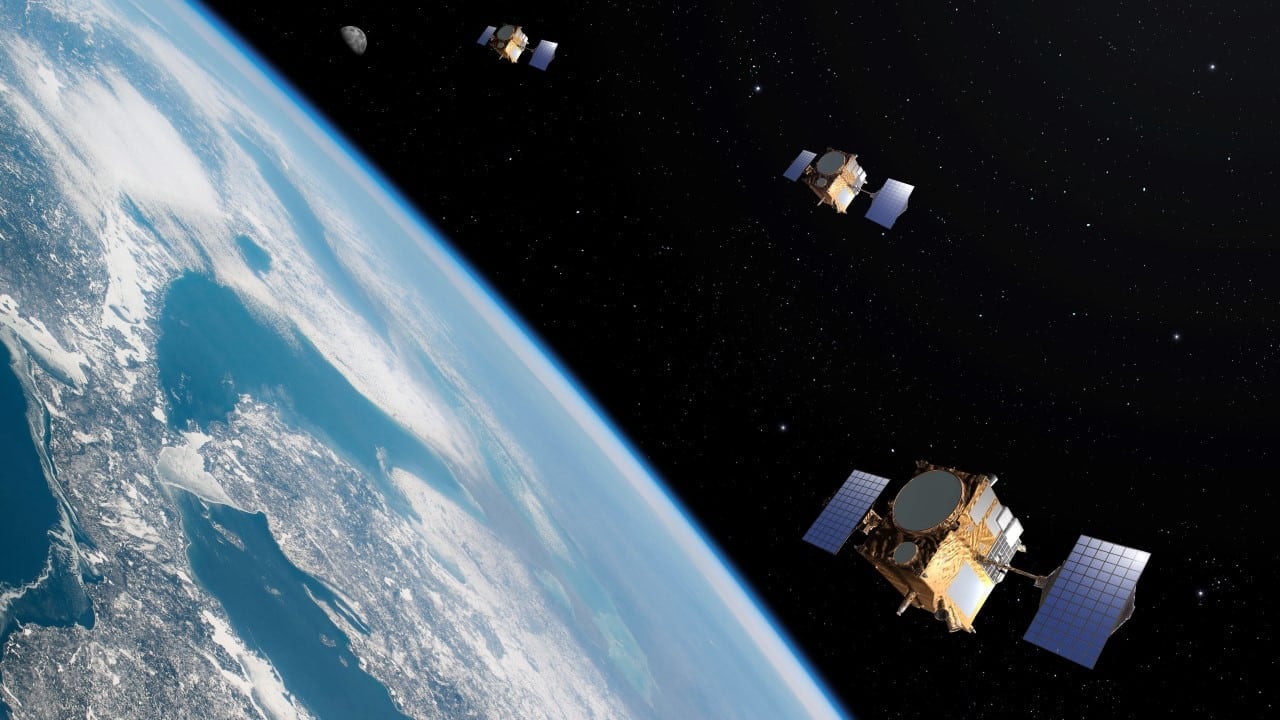
SpaceX is directing a significant portion of its future value towards creating a vast constellation of data centers in orbit, as revealed in detail on Wednesday, July 15, 2026. The company plans to launch millions of satellites equipped with high-capacity GPUs, an initiative that, according to the company, is crucial to its goals of growth and market appreciation, going beyond its traditional rockets and spacecraft.
SpaceX’s Grand Vision and Engineering Challenges
SpaceX’s vision, led by Elon Musk, is ambitious: a constellation of one million satellites capable of generating 120 GW of energy to power tens of millions — and potentially up to 100 million — of cutting-edge GPUs for data center services. Plans for this mega constellation were released months ago, but the size of the individual satellites remained largely unknown until June.
This month, Musk and Ian Dahl, director of satellite engineering at SpaceX, detailed in a promotional video the development of the first model, the AI1 satellite. Musk minimized the complexity, stating that “there is no magic needed that doesn’t exist” and that much of the technology has already been applied to Starlink V3 satellites, classifying the problem as “not super difficult”.
The complexity of heat dissipation in the space environment
Despite the SpaceX founder’s optimism, experts point to considerable technical challenges, especially in heat dissipation in an orbital environment. The radiators used on the International Space Station (ISS), for example, are known to be expensive and heavy, and the priority for orbital data centers is to develop lighter and more economical cooling systems, essential for the viability of the project.
The primary source of energy for these data centers would be the sun, providing unlimited and free energy. SpaceX’s design for each AI1 satellite includes solar panels that cover about 600 square meters, equivalent to one and a half times the area of a basketball court. These panels would have the capacity to generate 150 kW peak and 120 kW average computing power.
The weight of the solar panels is a critical factor, estimated at between 1 and 2 metric tons. Stuart Taylor, a satellite industry consultant, has suggested the possibility of SpaceX exploring lighter materials such as perovskite instead of traditional silicon, which could drastically reduce weight. However, the long-term stability of perovskites is still an open question, which leads the analysis to rely on standard silicon solar cells for now.
Analysis of divergent perspectives on real viability
The idea of installing data centers in space has generated widespread debate about its short-term viability, both in terms of feasibility and whether the current discussion is driven by exaggerated enthusiasm. This has become even more relevant now that SpaceX is a publicly traded company, with its strategies under intense scrutiny.
Matt Desch, chief executive of Iridium Communications and a seasoned satellite industry executive, expressed skepticism about the current enthusiasm. While acknowledging the possibility of resolving the technical problems, he emphasized the existence of “enormous technical challenges to be overcome” before such projects become a practical reality.
Desch speculated that the surge of interest in orbital data centers may be more tied to financial reasons and the quest to increase the market valuation of companies, rather than addressing an immediate and pressing need to put these centers in space. He considered the opportunity to be “very, very long term” at best.
The complexity of economic and technical obstacles
Although Elon Musk claims that the physics behind orbital data centers is “not magic”, the economic dimension of the venture is, to say the least, quite challenging. The financial viability of launching, maintaining and operating a constellation of one million satellites at competitive costs is still a significant unknown.
In addition to the financial issue, a series of crucial technical obstacles need to be overcome for SpaceX’s vision to become a functional and profitable reality:
- Massive launch:The logistics and cost of sending a million satellites into orbit efficiently and cost-effectively represent an unprecedented feat.
- Heat Dissipation:Developing lightweight, effective cooling systems for high-power hardware that operates at extreme temperatures and in the vacuum of space is a critical engineering challenge.
- Radiation Protection:Shielding sensitive electronic equipment against the harmful effects of cosmic radiation, which can cause failures and degradation, requires robust and durable solutions.
- On-orbit latency:Mitigating delays in data communication that can arise due to the vast distances and high orbital speed of satellites is essential for the performance and usability of services.
SpaceX’s strategic future and impact on technology
SpaceX’s bet on orbital data centers is a bold strategic move, aiming to capitalize on the potential of space computing and the promise of unlimited solar energy in space. The success of this initiative could radically redefine the future of global data processing and solidify the company’s position as a dominant force in the digital economy.
However, realizing this monumental plan will require not only continued technological innovation and significant advancements, but also the overcoming of economic and engineering complexities on an unprecedented scale. The outcome of this endeavor, which requires “a lot of things to go right,” will shape both SpaceX’s future assessment and the landscape of data infrastructure in space and on Earth.





