NASA activates defense protocol after capturing radio signals from interstellar comet
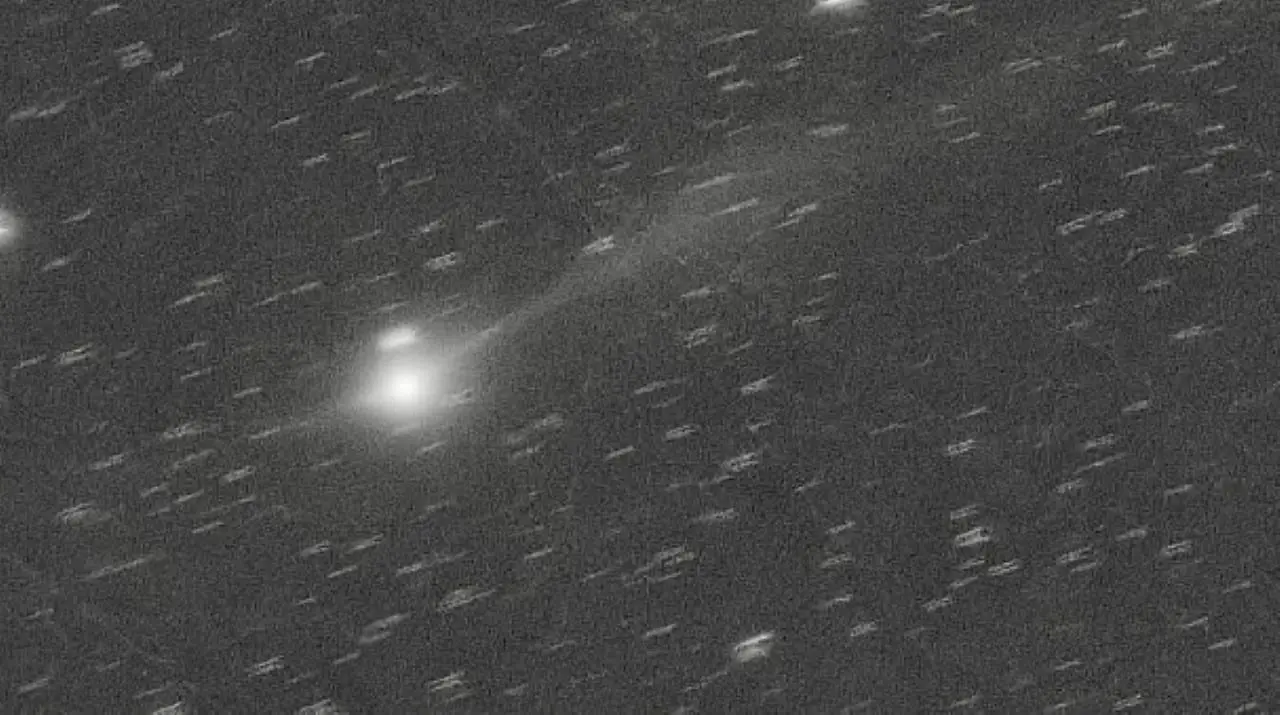
The American space agency has launched an intensive monitoring task force after identifying an unusual celestial body crossing our star system. Named 3I/ATLAS, the object was initially detected on July 1, 2025 through the lenses of the observatory located in Río Hurtado, Chile. Traveling at an impressive speed of approximately 100,000 kilometers per hour relative to the Sun, this cosmic traveler marks only the third time in the history of astronomy that scientists have been able to confirm the presence of an intruder from outside our space neighborhood.
The visitor’s atypical behavior raised alerts in the corridors of the National Aeronautics and Space Administration. The emission of unexpected radio frequencies caused the institution’s Planetary Defense Coordination Office to be immediately called in to assess any adverse scenario. Although the protocol sounds alarming to the lay public, the measure serves primarily to ensure that the body’s hyperbolic path does not suffer gravitational deviations that could put it on a collision course with the Earth, allowing a safe study of the phenomenon.
What prompted the highest alert at the American space agency
The major turning point in this discovery occurred at the end of October 2025, when radio observation equipment captured anomalies. The MeerKAT radio telescope complex, installed in South Africa, recorded continuous transmissions emanating from the 3I/ATLAS core in the 1.6 GHz band. For astrophysicists, this specific frequency works as a kind of digital signature of water in the space vacuum, corresponding exactly to the emission line of the hydroxyl radical, which forms when primordial ice sublimates under intense solar radiation.
Far from being a sign of extraterrestrial intelligence, the finding reassured and at the same time fascinated researchers. The presence of this chemical signature rules out the hypothesis of artificial interference and establishes the nature of the object as a highly active comet. Unlike rocky, inert asteroids, 3I/ATLAS is literally shedding its volatile components as it approaches the heat of our star, a natural process that subtly alters its acceleration in deep space.
To deal with the flood of data and coordinate the global response, experts in orbital dynamics were called to emergency meetings in August 2025. The main objective of this unprecedented mobilization was to unify tracking protocols between different nations. By centralizing information, the scientific community is able to predict with millimeter precision each stage of the journey of this stellar fragment, which was ejected from its origin system millions of years ago and now crosses our territory.
Learn more: Radio emissions from comet 3I/ATLAS make NASA activate planetary defense system
Colossal dimensions and the celestial body’s journey of no return
Preliminary assessments conducted by teams from the University of Hawaii in conjunction with the European Space Agency reveal gigantic proportions. The visitor’s solid core varies between 320 meters and an impressive 5.6 kilometers in diameter. Surrounding this central rock, there is a vast coma composed of toxic gases and cosmic dust, giving the object a diffuse glow that already allows it to be viewed even by amateur astronomers equipped with medium-sized telescopes here on Earth.
The trajectory drawn by the comet follows non-gravitational mechanics, which means that it is not tied to the attraction of our Sun. It is a unique and definitive passage. The point of closest proximity to our planet is scheduled for December 19, 2025. At this moment of closest approach, the celestial body will be around 270 million kilometers away from the Earth’s surface, a safety margin equivalent to almost twice the space that separates Earth from the planet Mars.
Rigorous space ballistics calculations confirm that the risk of impact is absolutely zero. After this distant encounter, 3I/ATLAS will continue its solitary journey towards deep space, without any possibility of return. This restricted observation window turns every second of monitoring into a race against the clock to extract as much information as possible about the composition of planetary systems orbiting other stars in the Milky Way.
Full coverage: Latest News (EN)
See Also

Mercury retrograde cycles in 2026: understand the phases and prepare
Phases of the moon: complete guide to the lunar calendar from August to December 2026

Dogs can have extended lives with new Loyal pill in the FDA approval process
Key differences from previous visitors
The history of interstellar intruders is extremely recent, starting only in 2017 with the passage of the enigmatic ‘Oumuamua, followed by comet 2I/Borisov in 2019. The new visitor presents characteristics that place it in an intermediate and fascinating category. While the first object looked like a rocky cigar with no apparent gaseous activity, and the second demonstrated violent and chaotic outgassing, 3I/ATLAS exhibits much greater structural stability, allowing for longer and more detailed analyses.
The luminosity variations recently noticed by space telescopes, such as Hubble, are explained by asymmetric jets of volatile material. When the ice on one side of the comet melts faster than the other, the ejected gas acts as a natural propellant, altering its path in an unpredictable way. This peculiar dynamic is exactly what scientists seek to catalog to understand the physical mechanisms that operate in alien environments.
On the same topic: Radio emission from interstellar comet 3I/ATLAS triggers NASA defense protocol
To understand the magnitude of the event, the research centers consolidated the most critical data from the ongoing monitoring mission:
- Cruising speed established at 100 thousand kilometers per hour at solar approach.
- Radio emission confirmed at a frequency of 1.6 GHz, indicating ice sublimation and the presence of hydroxyl.
- Minimum safe distance set at 270 million kilometers from Earth for December 2025.
- Nucleus with an estimated size that could exceed five kilometers in total length.
How the global scientific community is tracking the phenomenon
The technological arsenal aimed at the sky at this moment is unprecedented in the history of space exploration. High-precision instruments, including the James Webb Space Telescope and the Very Large Telescope (VLT) in the Atacama Desert, are dissecting the comet’s chemical spectrum. The goal is to look for organic compounds and minerals that are familiar to those found in comets in our own cosmic backyard, drawing a parallel to how life and planets form in different corners of the universe.
Determining core reflectivity and ongoing analysis of radio waves promises to rewrite current models of planetary formation. Each new piece of data collected by this global network of observatories helps to piece together a puzzle about the origin of matter and the distribution of water in the galaxy. Even after 3I/ATLAS disappears into the darkness of interstellar space, the legacy of its information will continue to fuel scientific theses and discoveries for decades to come, proving that constant surveillance of the sky is vital for the advancement of humanity.
More on this story: NASA activates planetary defense after comet 3I/ATLAS emits radio waves