
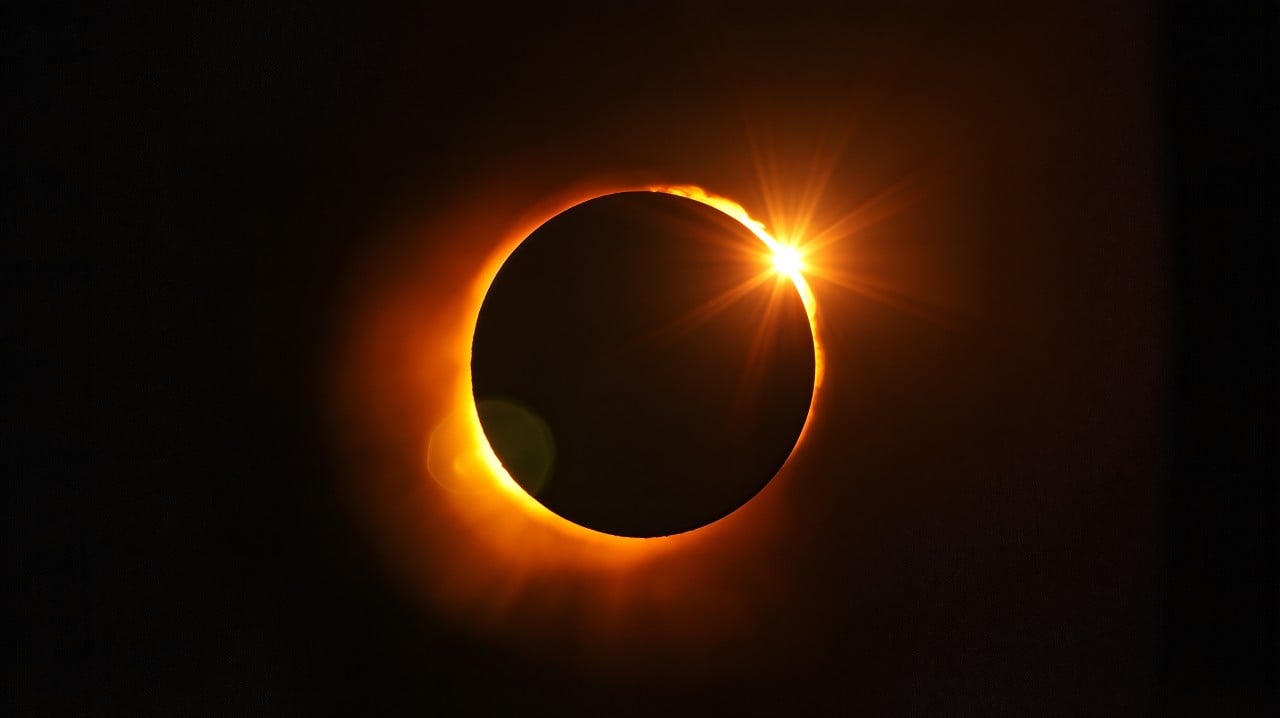
The scientific agenda for the eighth month of the year presents an intense movement for space observation enthusiasts, marking the alignment of two distinct celestial phenomena in a short period of time. Residents from different parts of the globe will have the opportunity to follow orbital movements that result in light blocking, both from the Sun and from our natural satellite. For the Brazilian public, the main highlight is the almost complete obscuring of the Moon, scheduled to occur during the transition between the 27th and 28th of August. This is an excellent opportunity to engage with science, as the nighttime event does not require the use of telescopes or eye protection filters.
Dynamics and times of lunar obscuration in the national territory
Those who wish to follow the movement of the Earth’s shadow projected into space will need to extend their vigil during the early hours of the morning. According to astronomical data calculated for the Brasilia time zone, the first changes in luminosity will begin to be noticed around 11:30 pm on the 27th. The peak of the alignment, the moment when darkness reaches its maximum area, is scheduled for 1 am on the 28th. Thiago Gonçalves, who acts as director of the traditional Valongo Observatory, one of the oldest space research institutions in the country linked to the Federal University of Rio de Janeiro January, confirmed that orbital conditions largely favor contemplation in all Brazilian states.
The geographic scope of a nighttime event of this type is usually vast, encompassing any region of the planet where the satellite is above the horizon at the time of alignment. In this way, in addition to the entire length of the Americas, populations located in several countries in Europe and the African continent will also share the same view of the sky. This simultaneity creates a kind of global wakefulness, connecting amateur observers and professional researchers to collect images and data about the Earth’s atmosphere, which directly influences the color projected during the blocking of sunlight.
Reason why the surface will not gain the classic reddish color
Unlike the total alignments that yield the popular “Blood Moon” nickname, the late August orbital configuration will deliver a slightly distinct and complex visual spectacle. Calculations indicate that the umbra, the darkest and most central part of the Earth’s shadow, will cover approximately 93% of the lunar disk. This small margin of 7% that escapes total blocking is enough to drastically alter the optical perception of the phenomenon, creating an intense contrast in the night sky. Celestial mechanics require a millimeter alignment between the Sun, Earth and Moon for 100% blocking, something that will not occur in this specific passage.
In practice, the upper portion of the satellite will remain directly illuminated by the sun’s rays, creating a bright white band that contrasts strongly with the rest of the darkened surface. The director of the Valongo Observatory classifies this partial configuration as highly attractive from a visual point of view. The presence of this luminous edge prevents the refraction of sunlight through Earth’s atmosphere from dyeing the entire Moon dark red, offering photographers and onlookers an unusual, three-dimensional image of our cosmic neighbor floating in the darkness.
Practical recommendations to ensure the best viewing experience
Although monitoring with the naked eye is perfectly safe and viable, some logistical choices can determine the success of the nighttime endeavor. The main barrier to amateur astronomy in large cities is light pollution emitted by poles, buildings and vehicles. Searching for areas further away from urban centers, such as parks, beaches or rural regions, significantly increases the contrast of the sky, allowing you to notice the subtle nuances of the shadow advancing over the lunar craters throughout the almost two hours of the show.
Another determining factor is the local meteorological condition, as the presence of dense clouds can completely frustrate the plans of those waiting for dawn. Experts recommend checking the weather forecast in advance and looking for open locations where there is no visual obstruction by skyscrapers or very high mountains. Since the natural satellite will be positioned at a favorable elevation during the 1 a.m. peak, all it takes is a cloud-free window for the mechanics of the solar system to reveal themselves in full to viewers on the ground.
Daytime alignment restricts observation to countries in the Northern Hemisphere
Weeks before the nocturnal movement, celestial mechanics will orchestrate another orbital ballet, this time involving blocking the Sun’s light. Scheduled for August 12th, this daytime crossing has much more restricted visibility dynamics. Unlike lunar events, which are seen by half the globe simultaneously, the shadow cast by the Moon on Earth creates a narrow path, drastically limiting the number of privileged spectators who can witness the occultation of our system’s central star.
Due to the inclination of the orbit and the positioning of the stars on this specific date, Brazilian territory will be completely outside the penumbra and umbra zone. The path of daytime darkness will exclusively favor nations located at higher latitudes in the Northern Hemisphere. International astronomy institutes have already mapped the exact route where residents and tourists will be able to use special glasses to follow the lunar silhouette crossing the solar disk with complete retina safety.
Geographic coordinates confirm that viewing of this solar block will be concentrated in the following international locations:
- Greenland, covering vast areas of ice in the Arctic
- Iceland, attracting natural phenomenon hunters
- Spain, boosting scientific tourism in the Iberian Peninsula
- Russia, covering extensive swathes of its western territory
- Portugal, allowing photographic records at dusk
The annual astronomical calendar often distributes these phenomena in pairs, reflecting the eclipse season that occurs when the lunar orbit crosses the Earth’s orbital plane around the Sun. Understanding these cycles allows researchers to calibrate instruments and the general public to reconnect with the dynamics of the universe. The systematic recording of variations in light and shadow continues to provide relevant data on the opacity of the Earth’s atmosphere, demonstrating that observation of the sky maintains its scientific relevance centuries after the first measurements recorded by humanity.





