An extraordinary discovery at the Egyptian archaeological site of Oxirrinco has revealed a piece of Homer’s Iliad inside a Roman-era mummy, dated at around 1,600 years old. The information was released by the University of Barcelona, and marks the first record in the history of archeology of a Greek literary text being purposely incorporated into the mummification process.
The find was made by the Oxirrinco Archaeological Mission, led by Maite Mascort and Esther Pons, from the Institute of Ancient Near Eastern Studies (IPOA) at the University of Barcelona. The discovery occurred in Al Bahnasa, a modern location located in the historic site of Oxirrinco, in Egypt.
How a literary papyrus was used in mummification
During excavations that took place between November and December 2025, a team led by Núria Castellano unearthed a mummy from the Roman period in Tomb 65 of Sector 22. On the mummy’s abdomen, a papyrus was found that had been intentionally positioned as part of the embalming ritual.
The mission had already revealed, in previous works, other Greek papyri arranged in a similar way. However, these texts were consistently magical or ritualistic in nature. This is the first example in which a literary work, specifically Homer’s Iliad, was identified for this purpose, expanding the understanding of funerary practices and the appreciation of literature in antiquity.
Experts identify famous passage from the Iliad
The papyrus underwent a thorough examination during a second phase of research, in January and February 2026. Conservator Margalida Munar, papyrologist Leah Mascia and Ignasi-Xavier Adiego, professor in the Department of Classical, Romance and Semitic Languages, classical philologist and director of the Oxirrinco project, analyzed the fragile document.
From Leah Mascia’s reading of the text, Professor Adiego confirmed that the fragment belongs to the “Catalogue of Ships”, present in Book II of Homer’s Iliad. This is a widely recognized section detailing the Greek forces preparing for the Trojan War and is considered one of the most celebrated passages in Western literature.
Professor Adiego clarifies: “This is not the first time that we have found Greek papyri, wrapped, sealed and incorporated into the mummification process, but until now, their contents have been mainly magical. Furthermore, it is worth mentioning that, since the end of the 19th century, a large number of papyri have been discovered in Oxyrhynchus, including Greek literary texts of great importance, but the real novelty is finding a literary papyrus in a funerary context.”
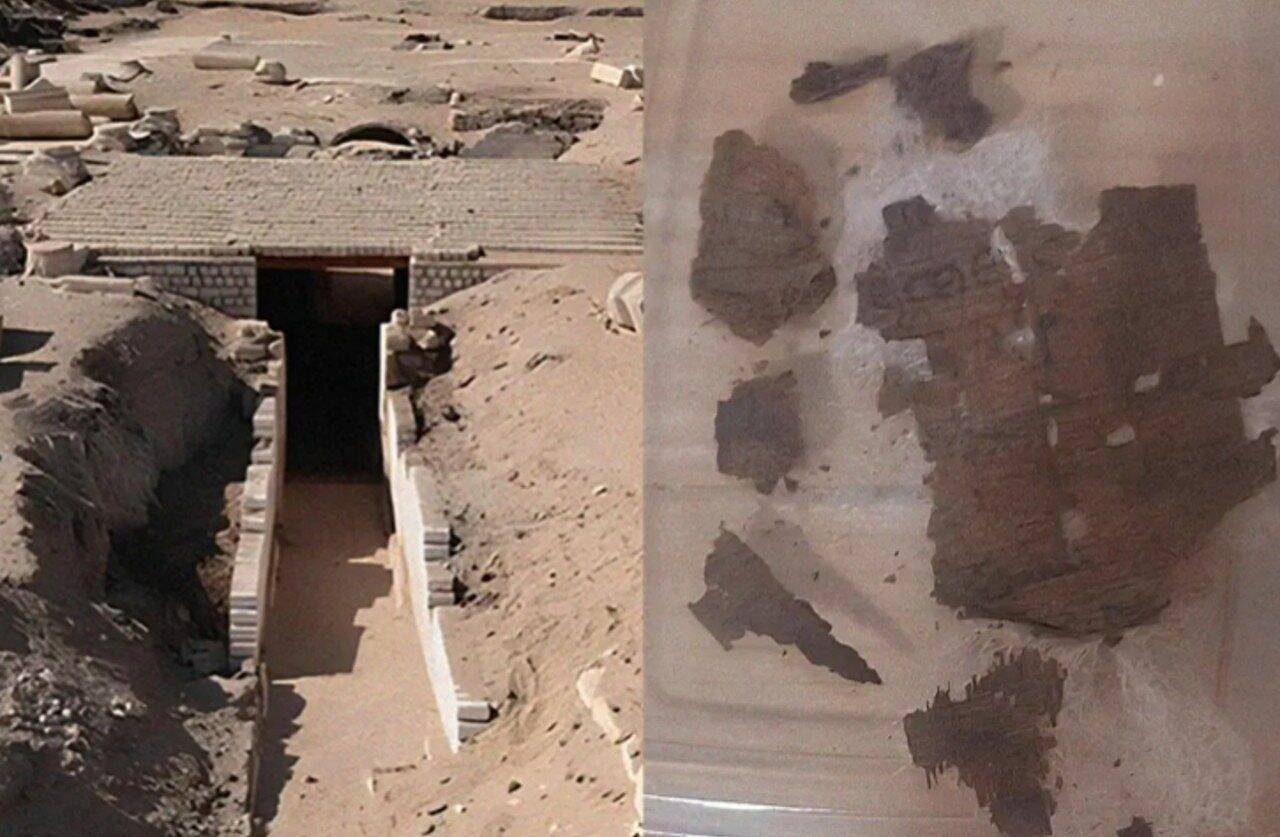
Details of excavations at the ancient site of Oxirrinco
The discovery was made in the Al Bahnasa necropolis, the archaeological site associated with ancient Oxyrhynchus, one of the most significant cities in Greco-Roman Egypt. Located approximately 190 kilometers south of Cairo, near the Bahr Yussef branch of the Nile, the area has long been known for the preservation of thousands of ancient papyri.
Excavations revealed a funerary complex with three limestone burial chambers, housing Roman-era mummies and decorated wooden sarcophagi. Many of the tombs had been damaged by looting in past times, leaving many artifacts in precarious condition.
History of the long-lasting archaeological mission
The Archaeological Mission of Oxirrinco, at the University of Barcelona, began in 1992, under the coordination of Professor Josep Padró. Since then, it has become one of the oldest and most consolidated Spanish archaeological projects in Egypt.
The mission’s most recent campaign, conducted between November 2025 and February 2026, resulted in several discoveries that researchers classify as historically and archaeologically important.
The mission has the support of the Ministry of Culture, the University of Barcelona, the Palarq Foundation, the Catalan Society of Egyptology and AIXA Serveis Arqueològics. It also collaborates with the Supreme Council of Antiquities of Egypt and Cairo University.
The team’s latest revelations were recently presented in a series of public lectures at the Faculty of Philology and Communication at the University of Barcelona, in the Gabriel Oliver room. The program included presentations by project members on archaeology, anthropology and conservation.