
NASA’s unprecedented analysis of comet 3I/Atlas reveals secrets of other solar systems

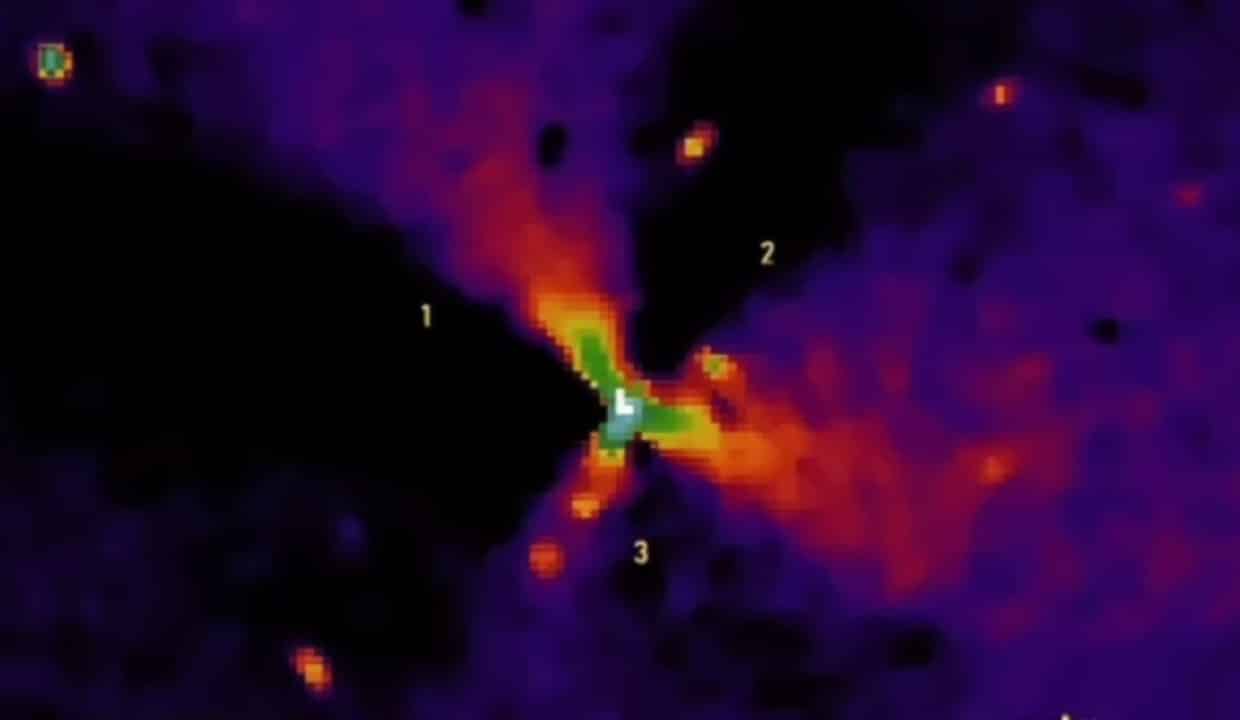
Researchers from the American space agency concluded, in 2026, the largest data collection ever carried out on the celestial body 3I/Atlas, a wandering body that continues to challenge astronomers around the world. The detailed monitoring, carried out by a set of equipment in orbit and on the Earth’s surface, exposed unprecedented details about its chemical structure and route, providing fresh answers about how planets are born in other stellar neighborhoods. The complete scan of this star, which has traveled trillions of kilometers since it was ejected from its mother star, forces science to review old theories about the movement of galaxies. This is a rare chance to analyze alien raw material in a pure state, completely free from the radiation and collisions that affect asteroids and comets in our own neighborhood.
The impact of the passage of a celestial body from outside our neighborhood
Officially cataloged as the third visitor from outside the Solar System to cross our path, 3I/Atlas had its presence noted a few years ago, but its secrets only came to light recently thanks to the technological leap in modern observatories. The label “3I” places the object in an extremely select group, joining the pioneer Oumuamua, discovered in 2017, and 2I/Borisov, found in 2019, each of which brought fragments of distant realities. Being able to map its path with mathematical precision, establishing that it came from another corner of the Milky Way, represented a triumph for contemporary astronomy and proved that the deep sky monitoring network is sharper than ever.
Unlike icy bodies that are born in the confines of our backyard, such as the Oort Cloud — which extends up to 100 thousand astronomical units from the Sun —, 3I/Atlas is not influenced by solar gravity. The breakneck pace of its displacement and the open curve of its orbit prove that it is a nomad detached from any star, transforming its visit into a phenomenon of epic proportions. Evaluating how it reacts to the heat and light of our Sun, no matter how short the exposure time, gives scientists an overview of how these nomadic rocks survive when crossing zones of high magnetic radiation during their travels through the intergalactic void.
Theories about the birthplace of the new wandering star
Exactly where 3I/Atlas departed remains a complex puzzle, although supercomputer simulations and light readings suggest a stellar cradle located hundreds of light-years from Earth. Experts seek to cross-reference the chemical elements found in the object’s gas trail with the profile of stars and dust disks already mapped by man. This fine-toothed comb allows you to deduce the climate and pressure of the place where the rock was expelled, opening a door to understanding the infinite ways in which solar systems can form throughout the Milky Way.
The most accepted hypothesis currently argues that the visitor was thrown into deep space after severe gravitational chaos, possibly a collision with a supermassive planet or a binary star. This type of expulsion is considered normal during the youth of a planetary system, a phase in which the fight for space between giant bodies ends up pushing smaller debris outside the stellar boundaries. The fact that we rarely manage to catch something like this reinforces the weight that each new interstellar comet has for science, serving as physical proof of a mechanics that organizes the structure of the universe.
Deciphering the past of 3I/Atlas is vital because it carries at its core the intact chemical recipe of the place where it was forged. It works like a time chest sent from an unexplored region, a destination that current human probes would take millions of years to reach. The information extracted from this rock provides the basis for researchers to confirm the presence of colossal exoplanets in other galaxies, as only worlds with extreme gravity would have enough strength to throw comets into the dark of outer space.
The arsenal of telescopes mobilized to track the phenomenon
The task force to not miss any details of the 3I/Atlas was led by NASA, which activated a veritable army of sensors capable of reading different spectrums of light. The veteran Hubble and the state-of-the-art James Webb Space Telescope (JWST) acted as key players, delivering sharp photographs and breaking up the comet’s light to reveal what was inside its nucleus. The JWST’s power to see in the infrared was the big difference, as it was able to penetrate the thick dust curtain and identify minerals that would have been missed by conventional lenses, changing what was known about the object’s anatomy.
To support the machines in orbit, giants based on Earth, such as the Very Large Telescope (VLT) in the Chilean desert and the Keck Observatory at the top of Hawaii, joined the game to monitor the growth of the comet’s tail minute by minute. Crossing the coordinates generated by such different equipment guaranteed an impeccable route calculation and showed how the celestial body melted when faced with the force of our Sun. This global teamwork proved to be the only way to extract real science from an event that lasted such a short time.
The American agency’s communications backbone, known as the Deep Space Network, was strained to the maximum to ensure that heavy data packets reached from satellites to servers on Earth without interruption. This robust connection gave scientists the power to crunch the numbers on the spot, allowing them to change the angle of their telescopes at the last minute so as not to miss the rock’s most intense gas explosions. The alignment between different nations and laboratories has become a model of efficiency, showing that human cooperation is the best weapon against the enigmas of space.
Heavy use of artificial intelligence and neural networks to scan the terabytes of images shortened the path to final conclusions. This cutting-edge software was able to find tiny variations in brightness and chemical signature that human eyes or ancient programs would never notice. Placing advanced computing at the center of astrophysics has become a milestone, ensuring that astronomers can squeeze every last drop of knowledge from each photon captured by the lens.
The chemical elements that surprised the scientific community
The chemical radiography of 3I/Atlas revealed a complex mixture of ingredients, including carbon-based molecules, solid water, carbon dioxide and rocky minerals. What caught our attention was the exact dosage of these materials, which completely differs from the pattern seen in comets that orbit our Sun. This anomaly is proof that the visitor’s nursery operated under completely different physical and chemical rules, perhaps with extreme temperatures or a greater load of heavy metals, which altered the formation of the rock from the first day.
The find that generated the most buzz was the identification of a very rare ice variant, practically absent on the celestial bodies in our system. This detail suggests that the comet was born in a frozen, dark area of its star, or that it suffered a very specific radiation bombardment before being expelled. Furthermore, the presence of extensive carbon chains has reignited discussion about how the basic building blocks of life spread throughout the universe, indicating that the chemistry needed to form organisms may be the rule, not the exception, in the Milky Way.
The escape route and the chances of observation in the coming years
The path taken by 3I/Atlas was drawn with almost zero margin of error, attesting to its hyperbole-shaped trajectory and its imminent farewell to our Solar System. The point of greatest proximity to solar heat is in the past, and now the rock accelerates towards the interstellar pitch, becoming increasingly colder and more distant. Even though it didn’t put on a show with the naked eye, enthusiasts with powerful homemade telescopes were able to record the glow of its tail on clear nights. As mathematics allows us to know where it will be in a thousand years, astronomers have already saved the coordinates for when humanity invents lenses capable of seeing further.
What do these discoveries change in the study of planets
Data extracted from 3I/Atlas is forcing the books on how matter clumps together in a vacuum to be rewritten. By dissecting a piece of rock that does not belong to the Sun’s domain, science gains the power to compare, side by side, the chemistry of two distinct solar systems. This takes theories of planetary formation out of the realm of ideas and places them in the realm of concrete evidence, something that physicists have been seeking for decades. Mapping the variety of these travelers is the first step toward drawing a chemical atlas of our galaxy and understanding where life is most likely to thrive.
The scientific heritage left by nomadic celestial bodies
The passage of 3I/Atlas, added to the history left by Oumuamua and Borisov, creates a permanent collection for modern astronomy. Each of these space pebbles acts as a free sample of other corners of the universe, saving humanity from spending billions on probes that would take generations to reach their destination. They shatter the myth that deep space is an empty desert, revealing a chaotic transit of rocks that cross the cosmos carrying the DNA of their stars of origin.
The hunt for these outsiders serves as fuel for young engineers to create increasingly sensitive radars and telescopes. The idea of launching a spacecraft to reach an interstellar comet and scrape off a piece of its ice is no longer a movie script and has become a real goal for space agencies in the coming decades. A successful mission of this size would deliver the definitive answer to what other worlds are made of and, who knows, prove that we are not alone in the dark.
Humanity’s next steps in hunting space intruders
The knowledge left behind by 3I/Atlas is already being used to design the probes of tomorrow, focused exclusively on hunting objects outside the Solar System. As the current comet travels at an absurd speed — easily exceeding 26 kilometers per second — reaching it is now physically impossible, but its data is worth gold. NASA and its European partners are already designing prototypes of autonomous spacecraft that would be parked in space, ready to accelerate as soon as a new visitor crosses the border of our system.
The ultimate ambition of scientists is not





