
T. Rex Gus fossil auction reaches record price and raises alarm among scientists

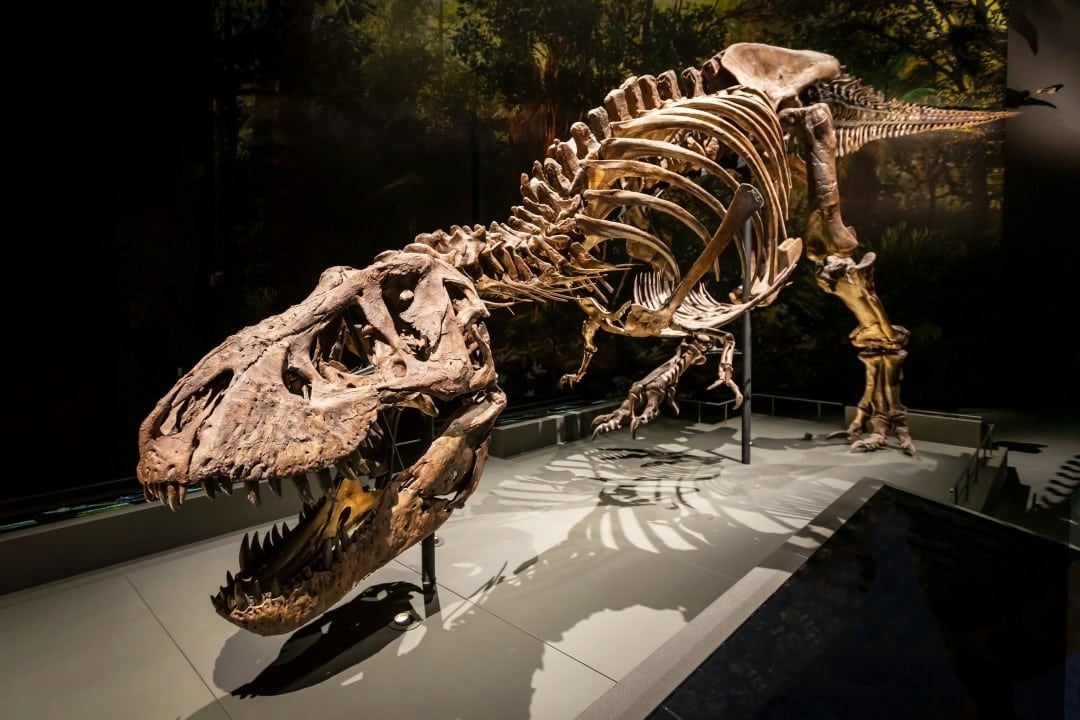
A T. Rex skeleton known as “Gus” sold for $50.1 million at an auction held by Sotheby’s on July 15, 2026, setting a new record for the most expensive dinosaur ever traded. The sale, however, reignited an intense debate among the scientific community about the private ownership of fossils of great paleontological value, raising concerns about access for future studies.
Discovery and recovery of a Cretaceous giant
The specimen, 67 million years old, is one of the most complete Tyrannosaurus rex ever found. Named “Gus” in honor of Gary “Gus” Licking, owner of the land where it was unearthed, the fossil was discovered in Harding County, South Dakota. Licking, who died in 2002, had been finding teeth and bone fragments for years before contacting Thomas Heitkamp, president of Theropoda Expeditions.
The commercial paleontology team carried out the excavation between the summers of 2021 and 2023. The following three years were dedicated to laboratory work, separating the fossilized bones from the surrounding rock and assembling the skeleton. Gus’ specimen has 183 fossilized bone elements, representing about 63% of a T. Rex’s total bones and up to 80% of its bone mass. It measures approximately 11.5 meters long and 3.8 meters high, with a 1.37 meter skull.
Details that enrich the study of the past
Gus presents characteristics of great scientific interest, such as fractured and healed bones. Bite marks on the skull were also identified, possibly left by carnivorous scavengers that fed on the body after the animal’s death. These details offer important insights into the lives and environment of dinosaurs.
Sotheby’s initially estimated Gus’s value at between $20 million and $30 million, which would already be a record figure for a dinosaur. Bidding started at 19 million dollars. The increasingly broad dinosaur market attracts not only museums and private collectors in the United States, but also large international institutions, foundations and individuals seeking to create their own exhibits, as reported by Cassandra Hatton, vice president and global head of science and natural history at Sotheby’s.
Fossil auctions and the growing market value
The value reached by Gus surpasses previous records and demonstrates an upward trend in the fossil market.
See some of the most expensive auctions ever recorded:
- Gus (T. Rex):Sold for $50.1 million on July 15, 2026.
- Apex (Stegosaurus):Acquired in 2024 for $44.6 million by Kenneth Griffin, exceeding Sotheby’s initial estimate by nine times. The fossil is currently on long-term loan at the American Museum of Natural History.
- Sue (T. Rex):First dinosaur auctioned, in 1997, for 8.4 million dollars. Sue is currently at the Field Museum in Chicago.
Scientific concern about the privatization of rare specimens
Gus’s sale raised important questions about the ability of private collectors to acquire specimens of such scientific relevance. Paleontologists express concern that fossils in private collections will become inaccessible for future research. This is because specimens need to be available for subsequent studies as new research emerges, something that cannot be guaranteed once they are in the hands of an individual.
Large scientific journals, for example, often refuse to publish studies based on specimens that are in private collections. Susannah Maidment, a paleontologist at the Natural History Museum in London, explained that if the owner loses interest, dies or divorces, access to the specimen could be compromised. “There have been many cases in which specimens were described scientifically, but ended up being discarded because they were in private collections,” he said. “This, then, is simply not science anymore.”
Investment in science versus private ownership
Scott Persons, curator of natural history at the South Carolina State Museum, suggests that buyers with the resources to acquire fossils like Gus could direct those funds toward funding paleontological research. He said an amount equivalent to Gus’s could support a research program at a public museum of the donor’s choice. “It would pay for a career of fieldwork, the discovery of new species and the public display of the discoveries,” Persons said.
Cassandra Hatton, from Sotheby’s, presented an alternative point of view, arguing that auctions are important in helping to discover fossils that would otherwise be lost to everyone. This perspective highlights the ongoing tension between the commercial value of fossils and the need to preserve scientific access to understanding the history of life on Earth.




