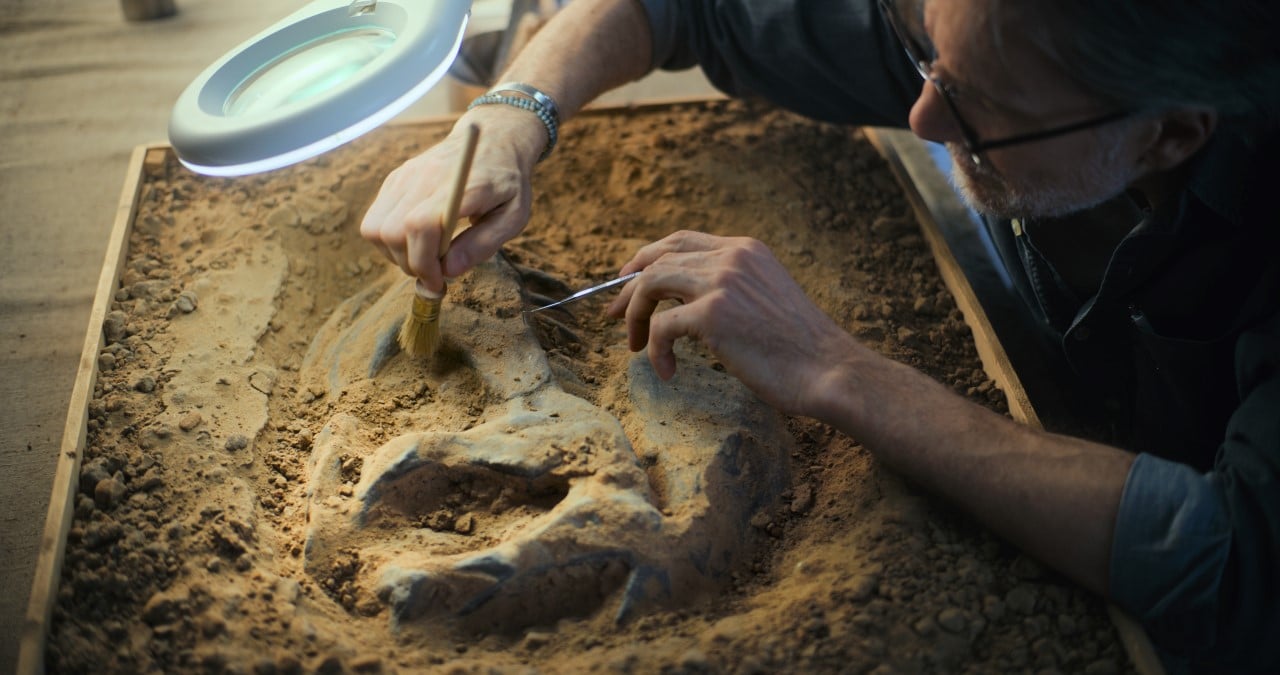
A group of teenagers attending high school in Kyoto province, Japan, made a historic moment by unearthing an ancient artifact. The action took place during a field activity focused on heritage education, whose objective is to connect new generations to the cultural roots of their region. The metallic object, preliminarily identified as a dagger or “toko”, caused an uproar among researchers, mainly due to the fact that it was rescued from the ground by the hands of a student who was helping to sort the sediments.
How the metal part was identified during the excavation
The pedagogical initiative, called “Promoting the attractiveness of local resources”, is part of the curriculum of the Mirai Creation Department, belonging to the Kumihama campus of Tango Ryokufu High School. In this edition, eight second-year students gained the chance to work directly at the archaeological construction site, thanks to a partnership with the Archeology Laboratory of the Faculty of Arts at Osaka Prefectural University. Before putting their hands in the dirt, the volunteers underwent theoretical training at a community center, where experts and academics detailed the burial architecture and the current stage of the investigations.
Once on the perimeter of the historic site, the group was divided into different work fronts. While part of the team assisted in the careful removal of debris from the stone chamber and the main mound, another group was responsible for thoroughly sifting the earth extracted from the interior of the tomb. It was exactly during this filtering stage that Ryoto Inoue, a 17-year-old teenager, noticed something unusual. He rescued a fragment of metal measuring two centimeters long and six centimeters wide, which was soon classified as a “toko”, attracting the immediate attention of all the coordinators present.
The young man responsible for the discovery expressed great enthusiasm with the result of his efforts. He reported that, deep down, he doubted that the school team would be able to locate any item of historical value before the end of practical activities. The student also highlighted that he hopes to see the artifact contributing to filling in the gaps that still exist about the ancient civilizations that inhabited the Japanese archipelago.
The historical weight of the Suda Hirano Kofun funeral complex
Located in the city of Kyotango, the Suda Hirano Kofun complex is considered one of the most promising sites in Kyoto Prefecture. The area has been explored for around two years by researchers from Osaka Prefectural University, who seek to understand the dynamics of ancient societies. The so-called “kofuns” are megalithic monuments erected between the 3rd and 7th centuries AD, a period that marks the beginning of the formation of a centralized state in Japan, often associated with the court of Yamato. Built to house the remains of political and military leaders, these structures, which often take the shape of a keyhole, hold treasures that reveal the hierarchy and power of that era.
Investigating monuments like Suda Hirano Kofun is a fundamental step in piecing together the puzzle of the pre-modern Asian era. Each fragment removed from the ground helps scientists map trade routes, burial techniques and the evolution of tools used by local elites. Keeping this work active means ensuring that the memory of the populations who lived in Kyoto more than a millennium ago is not lost over time. Furthermore, by placing teenagers in this rigorous research environment, Japan plants a vital seed to ensure that future generations take responsibility for protecting their own heritage.
How practical experience transforms young people’s learning
The methodology applied by Escola Secundária Tango Ryokufu breaks with the traditional teaching model tied to classrooms. The central proposal is to make students literally touch the history of their ancestors. The rescue of the ancient metal blade goes beyond the barrier of a mere scientific find, becoming an unforgettable practical lesson on the archaeological method. During the process, students realize that the narrative in textbooks is constructed from physical evidence, requiring patience, technique and a lot of observation.
This direct contact with the scientific method improves the analytical capacity of teenagers, who begin to see the environment around them with more critical sense. Professor Takahiro Kotani, 32, who guides the class during field trips, is already planning to expand the scope of this experience. The educator intends to articulate a way to include students in setting up a future exhibition at the state university, where the dagger and other rescued items will be presented to the community. This integration shows that the school can act as a real bridge between youth, the academic environment and the preservation of memory.
Laboratory analyzes will define the exact origin of the object
Now, the metallic fragment recovered in Suda Hirano Kofun will be sent to specialized laboratories, where it will undergo a battery of physical and chemical tests. Experts will try to discover the exact alloy of the metal, the carbon dating of the surrounding organic residues and the true usefulness of the piece in the burial ritual. This laboratory screening is essential to cross-reference the slide’s data with other artifacts already cataloged in the same complex. The expectation of the scientific community is that the results reveal unprecedented details about the level of mastery of metallurgy and the funeral traditions of that period of time.
For those enrolled at Tango Ryokufu Secondary School, the excavation day represented a milestone that could define future professional choices, sparking interest in careers linked to conservation, history and social sciences. The success of this endeavor proves that teaching based on real research engages young people in a deep and lasting way. The union of efforts between high school and public universities is thus consolidated as a successful format that has everything it needs to be replicated in other archaeological sites spread across Japanese territory.