
NASA research on comet 3I/Atlas unlocks mysteries of distant galaxies

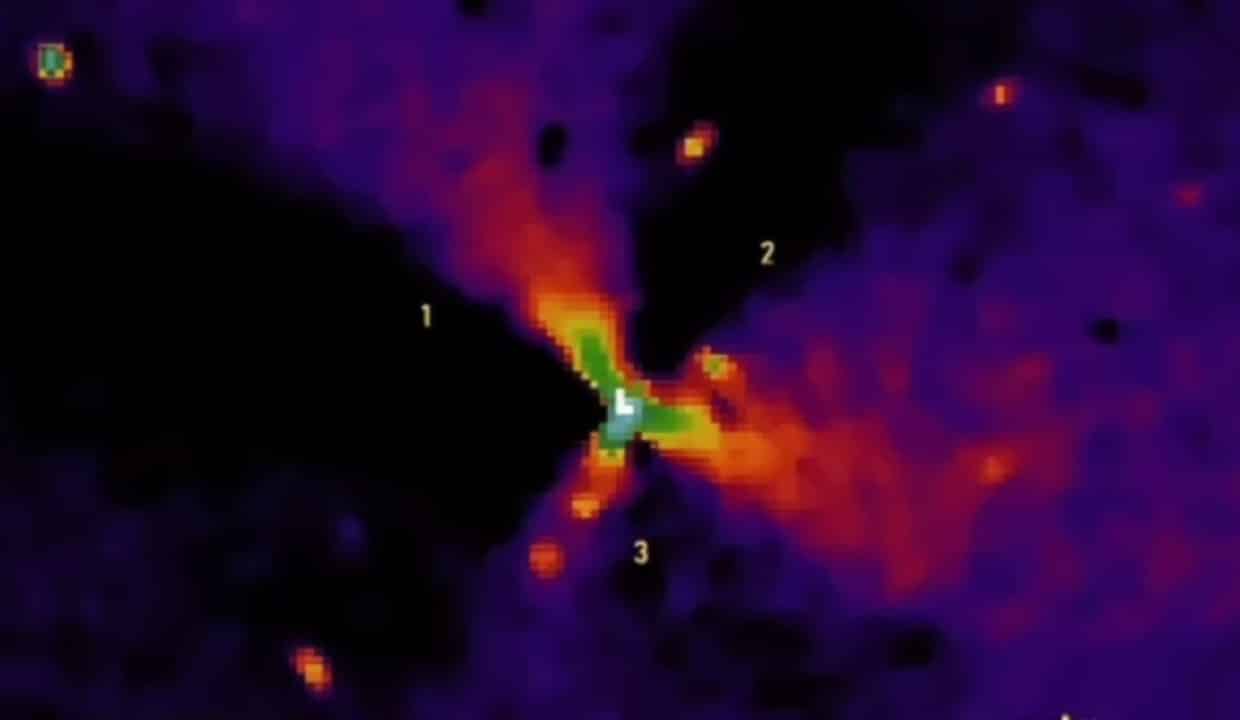
In 2026, the North American space agency completed the most extensive collection of information ever carried out on the 3I/Atlas, a wandering object that intrigues experts around the globe. The detailed monitoring, carried out by several terrestrial and orbital instruments, exposed unprecedented characteristics about the chemical composition and trajectory of the celestial body, providing fundamental clues about the formation of worlds in other regions of the galaxy. The full mapping of this asteroid, which has traveled trillions of kilometers since its expulsion from its original orbit, forces the scientific community to rethink old concepts about galactic dynamics. This is an exceptional opportunity to examine pristine alien material, free from the collisions and radiation that normally plague space debris in our neighborhood.
How the arrival of an interstellar visitor transforms understanding of the cosmos
Formally registered as the third body from outside the Solar System to cross our route, 3I/Atlas attracted attention a few years ago, but its hidden properties were only revealed recently thanks to technological advances in state-of-the-art telescopes. The “3I” nomenclature places the visitor in a very restricted club, alongside the pioneer Oumuamua — detected in 2017 and which even raised debates about artificial probes due to its elongated shape — and 2I/Borisov, identified in 2019, both carrying samples from remote environments. Being able to trace this route with mathematical accuracy, confirming its origin in a distant sector of the Milky Way, represented a significant victory for current astrophysics and demonstrated the precision of current deep space surveillance systems.
Unlike frozen objects formed at the ends of our own system, such as the Oort Cloud — a region that reaches 100,000 astronomical units away from the Sun — 3I/Atlas escapes the gravitational influence of our star. The breakneck pace of its displacement and the open format of its trajectory show that the body is a solitary traveler untethered from any star system, which elevates its passage to a historic astronomical event. Analyzing the reaction of this rock upon receiving solar lighting and heat, no matter how short the approach period, gives researchers a clear view of the resistance of these cosmic nomads when crossing intense magnetic fields during their journeys through the vacuum.
Main hypotheses about the region of origin of the space rock
The exact point where 3I/Atlas began its journey remains a puzzle, even though projections made by supercomputers and light analysis indicate a nursery located hundreds of light years from our planet. Scientists are trying to compare the chemical compounds detected in the object’s gaseous trail with the characteristics of stars and dust clouds previously cataloged by humanity. This thorough investigation makes it possible to deduce the temperature and pressure conditions of the environment that expelled the fragment, opening a new front to understand the multiple dynamics behind the creation of planetary systems spread across the Milky Way.
The most accepted theory at the moment suggests that the celestial body was thrown into outer space after an event of extreme gravitational turbulence, such as a shock involving a planet of colossal mass or a double star system. This ejection pattern is seen as a common process in the initial stages of planetary formation, a period in which the fight for space between gas giants ends up ejecting smaller materials into the interstellar medium. The difficulty of recording phenomena of this nature increases the relevance of each new foreign comet detected, as they serve as tangible evidence of the mechanical forces that shape the architecture of the universe.
Unraveling the history of 3I/Atlas is an indispensable task, as the object stores inside the chemical formula preserved from the place where it was formed. The comet acts as a time capsule dispatched from unknown territory, a point that Earth ships would take millions of years to access with current technology. The data collected from this rocky structure provides experts with the necessary foundations to attest to the existence of gigantic exoplanets in other corners of the galaxy, since only worlds with extraordinary gravitational force would be capable of catapulting debris into the interstellar darkness.
Cutting-edge equipment used to monitor the comet’s path
The task force set up to record every millimeter of the 3I/Atlas was led by NASA, which activated a robust network of sensors focused on reading varied light spectrums. The classic Hubble telescope and the modern James Webb telescope (JWST) took the lead in the operation, capturing high-resolution images and fragmenting the light of the celestial body to discover the contents of its core. The mission’s biggest difference was JWST’s ability to see in the infrared range, a feature that allowed it to traverse the dense dust cloud and locate minerals invisible to traditional equipment, rewriting what was imagined about the visitor’s composition.
To complement the work of satellites, gigantic structures installed on the Earth’s surface, such as the Very Large Telescope (VLT) in the Chilean desert and the Keck Observatory in Hawaii, came into operation to monitor the increase in the comet’s tail in real time. The crossing of information generated by such different instruments ensured absolute precision in calculating the route and highlighted the melting process of the star when faced with the Sun’s radiation. This international cooperation proved to be the only viable alternative to producing quality science from such a quick passage.
The United States space agency’s communications infrastructure, called the Deep Space Network, operated at maximum capacity to ensure that enormous volumes of data flowed from satellites to terrestrial computers without signal drops. This high-stability network gave astronomers the ability to process statistics instantly, enabling last-minute adjustments to lens positioning to capture the rock’s strongest gaseous explosions. The collaboration between different countries and research centers has consolidated a standard of excellence, proving that joint work is the most effective tool for unraveling the mysteries of the cosmos.
The intensive application of artificial intelligence and machine learning systems to analyze terabytes of photographs accelerated the achievement of definitive results. These state-of-the-art programs were able to identify tiny fluctuations in brightness and chemical signatures that would go unnoticed by human vision or outdated software. Inserting large-scale data processing into the core of astrophysics represented a historic milestone, ensuring that researchers extracted the maximum information from each particle of light recorded by the lens.
Unexpected chemical composition challenges traditional science models
The 3I/Atlas structural mapping exposed a complex combination of materials that diverge drastically from the pattern found in celestial bodies that orbit the Sun. Among the main components identified by the sensors, the following elements stand out:
- Molecules based on carbon chains;
- Significant solid water reserves;
- High concentrations of carbon dioxide;
- Extremely formed rocky minerals.
The exact proportion of these substances caught the attention of scientists, serving as proof that the visitor’s system of origin operated under completely different thermodynamic laws, possibly with severe temperatures or an excess of heavy metals interfering with rock formation from the beginning.
The finding that generated the biggest impact in the laboratories was the detection of a very rare category of ice, which does not usually appear on asteroids in our cosmic neighborhood. This factor indicates that the comet was generated in a frozen and unilluminated region of its parent star, or that it underwent an intense bombardment of radiation before being expelled into the vacuum. At the same time, the identification of long carbon structures has reignited the debate about the distribution of the building blocks of life throughout the universe, suggesting that the chemical reactions necessary for the emergence of biological organisms may be a common pattern in the Milky Way, rather than an anomaly.
Distancing trajectory and the future of space monitoring
The route taken by 3I/Atlas was calculated with a practically zero failure rate, confirming its hyperbolic design and the imminent farewell to our Solar System. The moment of greatest exposure to the heat of our star is behind us, and now the fragment is gaining speed towards the interstellar void, facing increasingly lower temperatures. Although the phenomenon did not produce a spectacle visible to the naked eye, amateur astronomers equipped with powerful lenses were able to capture the reflection of its tail on cloudless nights. As physical equations determine its exact position for the next millennia, scientists have already archived the coordinates for the time when humanity develops telescopes capable of seeing even further.
Impact of analyzes on understanding the formation of new worlds
The information taken from 3I/Atlas is forcing a complete review of the academic literature on the agglomeration of matter in outer space. By investigating a piece of rock that evolved outside the Sun’s domain, the scientific community gains the unprecedented opportunity to compare the composition of two different star systems directly. This advance takes hypotheses of planetary formation out of the theoretical field and supports them with physical evidence, an objective pursued by physicists for many decades. Cataloging the chemical diversity of these travelers represents the initial step towards creating a structural map of our galaxy, facilitating the identification of areas with the greatest potential to harbor life.



