

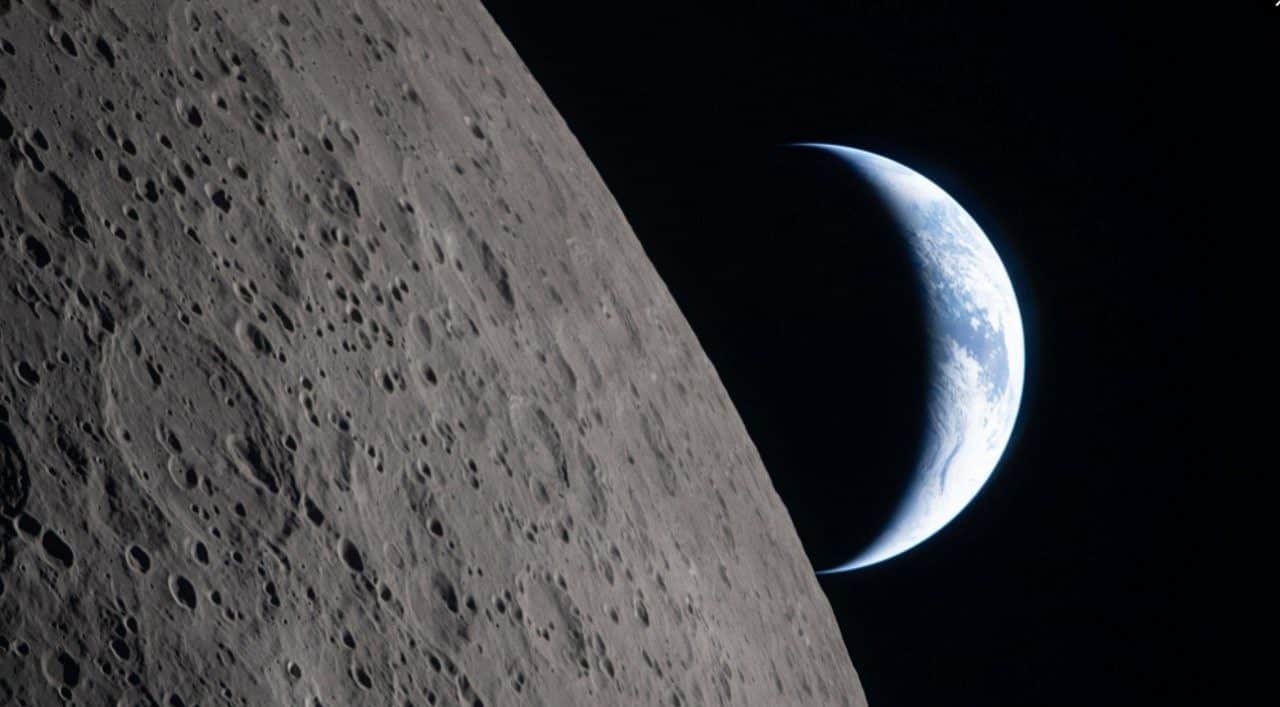
Recent research has revealed that rocks collected from the far side of the Moon are helping scientists rewrite part of the solar system’s early history. The findings challenge decades of theories about exactly when asteroid impacts shaped our celestial bodies, including Earth, and offer new insights into the conditions that influenced our planet’s evolution. These unprecedented samples, brought back from an unexplored lunar region, provide a cleaner record of the early universe.
New look at lunar history with new material
China’s Chang’e-6 mission carried out an unprecedented exploration, being the first to bring samples from the hidden side of the Moon. This region, as it is less exposed to geological events that alter its surface, such as erosion or volcanism, preserves a record of cosmic collisions that spans billions of years. Unlike Earth, where geological activity and plate tectonics have erased much ancient evidence, the lunar surface maintains a “natural archive” crucial to science.
Dr Fred Jourdan, co-author of the research and member of the School of Earth and Planetary Sciences and the John de Laeter Center at Curtin University, explained the importance of the satellite. He stated that the Moon functions as a time capsule, storing memories of events that were lost on Earth. The far-side samples are especially significant, allowing comparison between two distinct parts of the celestial body for the first time, as previous knowledge came almost entirely from the Earth-facing side. This exclusivity of far-side samples is what allows for a reevaluation of long-accepted astronomical concepts.
Asteroid Bombardment: A Redefined Timeline
The research team discovered new evidence about the frequency and intensity of asteroid bombardments of the lunar surface. Scientists determined that these impacts diminished gradually over time, rather than occurring in a single, intense explosion, as previously thought. This conclusion changes a decades-old understanding of the formation and dynamics of the early solar system.
Previous theory suggested that the solar system experienced a short, catastrophic period of impacts. However, analysis of lunar rocks suggests a more prolonged and less abrupt decline. By studying tiny rock fragments, researchers were able to reconstruct more than three billion years of the Moon’s impact history, with observed events dating back to approximately 4.33 billion to 1.13 billion years ago. The hidden side, with its purest record, was fundamental in revealing this new perspective.
The methodology behind lunar discoveries
To decipher the timeline of lunar impacts, the team of scientists employed the 40Ar/39Ar geochronology technique (argon-argon dating) on impact melt rocks collected by Chang’e-6. This methodology allows you to accurately determine the age of geological events. By analyzing the “tiny fragments” mentioned by Dr. Jourdan, researchers were able to identify when the rocks were heated and melted by asteroid collisions, offering a detailed chronology of cosmic interactions. Impact fusion, which occurs when the energy of a collision is so great that it melts rock, acts like a geological “clock”, resetting time and allowing accurate dating.
Valuable clues to the early environment and life on Earth
Understanding the chronology of impacts on the Moon offers vital information about Earth’s past. Dr Jourdan highlighted that the Moon and Earth, having formed together, share a common history, but evidence of the first impacts has been largely erased from our planet. Thus, each major impact recorded on the Moon reflects the conditions experienced by the young Earth, from its formation to the emergence of the first forms of life.
Studying these lunar rocks allows scientists to go back billions of years to understand the events that shaped the environments of both worlds. This includes investigating the role that asteroid collisions played in planetary evolution, such as the delivery of water and organic compounds, and the extreme conditions that may have influenced the emergence and persistence of life on early Earth. The discoveries therefore not only rewrite lunar history, but also enrich our understanding of the origins of life on our own planet.
Chang’e-6 mission milestone and scientific collaboration
The research, which marks a new era in lunar exploration, was led by the State Key Laboratory of Deep Earth Processes and Resources, Guangzhou Institute of Geochemistry, Chinese Academy of Sciences. China’s Chang’e-6 mission is a milestone for being the first to collect and return samples from the farthest side of the Moon, opening avenues for future investigations and missions. International collaboration, such as the participation of Curtin University and Dr Fred Jourdan, demonstrates the global reach and importance of these scientific discoveries for the astrophysics community.
- Main findings of the study:
- Collection location:Unprecedented samples from the far side of the Moon.
- Methodology:Geochronological analysis of 40Ar/39Ar in impact melt rocks.
- Period analyzed:Impact events dated between 4.33 and 1.13 billion years ago.
- New Bombing Theory:Asteroid impacts gradually diminished, contradicting the theory of a sudden catastrophic explosion.
- Implications for Earth:It helps decipher the primitive conditions of our planet, the delivery of essential elements and the role of asteroids in planetary evolution and the emergence of life.
- Research leadership:State Key Laboratory of Deep Earth Processes and Resources, Guangzhou Institute of Geochemistry, Chinese Academy of Sciences.





