

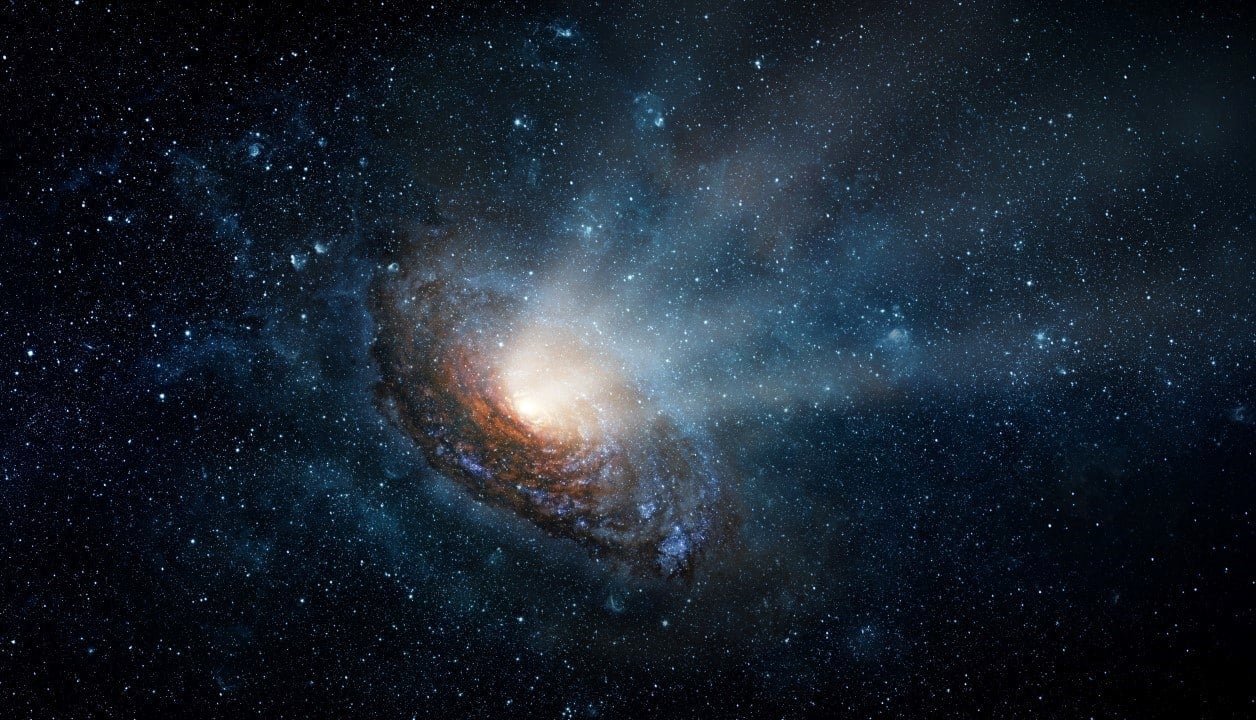
Revolutionary research has revealed the mechanism behind an intriguing cosmic phenomenon: the ability of supermassive black holes to be flung out of their home galaxies. The discovery, published in *New Scientist* magazine on July 24, 2026, offers an explanation for recent observations that challenged astrophysicists’ understanding. The study suggests that extreme collisions between black holes can generate a gravitational “recoil” powerful enough to launch these gigantic structures through space at supersonic speeds.
The mysterious line observed by the Hubble telescope
In 2023, a thin, linear formation was captured by the Hubble Space Telescope, in a vast region of space approximately 7.5 billion light years from Earth. This initial image aroused the curiosity of the scientific community. Pieter van Dokkum, from Yale University, and his team, deepened the analysis using not only data from Hubble, but also from the James Webb Space Telescope (JWST). They studied the light emitted by this peculiar line and came to an unprecedented conclusion: it was a cosmic event never before witnessed, a supermassive black hole on the run, leaving a trail of young stars in its wake.
On the same topic: NASA reveals detailed image of Centaurus A galaxy after cosmic merger

Black hole merger explains high-speed ejection
The enigma of how a black hole could be ejected from its galaxy appears to have finally been solved. The new theory proposes that the merger of two supermassive black holes could result in the formation of a single one, but with a powerful recoil. This gravitational “kick” is so intense that the newly formed black hole is propelled out of its galaxy, reaching extreme speeds, greater than that of sound in the vacuum of space. Although the occurrence of these events is rare, this is the most plausible explanation for the recent observation of a “runaway” black hole.
The impact of this discovery on astrophysics
The elucidation of this mechanism brings invaluable value to astrophysics, offering a crucial piece to the puzzle of galactic evolution and black hole dynamics. Understanding how and why these massive structures move through the universe in such extreme ways helps us refine our models about:
More on this story: ‘Wandering’ supermassive black hole discovered far from galactic center after devouring star
- Galaxy formation:Ejection from a central black hole can influence the distribution of matter and stellar growth in a galaxy.
- Cosmic Interactions:The study reveals the energetic consequences of black hole mergers, a fundamental event in the cosmic landscape.
- Life of black holes:Opens new perspectives on the trajectory and fate of black holes after merger events.
- New searches:It directs researchers to observe other signs of escaping black holes, expanding the field of investigation.
This knowledge expands our understanding of the most powerful gravitational forces in the universe and how they shape the structures we observe.
Future investigations into rare cosmic phenomena
The discovery of the mechanism that drives black holes out of their galaxies is a milestone that paves the way for future investigations. Scientists can now actively search for other examples of this rare phenomenon, using next-generation telescopes to confirm and detail these occurrences. Observing trails of young stars left by these fleeing objects, like the line detected by Hubble, could become a crucial signature for identifying more detached black holes. This advance promises to refine theoretical models and deepen understanding of the limits of gravity in the cosmos.