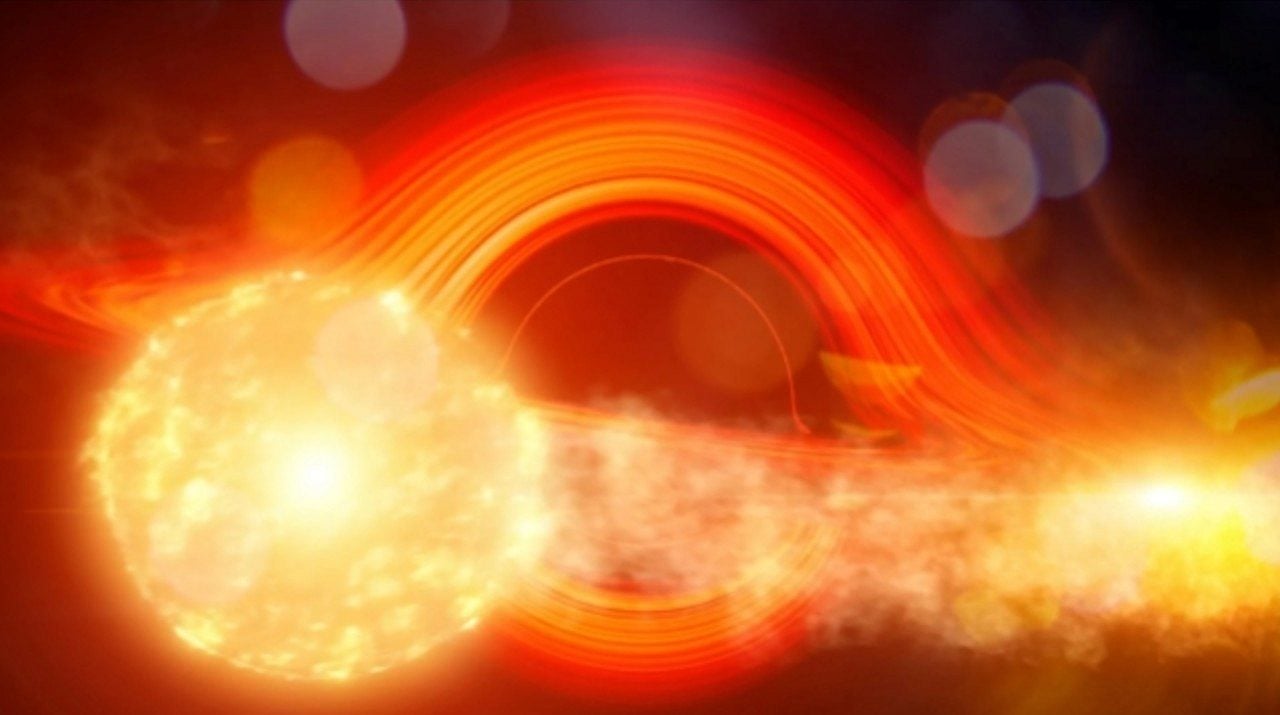
A supermassive black hole, which was “sleeping” and displaced, was discovered about 30 thousand light-years from the nucleus of its galaxy. This is the first inactive black hole found so far from the galactic center. It became visible after destroying a nearby star, generating an intense and rapid flash. Scientists speculate that the object may be a remnant of an absorbed galaxy or may have been flung away during a turbulent cosmic event.
The University of Maryland announced on August 6, 2026 the identification of this dormant supermassive black hole, located far from the center of its host galaxy. The revelation represents the first time that researchers have located an inactive black hole at such a considerable distance from a galactic nucleus.
Because it is not consuming matter, the black hole would remain invisible under normal conditions. Its presence was detected only when it shattered a passing star, releasing a bright and powerful flash. Details of this discovery were released in The Astrophysical Journal Letters on July 27, 2026.
“This is a groundbreaking result. What is new is that, until now, we have assumed that supermassive black holes reside at the centers of massive galaxies,” said Suvi Gezari, study co-author and associate professor of astronomy at the University of Maryland. She added: “This discovery will have a huge impact. It means we will find many more examples of wandering black holes, and we will be able to understand how galaxies and their black holes merge and form over time.”
How the existence of wandering black holes was already predicted by scientists
Scientists have long predicted the possibility of some black holes being displaced to the most distant regions of galaxies during galactic collisions and mergers. These objects are often called “wandering” black holes.
Locating them is a huge challenge. Most of them are quiescent, that is, they do not consume nearby material or emit light that can be detected. Consequently, they are able to move around the galactic outskirts without being observed by telescopes on Earth.
The researchers detected the quiescent black hole using the Zwicky Transient Facility (ZTF), an observatory that “scans the entire universe”, as explained by Robert David Stein, lead author of the study. Stein is a Neil Gehrels postdoctoral researcher at the Joint Space-Science Institute, a collaboration between the Astronomy and Physics departments at the University of Maryland and NASA’s Goddard Space Flight Center.
Artificial intelligence was crucial in locating the stellar flare
Operating with two telescopes at the Palomar Observatory in San Diego County, California, the ZTF scans the entire northern hemisphere sky every two days. The observatory records hundreds of thousands of variable celestial events per night, making it unfeasible for scientists to analyze each one individually for signs of a black hole.
To manage this immense volume of data, the team developed an artificial intelligence (AI) program trained to identify the characteristic light pattern emitted when a black hole disintegrates a star. This phenomenon, known as a tidal disruption event, happens when a star comes close enough to be torn apart by the gravitational pull of a black hole.
Researchers at the University of Maryland began operating the program in August 2025. Just three months later, artificial intelligence detected the event that led them to the discovery of the wandering black hole.
“I remember very clearly the moment we discovered it. It was a Saturday, and everyone was very excited exchanging messages. We dropped everything and started turning on all kinds of other instruments to get more data,” said Stein. He added: “We weren’t sure we would be successful so quickly, so it’s amazing that we found one so quickly.”
Details about supermassive black hole found far from galactic center
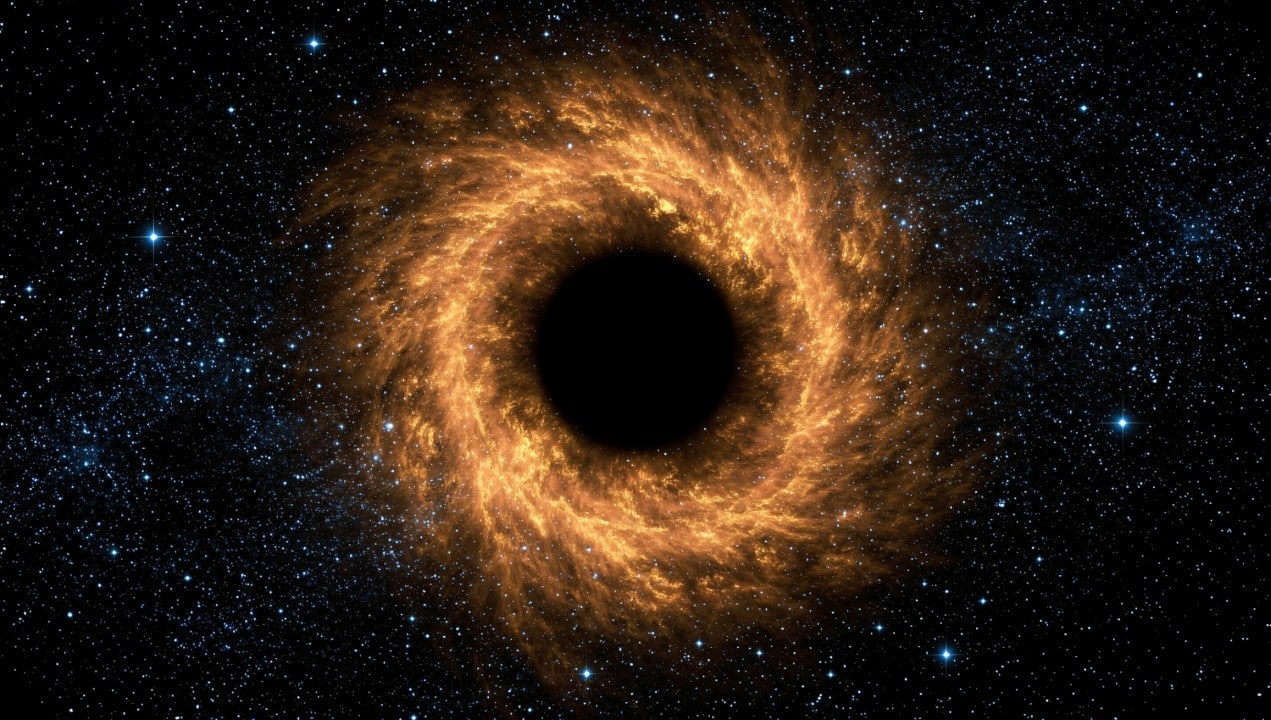
The black hole is located 9.3 kiloparsecs (approximately 30 thousand light years) from the center of its galaxy. Its mass is similar to that of the supermassive black hole located at the core of the Milky Way.
What makes the object particularly enigmatic is the apparent lack of a visible galaxy around it, according to Sylvain Veilleux, study co-author and astronomy professor at the University of Maryland. “To have a black hole that big outside of a galaxy is surprising to me,” he said. “There should be a Milky Way-like object around it and that’s definitely not the case.”
Researchers believe the black hole’s unusual location is likely linked to a previous collision between galaxies.
One hypothesis is that a larger galaxy would have absorbed a smaller companion. Over time, the larger galaxy may have removed almost all of the stars from the smaller galaxy, leaving only its dense central core and black hole.
Another possibility involves a more chaotic encounter between three black holes. A galaxy could already house two black holes orbiting close to each other at its center, forming a system known as a binary black hole. If a third black hole arrived during another galactic merger, the resulting interaction between the three bodies could have expelled the lowest-mass black hole from the center.
Additional observations of the tidal disruption event could help researchers determine which explanation is most likely.
Why Discovery Indicates Dormant Black Holes May Be Common
Understanding inactive black holes is critical, as most known black holes are dormant, including the one at the center of the Milky Way.
Scientists still don’t know whether there are rogue black holes in the outer regions of our own galaxy. However, Stein stated that there is no reason to worry about a possible meeting. “It’s very unlikely that we’ll come across one, at least in our lifetime.”
The research team continues to search for additional errant black holes in the sky. Finding more of these objects could help scientists “understand how galaxies form and how many black holes are buzzing around,” Stein said.
The discovery also proves that these hard-to-find objects can be identified through conventional celestial scans combined with machine learning, rather than relying solely on more expensive observation methods.
“It’s super exciting,” Gezari explained. “It’s an example of how machine learning is opening up an entirely new area of research.”
New observatories promise to find hundreds of additional wandering black holes
Stein predicts that future searches with NSF-DOE’s Vera C. Rubin Observatory could identify dozens or even hundreds of wandering black holes annually. The observatory, located in Chile, opened last June and obtains views of the sky in exceptional detail using the world’s largest digital camera.
Veilleux also mentioned the Lowell Discovery Telescope and its Rapid infrared IMAger-Spectrometer, which debuted in June 2025, the result of a collaboration between the Goddard Space Flight Center, the University of Maryland Department of Astronomy and the Lowell Observatory. This instrument could allow scientists to detect tidal disruption events at much greater distances from Earth than previously imagined.
“This is the strongest case of a wandering black hole that we know of,” Veilleux said. “This will set the standard.”