The North American Space Agency (NASA) is preparing for one of the most complex space operations in its history: the Artemis 3 mission, scheduled for the year 2027. The main objective is to take four astronauts into Earth orbit for a crucial integration test between three different space vehicles. This effort is a fundamental step towards future steps aimed at returning humans to the surface of the Moon.
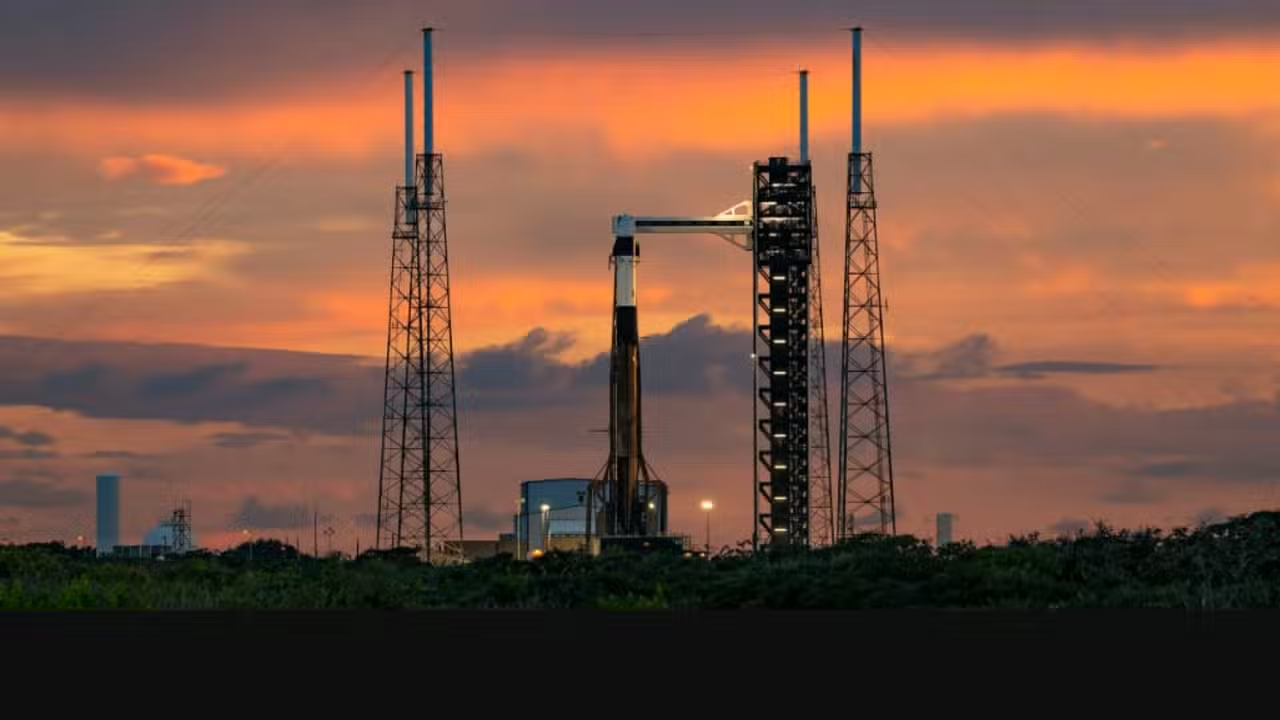
The operation will take place from the Kennedy Space Center and the Cape Canaveral Space Force Station, both located in Florida. The initiative will use the Space Launch System (SLS) rocket, the Orion capsule, and the commercial modules Starship, from SpaceX, and Blue Moon, from Blue Origin. The complexity of the project lies in the coordination of multiple launches and the interaction of technologies developed by different organizations, a different model from the Apollo missions.
A new era of integration and multiple vehicles in space
Artemis 3 represents a strategic shift in the way manned deep exploration missions are designed. Unlike the Apollo flights, which operated with a more direct architecture, the current program relies on a rigorous and coordinated sequence of operations between vehicles built by private partners and by NASA itself. This approach requires unprecedented synchronization to ensure the security and success of the endeavor.
Before the crew departs, the Blue Moon lunar module must be launched into low Earth orbit by Blue Origin’s New Glenn rocket. The spacecraft will remain in space for up to 30 days, allowing the company and NASA to evaluate its systems before the astronauts arrive. This early testing period is vital to identify and resolve potential glitches.
The detailed roadmap for Artemis 3 orbital operations
The Artemis 3 mission was carefully planned to test each step of the complex orbital integration. The timeline predicts a series of crucial events:
- Blue Moon Launch:Blue Origin’s module will be the first to be sent into Earth orbit aboard the New Glenn rocket, remaining active for up to a month for preliminary checks.
- Orion takeoff with crew:Later, the SLS rocket will take off from Launch Complex 39B at the Kennedy Space Center, carrying the Orion capsule with the four astronauts on board.
- Meeting and coupling with the Blue Moon:In orbit, the NASA spacecraft will rendezvous with and connect to the Blue Moon. The astronauts will spend approximately two days aboard the lunar module, checking environmental and avionics systems. A test spacesuit will also be evaluated, simulating equipment for future lunar activities.
- Approach with Starship:The final stage foresees an approach with SpaceX’s Starship, which will have a version adapted for lunar missions. This connection will be essential to test communication and maneuvers between the two structures in orbit.
Technological challenges and next steps for lunar landing
Despite Artemis 3’s ambition, the vehicles involved still need to overcome important development challenges. SpaceX, for example, continues to improve Starship to meet NASA’s stringent requirements for crewed missions to the Moon. This includes demonstrating fundamental technologies such as in-space fuel refueling, a capability crucial to the planned architecture of future missions. NASA estimates that Artemis 4, for example, will require multiple launches of supply spacecraft to prepare the lunar Starship.
Blue Origin also faces obstacles, especially after an incident that occurred during New Glenn rocket engine tests. Artemis Program Manager Jeremy Parsons said in a NASA update published in July that the mission will require unprecedented coordination between teams, launch structures and private partners. He described Artemis 3 as “a highly choreographed dance, with a demanding sequence of launches and equally complex operations for our ground and flight teams.”
Historical background and the future of lunar exploration
The experience that Artemis 3 seeks is rare in the history of space exploration. A NASA text highlights that only one previous manned mission carried out encounters with more than one spacecraft capable of supporting its own crews: the Soviet Soyuz T-15, in 1986, which involved operations with the Salyut 7 and Mir stations. This comparison underscores the complexity and innovation of NASA’s current plan.
Steve Creech, manager of NASA’s Human Landing System program, explained that tests with commercial vehicles are essential to increase confidence before landing with astronauts. The companies SpaceX and Blue Origin presented ambitious goals, including unmanned demonstrations to increase understanding and confidence in their spacecraft and rockets. If Artemis 3 achieves its goals, the learnings will be crucial for Artemis 4, a mission planned to return astronauts to the lunar surface, more than five decades after the end of the Apollo program, marking a new chapter in space exploration.