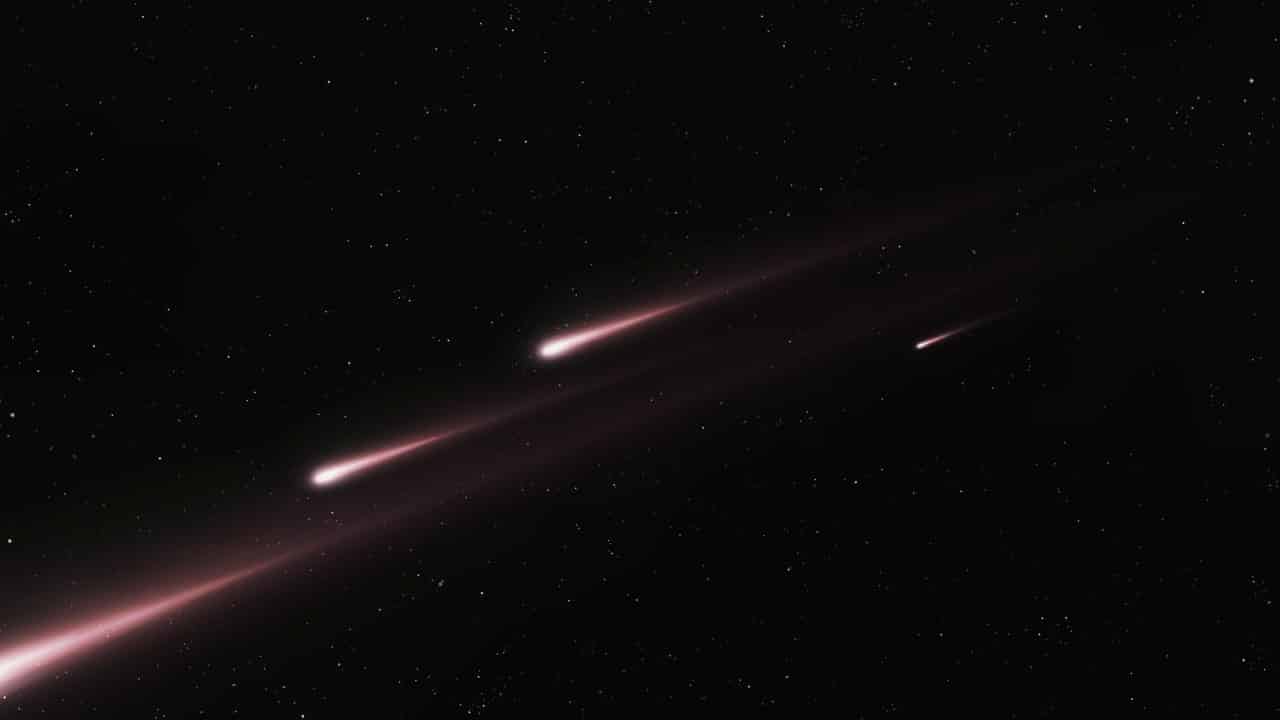
Astronomy enthusiasts will have an excellent opportunity to observe the Southern Delta Aquarids meteor shower, popularly known as “shooting stars”, between the dawn of July 30 and 31, 2026. This phenomenon reaches its highest point of activity during this period, promising a luminous spectacle in the sky.
When and how to observe the meteor shower
For those who want to follow the Delta Aquáridas do Sul, the dawn of July 30th to 31st, 2026 offers the best viewing window. Experts from the National Observatory and the Brazilian Space Agency indicate that the phenomenon can present up to 25 meteors per hour in ideal conditions. A promising sign of the intensification of the event was the recording of 196 meteors by the Exoss monitoring station, in Carnaubal, Ceará, in the early hours of July 30, indicating that activity is increasing before the main peak.
Even with the presence of a full Moon, which tends to lighten the sky and make it difficult to perceive meteors with lower brightness, the brightest fragments will be visible to the naked eye. There is no need for equipment such as telescopes or binoculars to enjoy the event.
Ideal time for the celestial phenomenon
The National Observatory suggests that the most favorable period for observing the meteor shower begins around 1:30 am and lasts until dawn. During these hours, the Southern Delta Aquarid meteors penetrate the Earth’s atmosphere at an impressive speed of around 41 kilometers per second, equivalent to approximately 147 thousand km/h, generating the characteristic light trails.
Although the constellation Aquarius appears to be the origin of these meteors, they can be seen anywhere in the sky. The South Aquarid Delta is an annual event that occurs when the Earth crosses the orbit of fragments left by comet 96P/Machholz.
Tips for a better viewing experience
To increase your chances of seeing the meteor shower, experts recommend some practices:
- Look for a location away from urban lights to avoid light pollution.
- Start observation at 1:30 am.
- Allow your eyes to adjust to the darkness for approximately 20 minutes.
- Avoid looking at the cell phone screen during observation, as the light impairs visual adaptation.
- Observe a wide area of the sky, preferably between the northwest and east directions.
- Do not use telescopes or binoculars, as meteors can appear anywhere in the sky, and these equipment limit the field of view.
Another meteor shower active in the same period
In parallel to the South Aquarid Delta, another meteor shower, the Alpha Capricornids, is also active. This is known for producing a smaller number of meteors, but with a more intense brightness. Some of these are classified as bolides, which exhibit a luminosity greater than that of the planet Venus, making them particularly spectacular.
Best places in Brazil to observe meteors
According to Climatempo, the best observation conditions in Brazil are predicted for areas in the Center-West, the interior of the Northeast, the state of Tocantins, the east of Pará, as well as Minas Gerais and Goiás. In these places, the weather forecast points to a sky with few clouds, favoring the visibility of meteors.
What are “shooting stars”
Despite the popular name, the so-called “shooting stars” are not stars. They are small fragments of rock, dust or ice, usually the size of a grain of sand, that break off from comets and, occasionally, asteroids. When this debris enters the Earth’s atmosphere at very high speeds – which can vary from 40,000 km/h to 260,000 km/h – friction with the air heats it quickly. This heating generates the light trails we observe from the surface, generally visible for less than a second before they completely disintegrate. The brightest meteors, such as bolides, can be seen for a few seconds.
[TAGS]Meteor shower,South Aquarid Delta,Astronomical observation,Celestial phenomenon,Shooting stars,National Observatory[/TAGS]